When it comes to precision cutting in manufacturing, the right CNC spindle motor can make or break your project. Choosing a motor that can handle high-precision cuts, maintain consistent performance, and last over time is essential.
But with so many options on the market in 2026, how do you know which one is truly the best?
As a decision-maker in the manufacturing process, you understand that downtime and inefficiency are costly. Selecting the best CNC spindle motor for precision cutting isn't just about buying a machine; it's about investing in the right tool for the job.
In this blog, let's look at the top CNC spindle motors available this year and break down the key features that make them ideal for high-precision work.
Key Takeaways
CNC spindle motors are critical for precision cutting, with specifications like power, RPM, and cooling system affecting performance.
High-speed motors are ideal for soft materials, while high-torque motors are better for tougher materials like steel.
Key factors to consider include motor power, speed range, cooling options, and compatibility with your machining needs.
Challenges such as overheating, vibration, and maintenance can be managed by selecting the right motor and maintaining it properly.
Pico Systems offers reliable components like the Spindle DAC to improve spindle motor control and ensure optimal performance in precision cutting.
What is a CNC Spindle Motor?
A CNC spindle motor is a crucial component in a CNC machine that powers the rotating spindle, enabling it to perform cutting, milling, and drilling operations. It controls the speed and precision of the cutting tool, ensuring accurate material removal.
These motors come in various types, each catering to different performance needs. It includes:
air-cooled
water-cooled
liquid-cooled systems
In precision cutting, the spindle motor's power and torque directly impact the quality of the cut and the machine's efficiency. A motor with the right specifications helps maintain consistency, reduce vibrations, and prevent overheating during prolonged use.
Now, let's explore the key factors to consider when choosing a CNC spindle motor for precision.
Key Factors to Consider When Choosing a CNC Spindle Motor for Precision Cutting
When selecting a CNC spindle motor for precision cutting, it's essential to consider factors that directly influence performance, accuracy, and operational efficiency. A carefully chosen motor ensures smooth, high-quality cuts while minimizing maintenance costs and downtime.
Below are the key factors that make a significant impact on your spindle motor choice.
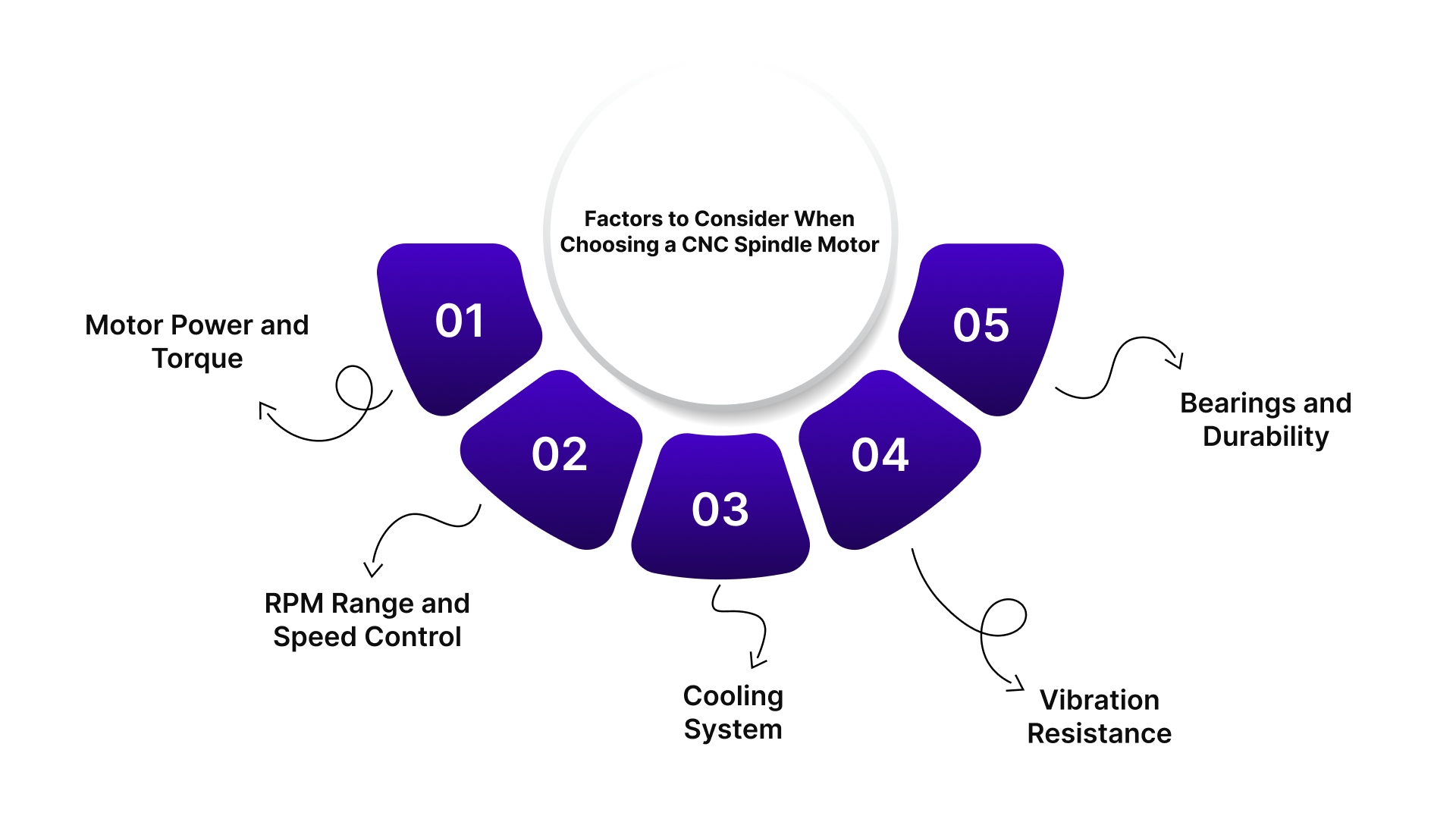
Motor Power and Torque: Look for motors with at least 3-5 kW power for heavy-duty applications, ensuring enough torque for materials like metal without stalling or overheating.
RPM Range and Speed Control: Spindle motors with adjustable RPM ranges from 10,000 to 30,000 RPM allow flexibility for different material types and cutting depths.
Cooling System: Opt for water-cooled or liquid-cooled motors for sustained high performance during long cuts, preventing overheating in high-speed operations.
Vibration Resistance: Motors with low vibration characteristics (e.g., less than 0.05 mm/s) ensure higher precision and better surface finishes on delicate materials.
Bearings and Durability: High-quality bearings (e.g., ceramic or hybrid bearings) extend motor lifespan and reduce friction, especially in motors with higher RPMs.
Understanding these factors helps you make an informed decision on the right motor. Let's now look into some of the top CNC spindle motors available for precision cutting in 2026.
Top 5 CNC Spindle Motors for Precision Cutting in 2026
Below are some of the top CNC spindle motors in 2026 that deliver reliable, high‑precision performance for demanding manufacturing environments.
These selections focus on key specifications like power, RPM range, cooling efficiency, and durability for precision cutting tasks.
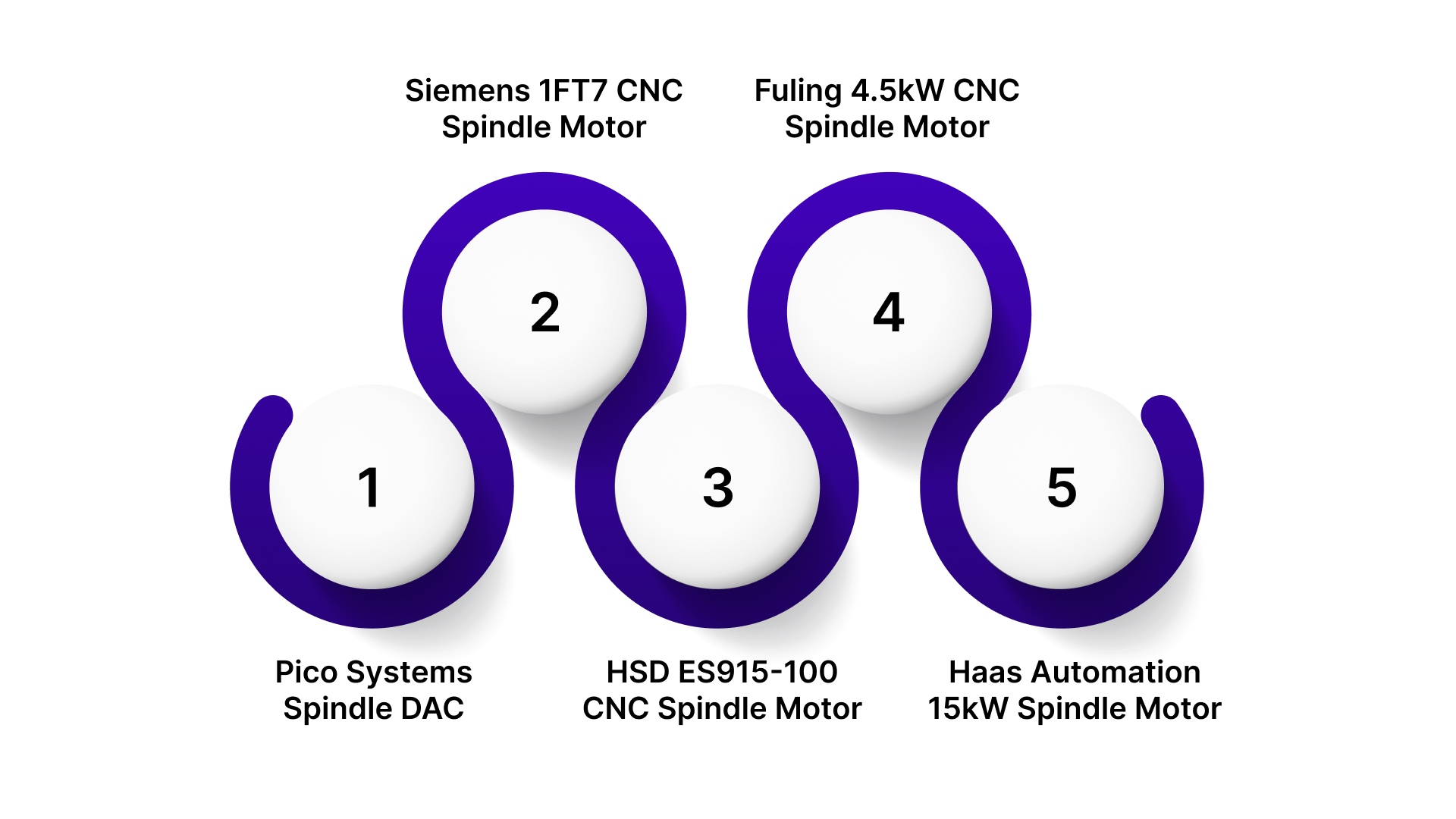
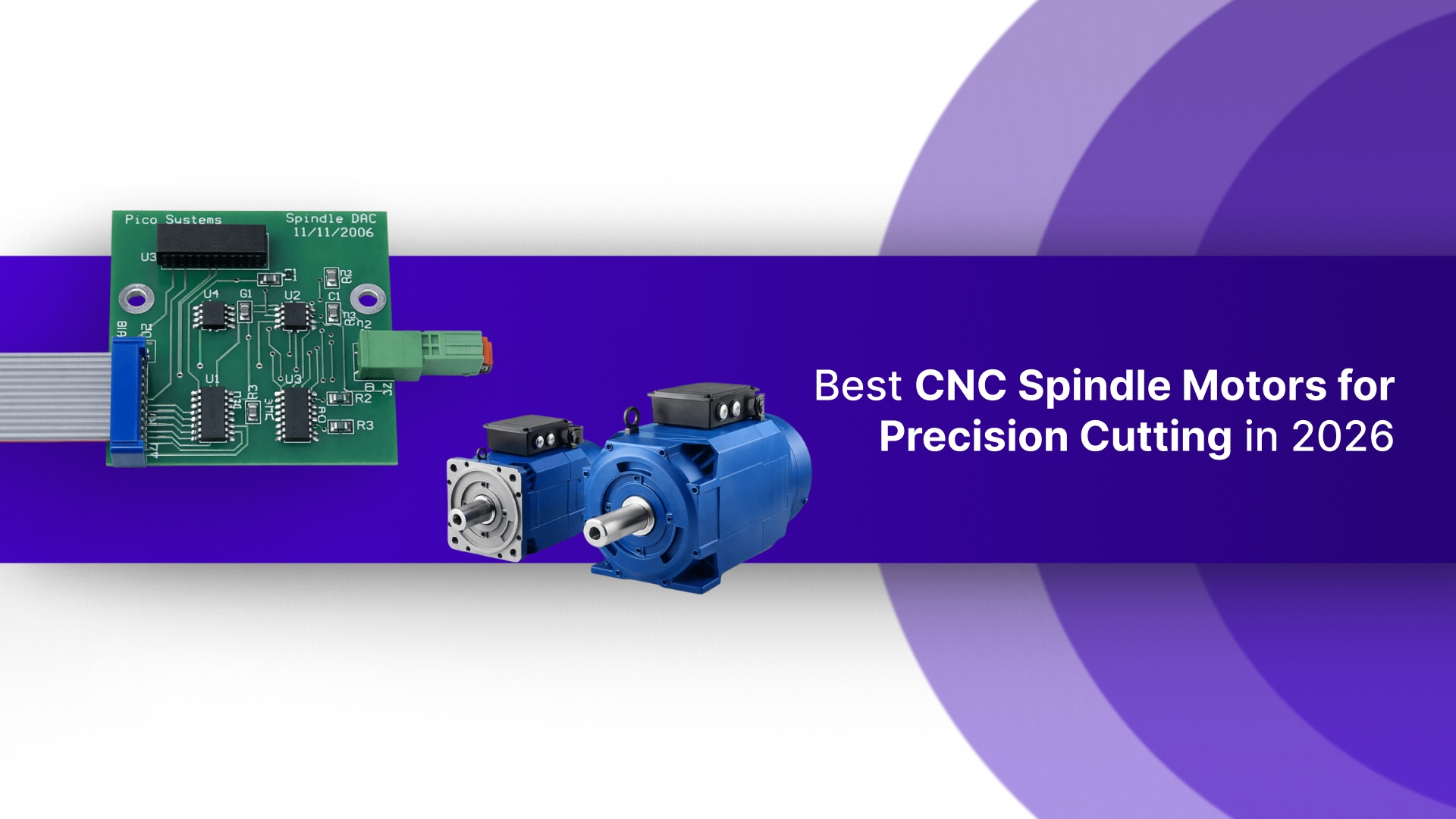
Pico Systems Spindle DAC - Analog Speed Control for CNC Systems
Price: $50.00
Power: N/A (Acts as a digital-to-analog converter)
RPM Range: N/A (Controlled via CNC software scaling)
Cooling: N/A
Best for: Controlling spindle motor speeds for systems requiring analog input. Ideal for users with the Universal Stepper Controller or Universal PWM Controller setups.
Key Features:
8-bit Digital to Analog converter with output options of 0 to +10 V or -10 to +10 V.
Compatible with the PPMC driver in LinuxCNC.
Flexible configuration for controlling spindle motor direction and speed via software.
Can also be used for controlling devices requiring less than 10 V.
Dimensions: 2 × 2 × 2 in
Weight: 0.5 lbs
Siemens 1FT7 CNC Spindle Motor
Power: 0.85 kW – 45.5 kW (depending on model)
RPM Range: 1,500 – 6,000 RPM
Cooling: Natural cooling, forced ventilation, or water-cooled options
Best for: CNC machine tools and precision automation applications.
Key Features:
Permanent-magnet synchronous motor for high precision and efficiency.
Equipped with absolute encoders (22-bit multi-turn) for full digital control via DRIVE-CLiQ interface.
Standard IP64, with optional IP65 or IP67 for enhanced environmental protection.
Ensures high surface quality on workpieces, making it ideal for precision machining.
HSD ES915-100 CNC Spindle Motor
Power: 3.8 kW – 5.0 kW (depending on model)
RPM Range: Up to 28,000 RPM
Cooling: Electric fan-cooled
Best for: CNC routers, particularly for wood, plastic, and aluminum machining.
Key Features:
Available in versions with up to 5.0 kW for various CNC router applications.
Uses ISO 30 tool holders for easy compatibility with industry-standard tooling.
Ceramic (front and rear) for long-life lubrication and durability.
Dual voltage option (220 V / 380 V), offering flexibility for different electrical setups.
Weight: Approximately 29 kg (64 lbs)
Fuling 4.5kW CNC Spindle Motor
Power: 10 kW (13.4 HP)
RPM Range: Up to 24,000 RPM
Cooling: Air-cooled or water-cooled options
Best for: CNC milling, engraving, and drilling applications on wood, plastic, and aluminum.
Key Features:
High power output (10 kW), ideal for heavy-duty milling and precision tasks.
Delivers stable torque (around 3.5-3.6 Nm) for high-speed precision machining.
Uses ER32 or BT30 collets for versatility in tooling and attachment.
Weight: Approximately 16-23 kg
Haas Automation 15kW Spindle Motor
Power: 15 kW (20 HP)
RPM Range: 10,000 – 15,000 RPM
Cooling: Air-cooled or liquid-cooled (depending on model)
Best for: 3D surfacing, smaller tool applications, and efficient material removal.
Key Features:
Available in both belt-drive (affordable) and inline direct-drive configurations (better thermal stability and finishes).
Fast acceleration, with some models reaching full speed in 2.3 seconds for quick starts and stops.
Commonly 40-taper, with some models available in HSK-A63 or ER11 for specialized applications.
Now that you know some of the top CNC spindle motors available, it's important to understand how to match the right motor to your specific cutting needs.
Let's look into the key considerations for selecting a spindle motor that aligns with your machining requirements.
How to Match Your CNC Spindle Motor with Your Cutting Needs
When selecting the right CNC spindle motor for your cutting needs, it's crucial to consider factors like material type, required precision, and cutting speed. Different materials and machining tasks demand specific spindle motor capabilities, from high-speed rotation for soft materials to high torque for harder materials.
Below are the key considerations to help you choose the ideal motor for your application:
Cutting Need | Recommended Spindle Motor Type | Key Specifications |
Woodworking & Plastics | Air-cooled, lower power motors | Power: 3 kW - 5 kW, RPM: 18,000 - 24,000, Cooling: Air-cooled, Ideal for fast, smooth cuts with minimal wear. |
Aluminum & Light Metals | Water-cooled, mid-range power motors | Power: 5 kW - 10 kW, RPM: 10,000 - 20,000, Cooling: Water-cooled, Offers higher torque for heavier-duty cutting. |
Steel & Hard Metals | Water-cooled, high torque motors | Power: 10 kW+, RPM: 5,000 - 10,000, Cooling: Water-cooled, High torque for deep cuts and precision. |
Composite Materials | High-speed, low-torque motors | Power: 4 kW - 6 kW, RPM: 20,000 - 30,000, Cooling: Air-cooled, Provides high-speed performance for fine finishes. |
General Purpose Cutting | Versatile, medium power motors | Power: 5 kW, RPM: 10,000 - 18,000, Cooling: Both air and water-cooled options, Versatile for various materials. |
With these considerations in mind, selecting the right motor will improve your machining process, ensuring efficiency and quality in every cut.
Now, let's explore some of the common challenges faced with CNC spindle motors and how to address them.
Common Challenges in CNC Spindle Motors for Precision Cutting and How to Overcome Them
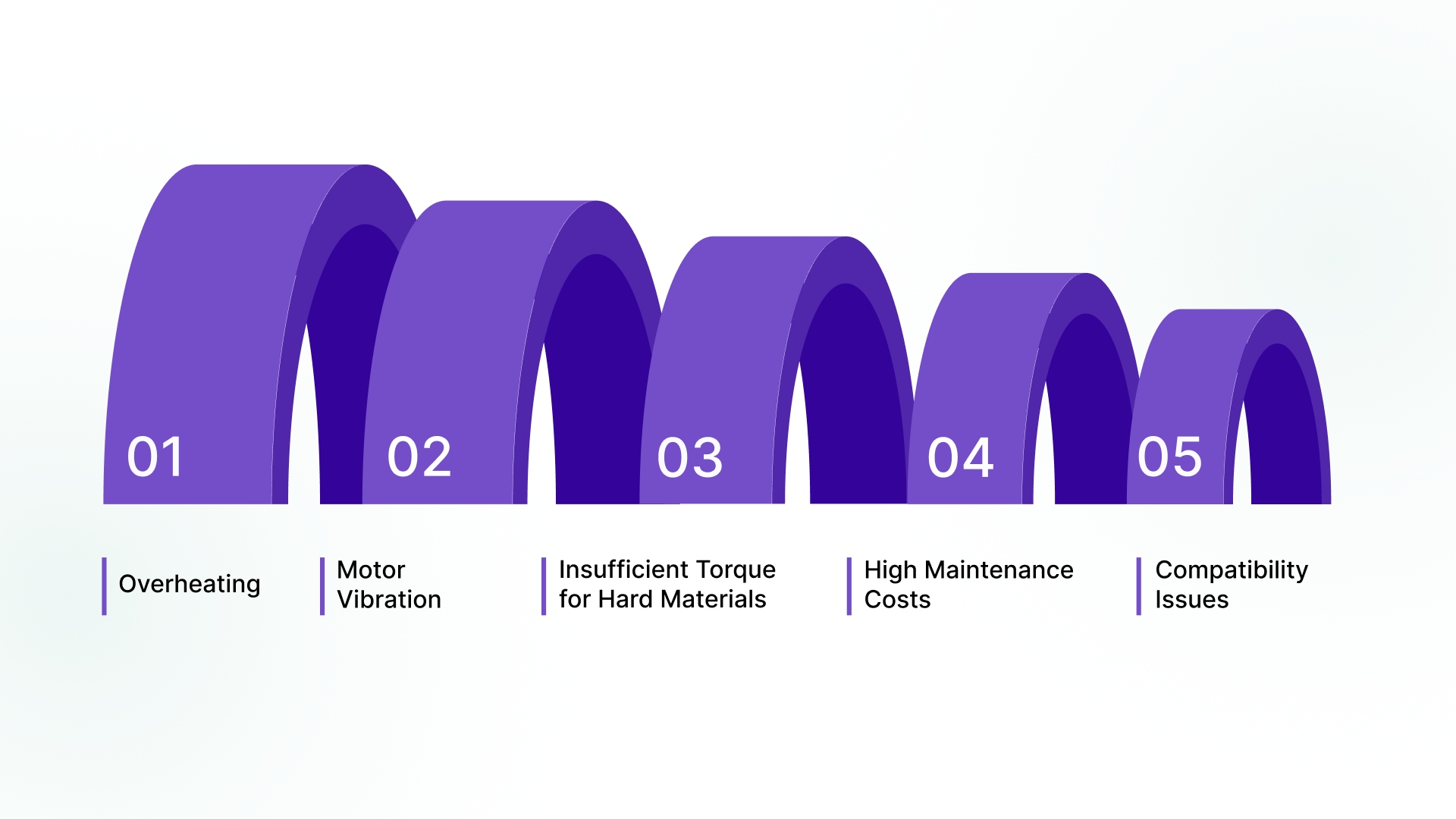
CNC spindle motors, while critical for high-precision cutting, often present challenges that can affect performance and productivity. Overcoming these challenges ensures optimal operation and longevity of the motor, improving machining results.
Below are some of the common issues faced with CNC spindle motors and how to address them:
Overheating: It can lead to motor failure or reduced performance, especially during extended cutting cycles.
How to overcome: Ensure the motor is equipped with an efficient cooling system, such as water cooling, and monitor the temperature regularly to prevent overheating.
Motor Vibration: Excessive vibration can lead to inaccuracies, poor surface finishes, and tool wear.
How to overcome: Choose a spindle motor with low vibration characteristics and ensure proper machine calibration to minimize vibrations.
Insufficient Torque for Hard Materials: Inadequate torque can result in underperformance, particularly when cutting dense or tough materials.
How to overcome: Opt for a high-torque spindle motor and consider motors with adjustable torque settings to meet specific material needs.
High Maintenance Costs: Frequent breakdowns or wear-and-tear lead to high maintenance costs, especially in high-duty applications.
How to overcome: Perform regular maintenance checks, use high-quality bearings, and lubricate the motor according to manufacturer recommendations.
Compatibility Issues: Motors may not always be compatible with all CNC machines or software systems.
How to overcome: Ensure the motor is compatible with your CNC machine's interface, and always check the specifications for software compatibility.
Addressing these challenges proactively will keep your CNC spindle motor running smoothly and improve your machining precision.
Is Your CNC Spindle Motor Ready for Precision Cutting?
Selecting the proper motor ensures optimal performance and accuracy, whether for wood, metal, or composite materials.
Looking to integrate a high-performance spindle motor with your CNC system? Pico Systems offers innovative solutions like the Spindle DAC to improve your setup and provide precision control.
Contact Us today to find the perfect CNC spindle motor for your operations and take your machining to the next level.
FAQs
What factors should I consider when choosing a CNC spindle motor?
When selecting a CNC spindle motor, consider factors like power, RPM range, cooling system, and material compatibility. These elements directly influence the motor's performance and suitability for your specific cutting tasks.
Can a CNC spindle motor be used for both high-speed and high-torque applications?
Yes, some CNC spindle motors are designed with adjustable speed and torque settings, making them versatile for both high-speed and high-torque applications.
How long do CNC spindle motors typically last?
The lifespan of a CNC spindle motor depends on usage, maintenance, and load conditions, but generally, they can last anywhere from 5 to 7 years with regular maintenance and proper operation.
Are water-cooled CNC spindle motors more efficient than air-cooled models?
Yes, water-cooled CNC spindle motors are more efficient for extended operations as they maintain a stable temperature during heavy-duty cycles, preventing overheating and reducing wear.
Can a CNC spindle motor be upgraded to improve performance?
Yes, upgrading your CNC spindle motor is possible, especially if you're looking to enhance speed, power, or precision. Ensure the new motor is compatible with your existing machine and control systems for seamless integration.