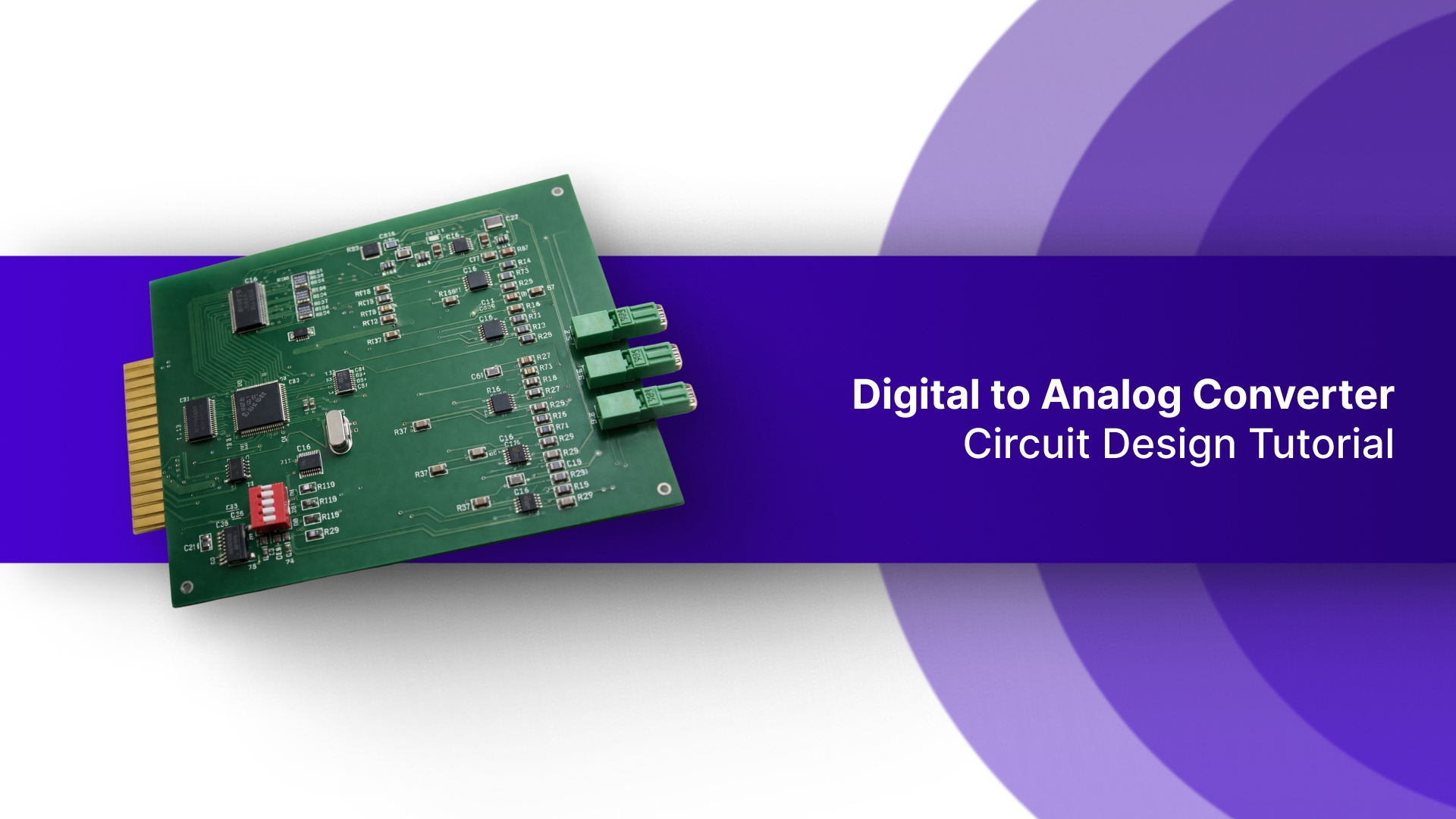
But not all DAC boards deliver the same performance. Resolution, channel count, interface compatibility, and isolation features determine whether your system achieves sub-micron positioning accuracy or introduces quantization noise that degrades servo loop performance. A 12-bit DAC provides 4,096 discrete voltage steps; a 16-bit DAC delivers 65,536—and that difference directly impacts motion smoothness in multi-axis CNC applications.
This guide covers ten leading manufacturers of DAC boards specifically relevant to industrial and motion control applications. Whether you're a chip-level designer prototyping a custom PCB, a machine builder integrating off-the-shelf I/O cards, or a CNC retrofitter working with LinuxCNC, you'll find the technical details and selection criteria you need to make an informed choice.
Key Takeaways
- DAC boards convert digital commands into ±10V or 4-20mA analog signals that drive servo amplifiers and actuators in CNC and industrial systems
- Key specs include bit resolution (12-16 bit typical), channel count, update rate, interface type (PCIe, USB, Ethernet), and galvanic isolation
- Top manufacturers span chipmakers (Texas Instruments, Analog Devices), DAQ specialists (National Instruments, Measurement Computing, Advantech), and motion-focused suppliers (Mesa Electronics, Pico Systems)
- LinuxCNC users benefit from niche vendors like Mesa Electronics and Pico Systems, which offer boards purpose-built for real-time motion control
- Match your DAC board to controller software, drive interface standards, and update rate requirements rather than brand reputation alone
What Are DAC Boards and Why Do They Matter in Industrial Applications?
A DAC board is a printed circuit board carrying one or more digital-to-analog converter chips plus supporting circuitry—reference voltage sources, output buffers, host interface logic, and connectors. Unlike standalone DAC chips that require custom PCB design or consumer audio converters optimized for sound reproduction, industrial DAC boards prioritize precision, throughput, and system integration.
That distinction matters most in motion control and CNC applications, where DAC boards translate position or velocity commands from software controllers (LinuxCNC, PLCs, or DSPs) into analog signals that servo amplifiers execute. A typical servo drive expects a ±10V analog input for velocity control; the DAC board must deliver that voltage with sufficient resolution and update speed to hold stable closed-loop positioning.
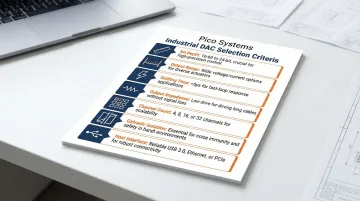
Critical specifications to evaluate before shortlisting vendors:
- Bit depth – Determines voltage step size; 16-bit resolution provides ~0.3mV steps across a ±10V range
- Full-scale output range – ±10V for servo drives, 4-20mA for process control instrumentation
- Settling time – Time for the output to reach its final value after a command update; 10µs is typical for high-performance boards
- Output impedance – Affects drive compatibility and noise immunity
- Channel count – 4-8 simultaneous channels is standard for multi-axis CNC and motion systems
- Galvanic isolation – Prevents ground loops and protects control logic from high-voltage transients (up to 3,000VDC in harsh environments)
- Host interface – PCIe for lowest latency, USB for portability, EtherCAT for distributed I/O
Top 10 Digital to Analog Converter Board Manufacturers
The following manufacturers were selected based on product reliability, industrial adoption, technical specification range, interface flexibility, and relevance to motion control or automation applications.
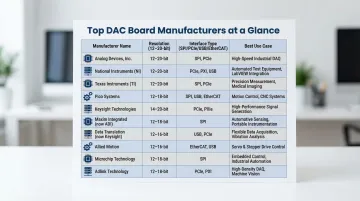
| Manufacturer | Resolution | Interface | Best For |
|---|---|---|---|
| Texas Instruments | 8–20-bit | SPI, I²C, Parallel | Custom industrial PCB design |
| Analog Devices | Up to 20-bit | SPI, Parallel, USB | High-accuracy closed-loop control |
| National Instruments | Up to 16-bit | PCIe, PXI, USB, Ethernet | Test systems, multi-axis servo |
| Measurement Computing | 12–16-bit | USB, PCIe, Ethernet | Cost-sensitive OEM builders |
| Advantech | 12-bit | PCI, PCIe, RS-485, Ethernet | Factory automation, distributed I/O |
| Acromag | 12–16-bit | PCIe, XMC/PMC, Ethernet | Defense, aerospace, critical control |
| Mesa Electronics | ±10V analog | PCIe, PCI, Ethernet | LinuxCNC CNC retrofits |
| Pico Systems | 16-bit | Parallel, PCIe | Analog servo interfaces, LinuxCNC |
| Sensoray | 16-bit | PCIe, USB | Medical, robotics, Linux environments |
| Data Translation | 12–16-bit | USB, PCIe | OEM integrators, legacy systems |
Texas Instruments
One of the world's largest semiconductor companies, Texas Instruments offers an extensive portfolio of DAC ICs and accompanying evaluation boards — from low-cost 8-bit devices to precision 20-bit modules — widely adopted in industrial sensing and control designs.
The DAC80508 (16-bit), DAC70508 (14-bit), and DAC60508 (12-bit) series target industrial automation with 4 or 8 channels and high linearity. For process control, the DACx760 family provides fully programmable 4-20mA current and voltage outputs. The TI LaunchPad and EVM ecosystem helps engineers prototype quickly before committing to custom PCB designs.
Key Offering: Precision DAC ICs with companion evaluation modules spanning 8-20-bit resolution
Interface Options: SPI, I²C, parallel; EVM boards provide USB-to-host connectivity via onboard FTDI controllers
Best Suited For: Engineers designing custom industrial or motion control PCBs who need chip-down solutions with comprehensive prototyping support
Analog Devices (ADI)
Analog Devices is a global leader in high-performance signal processing, with a broad DAC portfolio — including the AD5xxx and LTC series — that covers single-channel precision parts through high-speed multi-channel devices used in automated test equipment and industrial drives.
The AD5760 (16-bit) and AD5791 (20-bit) are benchmark precision products; the AD5791 delivers 1ppm resolution and ±1 LSB Integral Nonlinearity (INL). For functional safety applications, ADI offers AEC-Q100 qualified DACs for automotive use and IEC 61508-compliant parts like the ADFS5758.
The iCoupler digital isolation technology enables high-voltage protection with minimal latency, which matters for maintaining servo loop timing in closed-loop systems.
Key Offering: High-precision DAC ICs (AD5760, AD5791, LTC2758) plus EVAL boards
Interface Options: SPI, parallel, USB via EVAL board; iCoupler digital isolation available
Best Suited For: High-accuracy closed-loop control, instrumentation, and automated test equipment applications
National Instruments (NI)
NI (now part of Emerson following its October 2023 acquisition) produces PXI, PCIe, and USB-based multifunction DAQ boards with analog output channels that serve as industrial-grade DAC boards in test, measurement, and motion control environments trusted by aerospace, automotive, and semiconductor manufacturers.
The 63xx series (formerly X Series) and modular CompactDAQ (cDAQ) platform support analog output modules with up to 16-bit resolution. The tightly integrated LabVIEW/NI-DAQmx software ecosystem provides deterministic timing and lets engineers combine DAC channels with digital I/O and encoder inputs on a single card, simplifying multi-axis motion control architectures.
Key Offering: Multifunction DAQ/AO boards (63xx and cDAQ series); up to 16-bit analog output
Interface Options: PCIe, PXI, USB, Ethernet (CompactDAQ); LabVIEW and C/Python API support
Best Suited For: Test and measurement systems, multi-axis servo control, research automation
Measurement Computing (MCC)
Measurement Computing (now a Digilent/NI subsidiary) offers an accessible range of USB, PCIe, and Ethernet DAQ boards with analog output channels, positioning itself as a cost-effective alternative to NI for small-to-mid-scale industrial and educational automation projects.
Competitive pricing and a free Universal Library SDK compatible with Windows and Linux are the practical draws here. The SDK supports C, C++, Python, and MATLAB, lowering integration burden for OEM machine builders. Products like the USB-1208HS-4AO and PCIe-DAS1602/16 provide 12-16-bit DAC channels with plug-and-play setup.
Key Offering: USB-200x, PCIe-based AO boards with 12-16-bit DAC channels
Interface Options: USB, PCIe, Ethernet; SDK supports C, C++, Python, MATLAB
Best Suited For: Cost-sensitive OEM and industrial machine builders needing reliable analog output
Advantech
Advantech is a global industrial computing and I/O company offering PC-based DAQ cards, embedded I/O modules, and distributed I/O boards with DAC outputs designed for factory automation, process control, and machine vision across a wide range of form factors (PCI, PCIe, USB, Ethernet, EtherCAT).
The PCL-726 is a classic PCI card offering 6 channels of 12-bit analog output with selectable ranges (±10V, 4-20mA). For distributed I/O, the ADAM-4024 module provides 4 channels of 12-bit analog output via RS-485 (Modbus/RTU) with 3,000VDC isolation. Advantech also emphasizes product longevity with 10-year support lifecycles and advanced EOL notices , which matters for industrial machinery that stays in service for decades.
Key Offering: PCI/PCIe DAQ cards and ADAM I/O modules with analog output (PCL-726, ADAM-4024 series)
Interface Options: PCI, PCIe, USB, RS-485, Ethernet; compatible with Windows and Linux drivers
Best Suited For: Factory automation, process control, and distributed I/O in harsh industrial environments
Acromag
Acromag specializes in industrial I/O, signal conditioning, and embedded computing boards, including isolated DAC output modules for process control and military/aerospace applications where ruggedization and channel isolation are non-negotiable.
The AP236 is a notable PCIe module featuring 16-bit DACs with 8 isolated channels. Acromag boards are characterized by channel-to-channel isolation and extended operating temperature ranges (-40 to 85°C). Products meet VITA standards (VITA 42/61 for XMC) and are suitable for MIL-SPEC environments, with specific compliance for shock (VITA 47 Class OS1) and vibration (Class V1).
Key Offering: Isolated analog output boards and mezzanine modules (AIO/APCIe, AP236 series); 12-16-bit
Interface Options: PCIe, PCI, XMC/PMC, Ethernet; rugged chassis-mount and board-level options
Best Suited For: Defense, aerospace, and critical process control requiring isolated, certified DAC outputs
Mesa Electronics
Mesa Electronics produces FPGA-based motion control boards (the 5i and 7i series) that integrate multi-axis step/direction and PWM outputs alongside ±10V analog (DAC) output channels, making them a popular choice in the LinuxCNC community for CNC retrofits.
The 7i77 daughtercard is a standard for servo control, providing six ±10V analog output channels for interfacing with industrial servo amplifiers.
Mesa boards use Xilinx FPGAs (such as the Spartan-6) running HOSTMOT2 firmware — an open-source configuration that offloads step generation, encoder counting, and PWM from the host PC. The result is high-performance real-time control within LinuxCNC with direct driver support.
Key Offering: FPGA-based motion cards with integrated ±10V DAC channels (e.g., 7i77, 5i25 series)
Interface Options: PCIe, PCI, Ethernet; LinuxCNC HOSTMOT2 firmware; field I/O via daughter cards
Best Suited For: CNC machine builders and retrofitters using LinuxCNC with servo amplifier drives
Pico Systems
Pico Systems, based in Kirkwood, Missouri, designs specialized motion control interface boards — including DAC-based servo interface cards — that bridge digital controllers and analog servo amplifiers in CNC and industrial automation systems, with specific compatibility for LinuxCNC.
The flagship DAC16 is a 4-axis, 16-bit converter with a -10V to +10V output range. Its integrated watchdog and E-stop logic enable position tracking during emergency stops, allowing LinuxCNC to function as a DRO (Digital Read Out) even when drives are powered down — so the coordinate system stays intact for a clean return to CNC mode.
Pico Systems boards interface directly with analog-input servo drives from manufacturers like Copley Controls, AMC, and Gecko.
Key Offering: DAC-based servo interface boards for analog servo amplifier command (±10V output); DAC16 (4-axis, 16-bit)
Interface Options: Compatible with LinuxCNC via PPMC driver; parallel port and PCIe connectivity options
Best Suited For: CNC retrofitters and motion control developers needing purpose-built analog servo interfaces with E-stop position tracking
Sensoray
Sensoray develops PC-based data acquisition and control boards — including multi-channel analog output cards — aimed at medical devices, industrial automation, and machine vision systems where reliable hardware and responsive technical support are priorities.
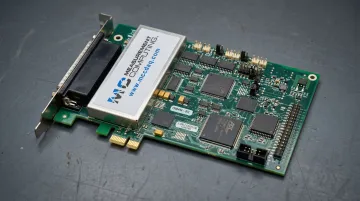
The Model 826 is a PCI Express board featuring eight 16-bit analog outputs, sixteen analog inputs, and 48 digital I/Os, making it a comprehensive single-board solution for machine control. A focused product line backed by strong application engineering support, CE and RoHS certifications, and open-source Linux drivers makes Sensoray a practical choice when Linux compatibility is a hard requirement.
Key Offering: Analog output modules and DAQ boards with simultaneous DAC outputs (Model 826, 618 series)
Interface Options: PCIe, USB; Linux and Windows SDK; open-source Linux driver availability
Best Suited For: Medical, robotics, and industrial applications requiring DAC control with Linux driver support
Data Translation (DATAQ Instruments / Measurement Specialties)
Data Translation produces PC-based data acquisition boards with analog I/O channels covering both input and output. Now a brand under Digilent (NI), its DAC-equipped boards serve industrial test, process monitoring, and OEM equipment where USB or PCIe connectivity is needed.
The DT9818 is a high-performance USB DAQ module featuring two 16-bit analog outputs alongside analog inputs and digital I/O. Legacy support continues for PCI boards like the DT322, which offers 16-bit analog output resolution. Data Translation's strengths are legacy compatibility with long-deployed industrial systems, straightforward SDK licensing, and board-level variants suited to OEM embedding.
Key Offering: USB and PCIe multifunction boards with analog output channels (DT9818, DT322 series); 12-16-bit
Interface Options: USB, PCIe; Windows SDK; .NET and C libraries available
Best Suited For: OEM system integrators and legacy industrial setups requiring well-supported analog output cards
How We Chose the Best DAC Board Manufacturers
Each manufacturer on this list was assessed on portfolio depth, technical documentation quality, and real-world adoption in CNC and automation environments. Software ecosystem maturity and LinuxCNC compatibility carried significant weight alongside hardware specifications.
Common mistakes buyers make:
- Focusing only on bit resolution while ignoring settling time and output impedance, both of which directly affect servo loop stability
- Selecting a USB board without confirming whether the controller OS requires deterministic PCIe latency
- Choosing general-purpose DAQ boards when an application-specific motion interface board would deliver better real-time performance
Four factors that separate a working solution from one that causes timing or noise issues:
- Form factor — PCIe, USB, or Ethernet, depending on latency requirements
- Isolation ratings — channel-to-channel and channel-to-ground voltage specs
- Channel count — number of simultaneous analog outputs the application demands
- Update rate — DAC settling time relative to your servo loop frequency
Conclusion
The right DAC board manufacturer depends on your application layer. Chip-level designers gravitate toward Texas Instruments and Analog Devices for comprehensive IC families and evaluation modules. Machine builders and integrators favor NI, Measurement Computing, or Advantech for full I/O ecosystems with mature software support. CNC-specific builders benefit most from FPGA-based motion boards from Mesa Electronics or dedicated servo interface boards from Pico Systems.
The final decision should rest on factors beyond spec sheet numbers:
- Scalability as your machine count or axis count grows
- Long-term product availability and vendor support
- Driver compatibility with your target OS, particularly Linux/LinuxCNC environments
- Application-specific features such as galvanic isolation or emergency-stop position tracking
For CNC builders working in LinuxCNC environments, Pico Systems' analog servo interface boards address several of these criteria directly — with real-time compatibility and emergency-stop position tracking built into the hardware design.
Frequently Asked Questions
Who are the best digital to analog converter board manufacturers?
Leading manufacturers span multiple segments: Texas Instruments and Analog Devices for chip-level designs and evaluation boards, National Instruments and Measurement Computing for multifunction DAQ cards, and Mesa Electronics and Pico Systems for CNC/motion control boards. The best choice depends on your application, interface requirements, and software environment.
What is a DAC board used for in industrial and CNC applications?
DAC boards convert digital command signals from a controller (PC, PLC, or FPGA) into analog voltages (typically ±10V) or currents (4-20mA) that drive servo amplifiers, variable-frequency drives, or other analog-input hardware in motion control and process automation systems.
What resolution do I need for a motion control DAC board?
Most servo motion control applications use 12-16-bit DAC resolution. 12-bit provides 4,096 discrete steps (~5mV at ±10V), while 16-bit provides 65,536 steps (~0.3mV). Higher resolution reduces quantization noise in velocity commands, making it the better choice for precision multi-axis CNC work.
What is the difference between a DAC chip and a DAC board?
A DAC chip is the bare integrated circuit performing digital-to-analog conversion. A DAC board is a fully assembled PCB that includes the DAC chip(s), reference voltage circuitry, host interface logic, and connectors, ready to drop into a system without additional design work.
Are industrial DAC boards compatible with LinuxCNC?
Compatibility varies by manufacturer. Mesa Electronics boards are natively supported through HOSTMOT2 drivers in LinuxCNC, and Pico Systems boards are designed for LinuxCNC environments via the PPMC driver. General-purpose boards from NI or Measurement Computing require additional driver and HAL configuration to work with LinuxCNC.
What interface type should I choose for a DAC board in a real-time control system?
For hard real-time motion control, PCIe or FPGA-direct interfaces are preferred for their deterministic latency (1-10µs). USB suits slower process control tasks, while EtherCAT is the go-to for distributed I/O architectures with long cable runs, offering deterministic performance in the 30-100µs range.