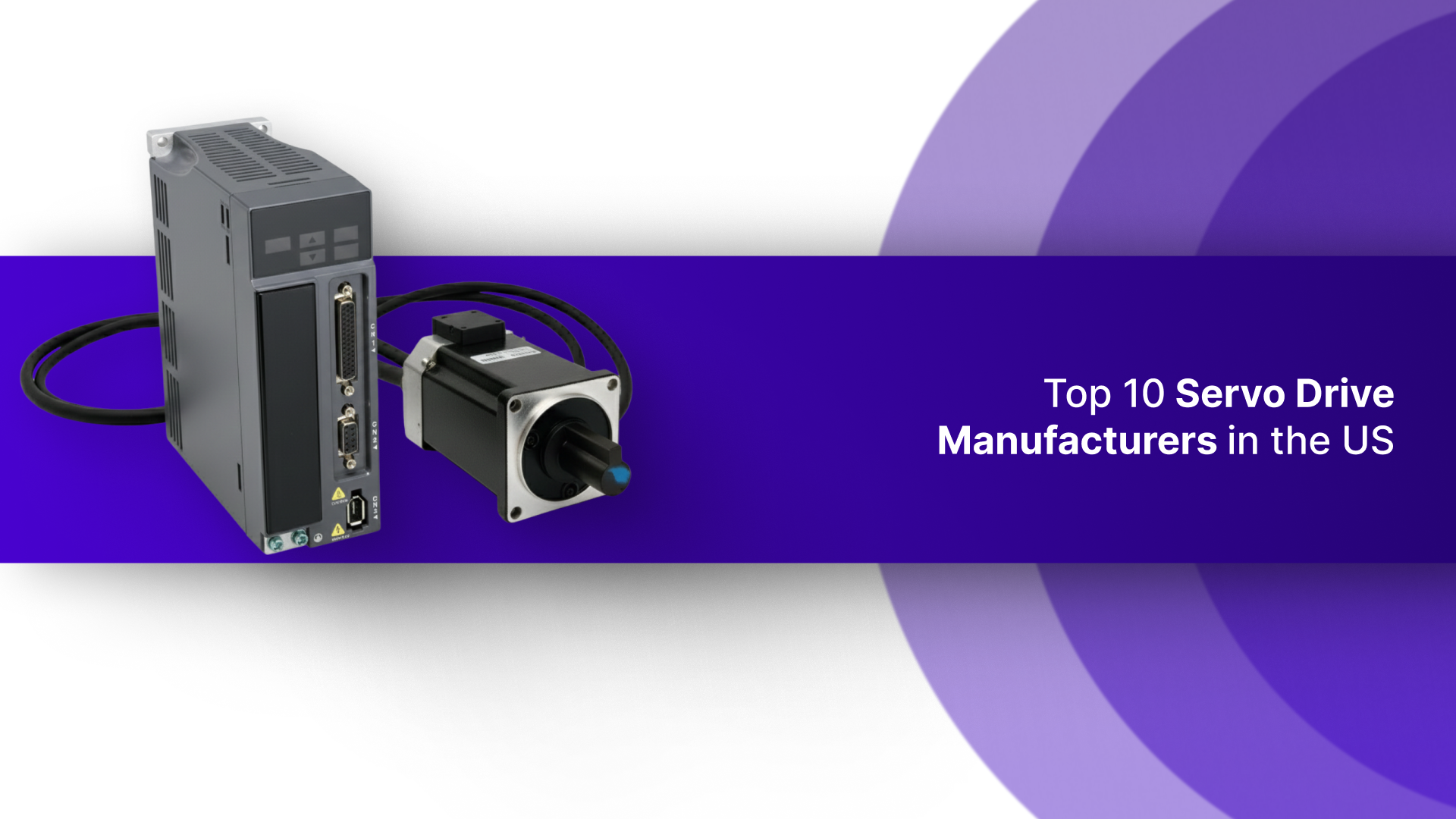
Servo drives determine how accurately, reliably, and safely motion systems operate. In automation environments, a poor servo drive choice does not fail immediately. It creates tuning instability, intermittent faults, higher maintenance load, and production risk over time.
With many options available, comparing the best servo drive manufacturers in the US requires more than feature lists. Teams must evaluate environment suitability, control behavior, support depth, and lifecycle reliability.
In this guide, you will learn how to evaluate the US servo drive manufacturers, understand where each manufacturer fits best, and identify selection risks before they affect uptime and scalability.
Key Takeaways
Many servo drive failures result from selection mistakes, not hardware defects.
Manufacturer support and lifecycle continuity directly affect long-term reliability.
Poor integration increases tuning effort, downtime, and troubleshooting complexity.
Motion-first manufacturers help reduce operational risk in demanding automation systems.
Servo drive selection should prioritize environment fit and system integration, not brand alone.
How to Evaluate Servo Drive Manufacturers Before Comparing Brands?
Before comparing vendors, teams should align on evaluation criteria. Servo drive performance depends as much on application context as on specifications.
Key evaluation factors include:
Load dynamics and motion precision requirements
Support availability during commissioning and failures
Long-term supply continuity and replacement strategy
Integration with controllers, encoders, and power systems
Environmental exposure (temperature, vibration, electrical noise)
These criteria provide the lens needed to assess the top servo drive manufacturers in the US objectively.
With this framework established, let’s review the manufacturers.
10 Best Servo Drive Manufacturers in the US
Selecting from the best servo drive manufacturers in the US requires more than brand recognition. Each manufacturer aligns differently with motion accuracy, environmental tolerance, system integration, and long-term support needs.
The following manufacturers represent leading US-based options, evaluated through application fit, operational reliability, and suitability for industrial automation environments.
1. Pico Systems

Pico Systems is a technology hardware company focused on industrial motion control and automation solutions. The firm designs, produces, and supplies motion control components and automation hardware used in industrial environments for industrial automation, CNC systems, robotics, and OEM motion platforms.
Offerings:
Motion-first servo architecture: Servo drives prioritize deterministic motion behavior rather than generic power conversion.
Tight encoder and feedback integration: Encoder interfaces and DACs natively integrate to minimize signal mismatch and tuning instability.
Designed for harsh automation environments: Products withstand vibration, electrical noise, and thermal cycling common in industrial systems.
OEM and long-lifecycle focus: The company customizes solutions, ensures long-term availability, and delivers stable designs for machine builders.
Direct US-based engineering support: Engineers help set up, tune, and analyze root causes to reduce downtime risk.
Pico Systems fits applications where motion accuracy, system stability, and long-term reliability matter more than mass-market standardization.
2. Rockwell Automation (Allen-Bradley)
Rockwell Automation is a US-based industrial automation leader known for PLC-driven control ecosystems.
Features:
Strong network and diagnostics capabilities
Scalable solutions for large production facilities
Deep integration with Allen-Bradley PLC platforms
Rockwell servo drives work best in plants standardized on Rockwell control architectures.
3. Kollmorgen (Danaher Motion)
Kollmorgen is a US-based motion control company specializing in servo systems for robotics and automation.
Features:
Strong motor-drive integration
Proven use in robotics and packaging systems
High dynamic response for coordinated motion
Kollmorgen suits applications requiring fast response and coordinated multi-axis motion.
4. Parker Hannifin
Parker Hannifin is a US-based industrial manufacturer with a broad motion and control portfolio.
Features:
Strong industrial durability focus
Support for complex, multi-technology machines
Servo drives integrated with mechanical and fluid power systems
Parker drives fit systems where motion interacts with hydraulic or electromechanical components.
5. Moog Inc.
Moog is a US-based manufacturer known for precision motion in aerospace and defense applications.
Features:
High reliability in mission-critical systems
Strong performance in extreme environments
Extremely stable control under demanding conditions
Moog servo drives suit applications where failure tolerance is minimal.
6. Advanced Motion Controls (AMC)
Advanced Motion Controls is a US-based company focused on compact servo drives.
Features:
High power density designs
Flexible form factors for embedded systems
Strong use in medical and semiconductor equipment
AMC fits space-constrained systems requiring precise control.
7. Galil Motion Control
Galil Motion Control is a US-based manufacturer offering combined motion controllers and servo drives.
Features:
Integrated control and drive architecture
Suitable for mid-range automation systems
Reduced system complexity for smaller platforms
Galil fits applications seeking simplified motion architectures.
8. Delta Motion (US)
Delta Motion is a US-based company specializing in coordinated motion control.
Features:
Focus on industrial automation reliability
Deterministic multi-axis synchronization
Strong performance in continuous operations
Delta Motion suits synchronized automation systems.
9. Aerotech
Aerotech is a US-based manufacturer focused on ultra-precision motion systems.
Features:
Nanometer-level motion accuracy
Excellent thermal and control stability
Used in semiconductor and laser processing
Aerotech fits precision manufacturing and metrology environments.
10. Emerson Motion Control Technologies (US)
Emerson’s US motion control division supports industrial automation platforms.
Features:
Emphasis on diagnostics and reliability
Strong lifecycle and service infrastructure
Integration with plant-level control systems
Emerson suits large industrial environments with centralized control strategies.
Even strong manufacturers can deliver poor outcomes when selection decisions go wrong. Next, let’s discuss the most common mistakes teams make when choosing a servo drive manufacturer and how to avoid them.
Common Mistakes to Avoid When Choosing a Servo Drive Manufacturer
Many servo drive issues trace back to selection mistakes rather than product defects. These errors often surface months after commissioning, when systems operate under real production stress.
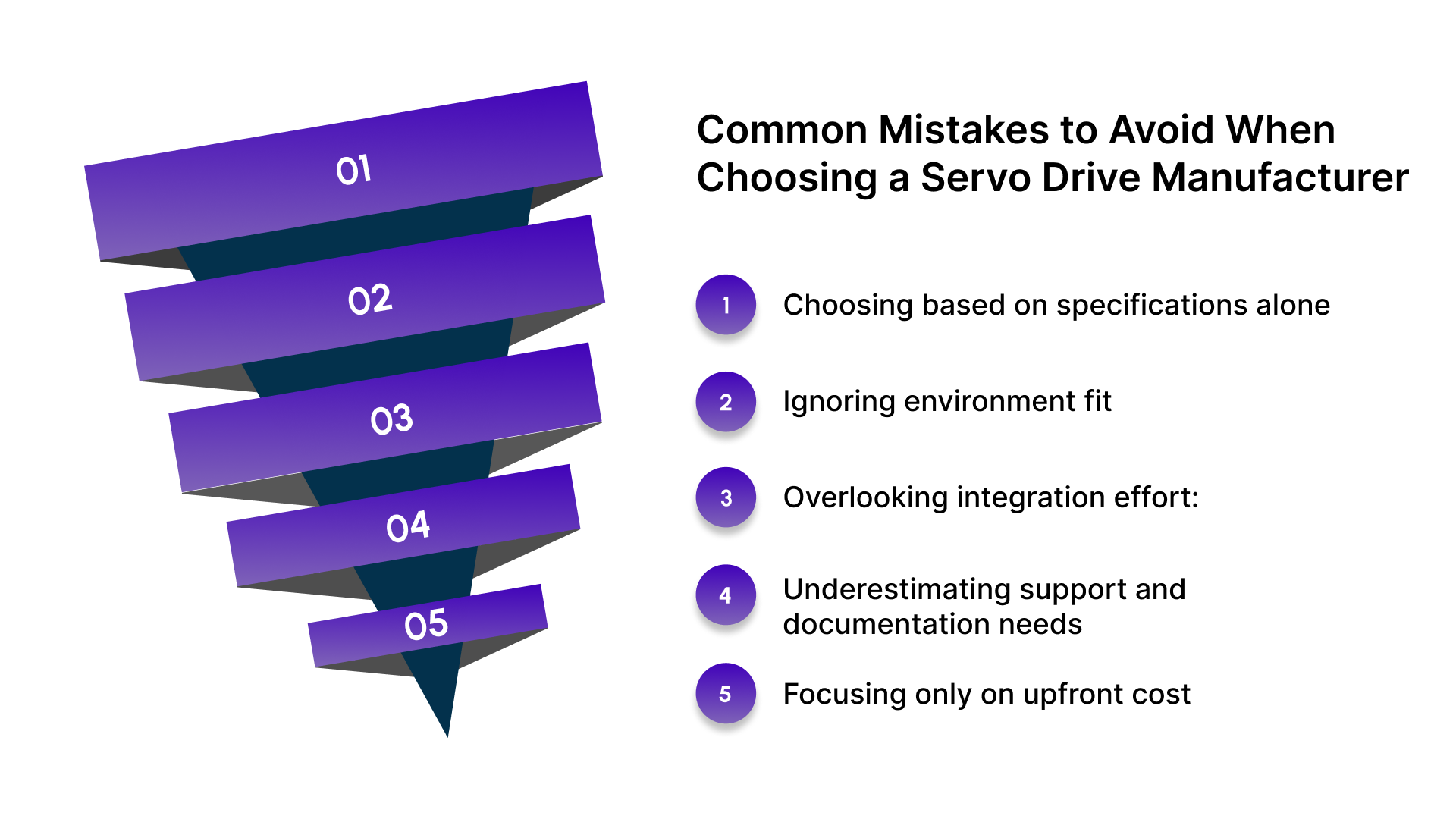
Common mistakes include:
Choosing based on specifications alone: Paper performance does not reflect behavior under vibration, electrical noise, or thermal cycling.
Ignoring environment fit: Drives selected without considering temperature variation, contamination, or enclosure constraints often degrade prematurely.
Overlooking integration effort: Poor compatibility with controllers, encoders, or power systems increases tuning time and instability risk.
Underestimating support and documentation needs: Limited application guidance delays troubleshooting and extends downtime during failures.
Focusing only on upfront cost: Lower initial pricing can increase long-term costs through replacements, rework, and operational disruption.
Avoiding these mistakes helps teams select servo drive manufacturers that support reliable, scalable motion systems.
Conclusion
Choosing among the best servo drive manufacturers in the US requires balancing technical suitability with operational reality. The right choice supports stable motion, predictable maintenance, and long-term system confidence.
Teams should evaluate application-specific motion demands, environmental exposure and operating stress, integration complexity across the control stack, supplier reliability, support, and lifecycle continuity.
Manufacturers such as Pico Systems focus on motion-first design, long-term availability, and practical integration into industrial automation environments. This approach helps reduce tuning friction, minimize environmental risk, and support consistent performance over time.
Are servo drive issues limiting uptime or making troubleshooting unpredictable in your systems? Get in touch with us to discuss your motion control requirements and evaluate servo drive solutions built for real-world automation conditions.
Frequently Asked Questions
1. How should teams compare the top servo drive manufacturers in the US?
Teams should evaluate application demands, environmental exposure, integration needs, supplier support, and lifecycle availability. Comparing servo drives without this context often leads to long-term reliability and maintenance issues.
2. Are higher-priced servo drives always more reliable?
No, reliability depends on environment fit, integration quality, and support, not just price. An over-specified drive can still fail if it does not match the operating conditions.
3. Should procurement teams be involved in servo drive selection?
Yes, supplier stability, lead times, and long-term availability directly impact operational risk. Procurement input ensures the servo drive choice supports lifecycle planning.
4. Why do servo drive failures often appear months after installation?
Many issues emerge under real operating stress, such as vibration, thermal cycling, or electrical noise. These conditions rarely appear during commissioning.
5. When should OEM-focused manufacturers be preferred?
OEM-focused manufacturers are better when systems require long lifecycle support, customization, and stable designs across many years of operation.