Integrating servo motion control into automation systems is a challenge that most engineers face at some point, whether it's struggling with mismatched components, confusing wiring diagrams, or calibration issues. One wrong setting, and you risk everything from poor performance to system failures.
This guide will walk you through the essentials of servo motion control integration. We’ll cover the various components, types, and workings of a servo motor. Let’s get started.
Quick Recap
Precision Control: Servo motors provide precise control over position, speed, and torque, ideal for automation in robotics and CNC applications.
Key Selection Factors: Focus on inertia matching, torque, precision, and environmental adaptability to ensure optimal motor performance.
Closed-Loop Feedback: Servo motors use closed-loop feedback for real-time adjustments, ensuring accuracy and stability in motion.
Component Integration: PWM controllers, servo amplifiers, and encoder converters are critical for seamless servo system integration and reliable performance.
Environmental Suitability: Choose motors with the right IP rating and temperature tolerance to maintain performance in harsh or specialized conditions.
What is a Servo Motor?
A servo motor stands out from ordinary motors due to its ability to continuously monitor its movement and adjust in real-time based on a target signal. This constant feedback system allows the servo motor to maintain precise control over key parameters like position, speed, and torque.
What makes them reliable is their ability to adapt and correct in real-time, ensuring controlled, repeatable movements.
How Does a Servo Motor Work?
A servo motor is engineered for precise control of position, speed, and torque, making it ideal for tasks requiring accuracy over continuous movement. A servo motor’s movement is controlled and stopped at specific positions, offering much greater precision.
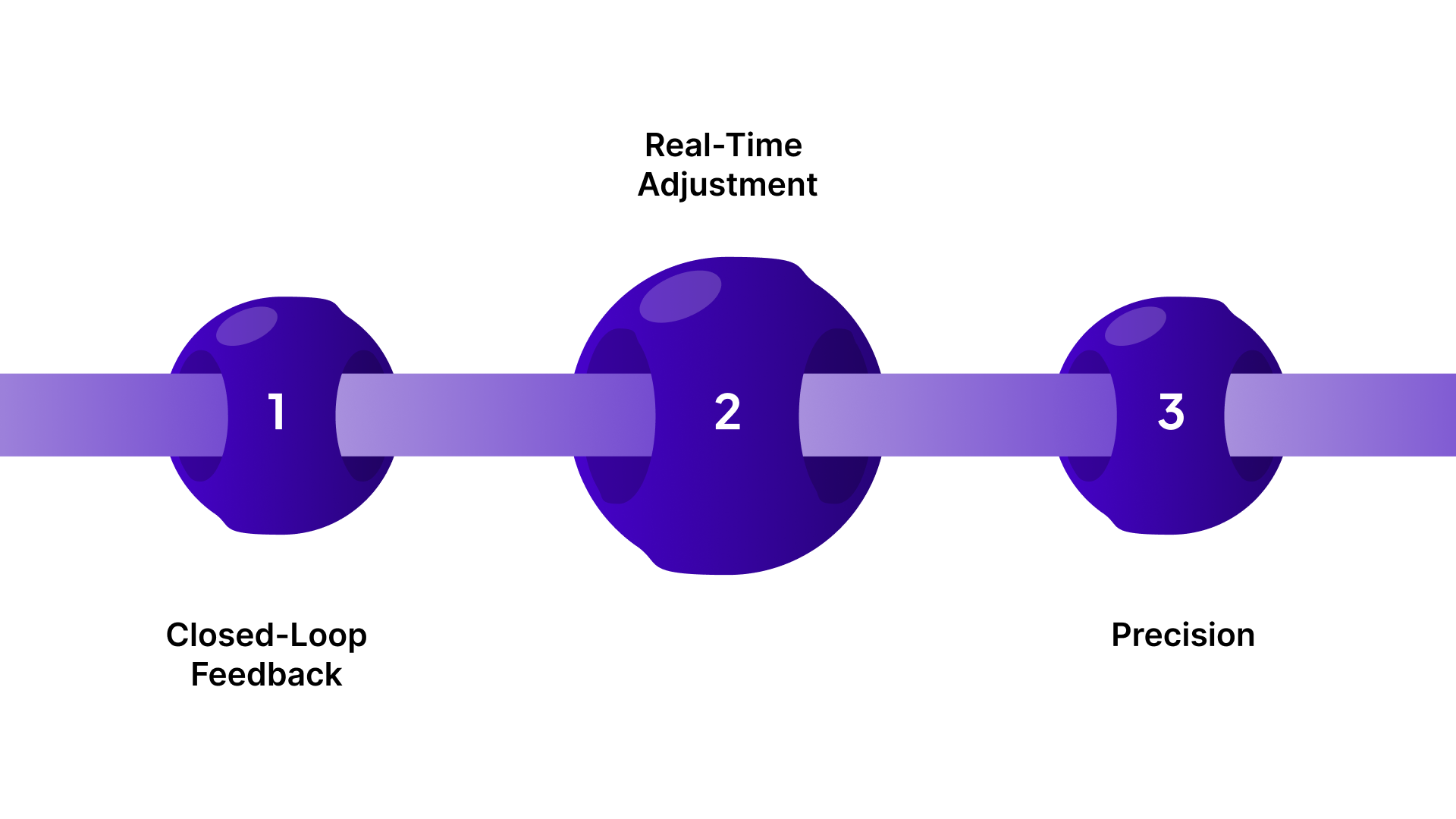
Here’s how it works:
Closed-Loop Feedback: The motor continuously monitors its position using an internal feedback sensor, such as an encoder or potentiometer.
Real-Time Adjustment: If there’s any difference between the desired position and the actual position, the servo immediately adjusts until they match.
Precision: This feedback loop ensures the motor moves to an exact location, making it perfect for tasks like robotic arms, drones, or CNC machines.
The Basic Principles:
Control Signal: A controller sends a signal to the servo motor, indicating the desired position or speed.
Feedback Comparison: The motor checks its position against the feedback from the position sensor (encoder or potentiometer).
Error Correction: If the servo hasn’t reached the commanded position, the control circuit adjusts the motor to correct the error.
Stabilized Position: Once the motor reaches the desired position, feedback confirms it, and the servo holds steady.
Servo motors use continuous adjustments to maintain accurate position and torque, making them a reliable choice for precise automation systems.
Also Read: How to Estimate the Cost of a Production Servo Motor: A Complete Guide
Understanding how the motor works gives you insight into its core functionality. Next, let's break down the main components that make this possible.
What Are the Main Components of a Servo Motor?
A servo motor consists of several key components that work together in a closed-loop system, enabling precise control of movement. Here’s a breakdown of the core elements:
Motor (AC or DC): The heart of the servo, the motor generates the rotation and torque. DC motors are common in smaller projects, while AC motors power larger systems in industrial machines.
Power Supply: This component provides the necessary energy for both the motor and its electronics, ensuring smooth operation and consistent performance.
Position Sensor: Typically, an encoder or potentiometer, this sensor tracks the actual position of the motor’s shaft. It sends feedback to the control system to ensure accurate positioning.
Control Circuit: This circuit compares the command input to the feedback from the position sensor. It continuously adjusts the motor’s movement to match the target position.
Gear Assembly: The gear assembly reduces the motor’s speed, increases its torque, and makes the servo more compact, all while delivering the necessary power for precise adjustments.
Together, these components enable a servo motor to maintain accurate, continuous position adjustments, making it indispensable in various applications.
With the components in mind, it's time to explore the different types of servo motors and how they fit into various applications.
Types of Servo Motors
Choosing the right type of servo motor for your application depends on the power, precision, and required feedback speed. Here’s a breakdown of the most common types:
Type | Description | Applications | Pros | Cons |
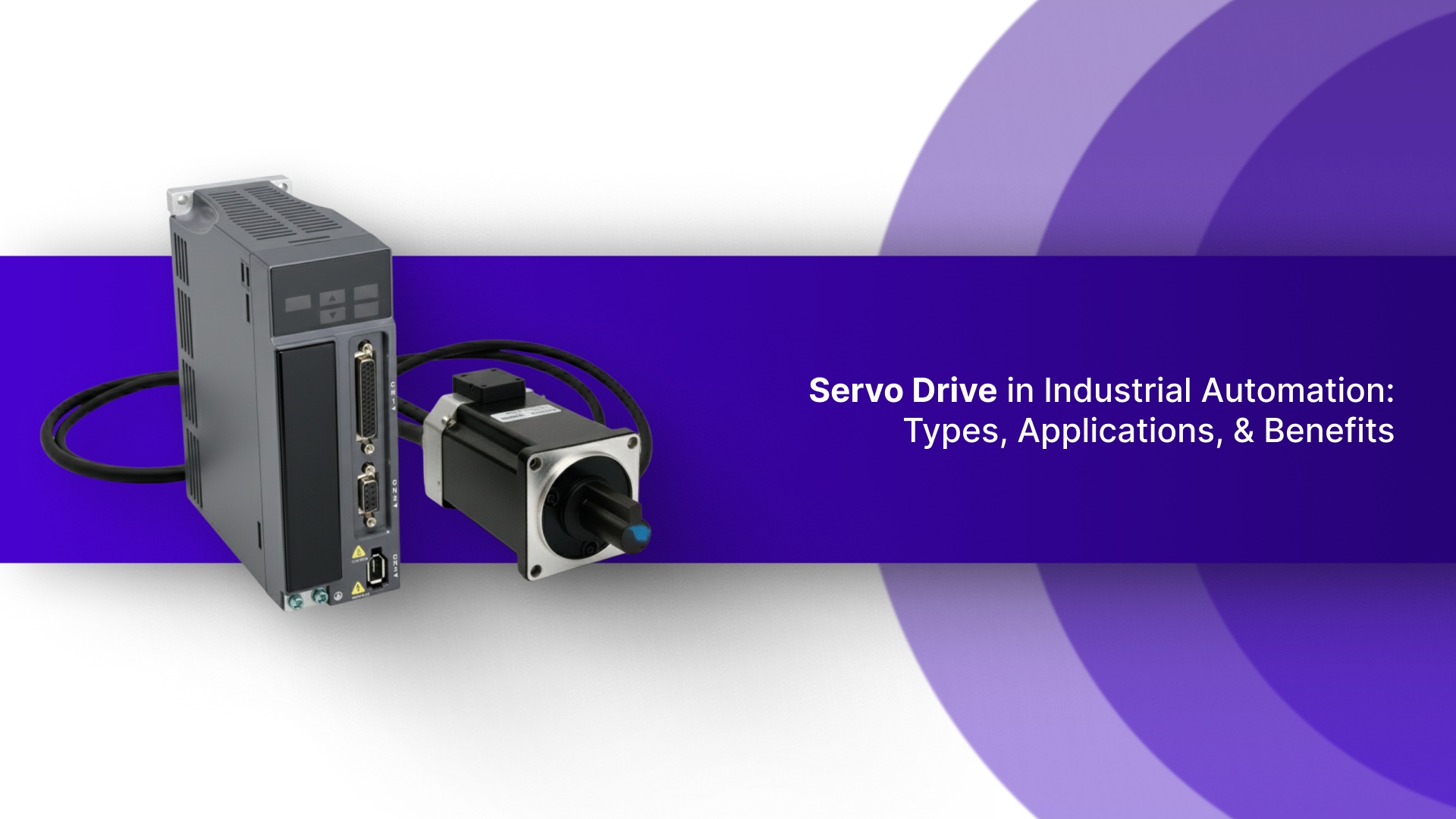
AC Servo Motors | Powered by alternating current, AC servos offer high torque and stability, even at high speeds. These are built for industrial-grade performance. | CNC machines, robotic welding, automated assembly lines. | High precision and torque. Built for continuous use. | More expensive and complex than DC and RC servos. |
DC Servo Motors | These run on direct current and are simpler to control. They are fast to respond and great for small automation systems. | Robotics, light-duty machines, mini robots, and educational setups. | Affordable, easy to set up, and responsive. | Lower torque and speed compared to AC servos. |
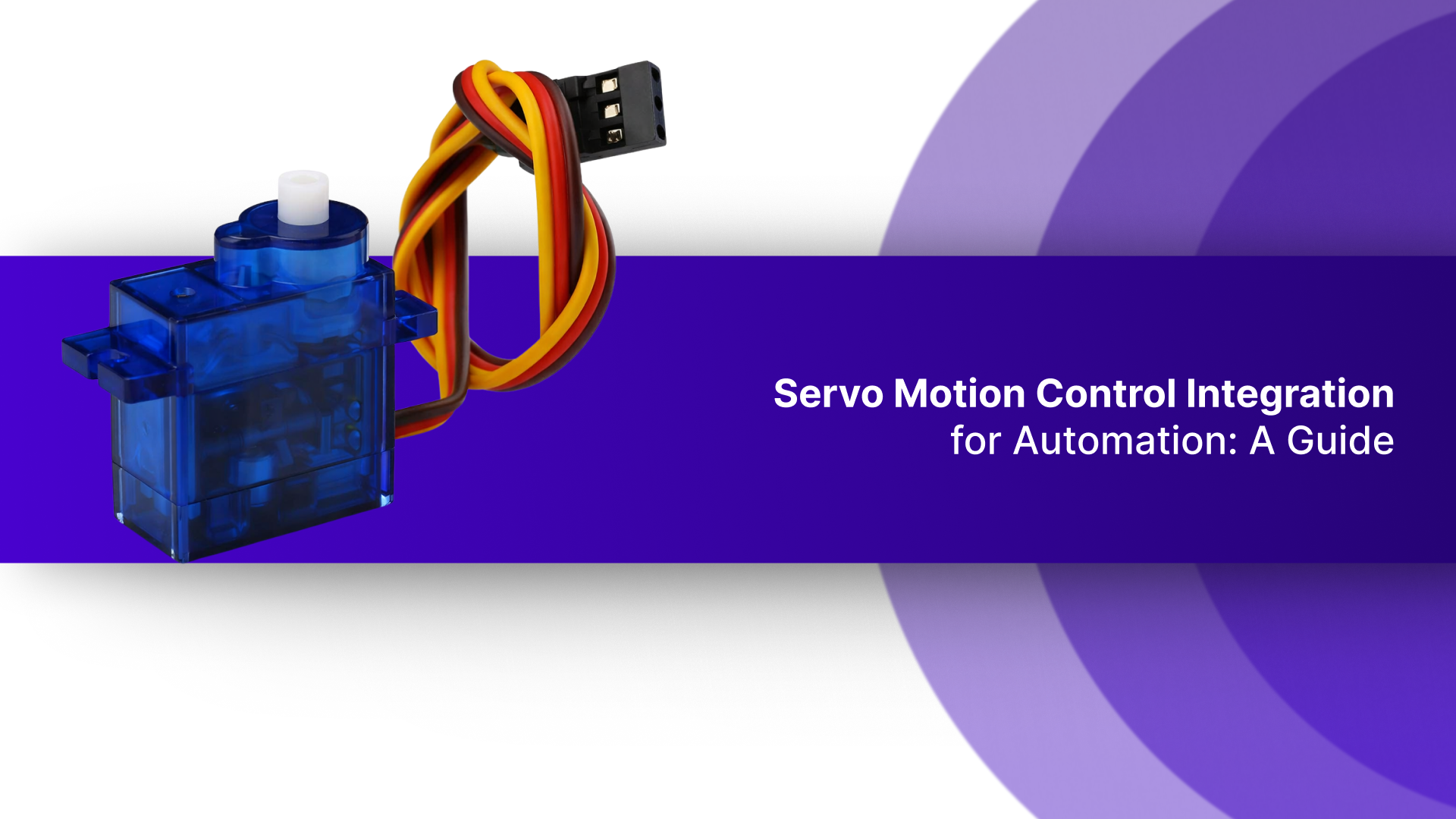
RC Servo Motors | Compact units that combine a motor, gears, sensor, and controller. Typically used in hobby robotics. | RC cars, drones, DIY robotics kits, and educational projects. | Simple, affordable, and easy to integrate. | Limited torque and power for heavy-duty tasks. |
Servo motors are an essential component in various automation systems, each serving a specific purpose depending on your needs. The key is to match your choice with the required feedback loop speed and precision for your system.
Now that we've covered the different types of motors, let's look at the advantages and limitations to help you decide when to use them.
Advantages and Limitations of Servo Motors
Servo motors are a cornerstone of high-precision applications. However, like all technology, they come with both strengths and trade-offs. Here’s a breakdown:
Advantages
High Precision: Servo motors provide excellent accuracy through closed-loop control, making them ideal for tasks requiring fine position control.
Compact Size: Their small form factor allows integration into space-limited systems without sacrificing performance.
Energy Efficiency: These motors are designed to draw only the necessary power, reducing waste and improving overall system efficiency.
Versatility: From robotics to CNC machines, servo motors are highly adaptable and can handle a variety of automation tasks with ease.
Limitations
Higher Cost: Compared to standard motors, servo motors are more expensive due to their specialized components and control systems.
Complexity: Integrating a servo motor requires additional components, such as controllers and tuning, which can complicate the setup and increase maintenance requirements.
Limited Torque Range: While ideal for precise movements, servo motors are generally unsuited for heavy-duty applications requiring high torque.
Environmental Sensitivity: Harsh environments can degrade performance, requiring recalibration or additional protective measures to maintain accuracy.
While servo motors offer remarkable benefits in precision and efficiency, their cost, complexity, and torque range limitations must be considered when selecting the right motor for your application.
Next, let’s look at how they’re used in real-world applications across industries.
5 Real-World Applications of Servo Motors
Servo motors are integral to a wide range of applications, thanks to their precise control and reliability. Here’s a breakdown of where servo motors are making an impact:
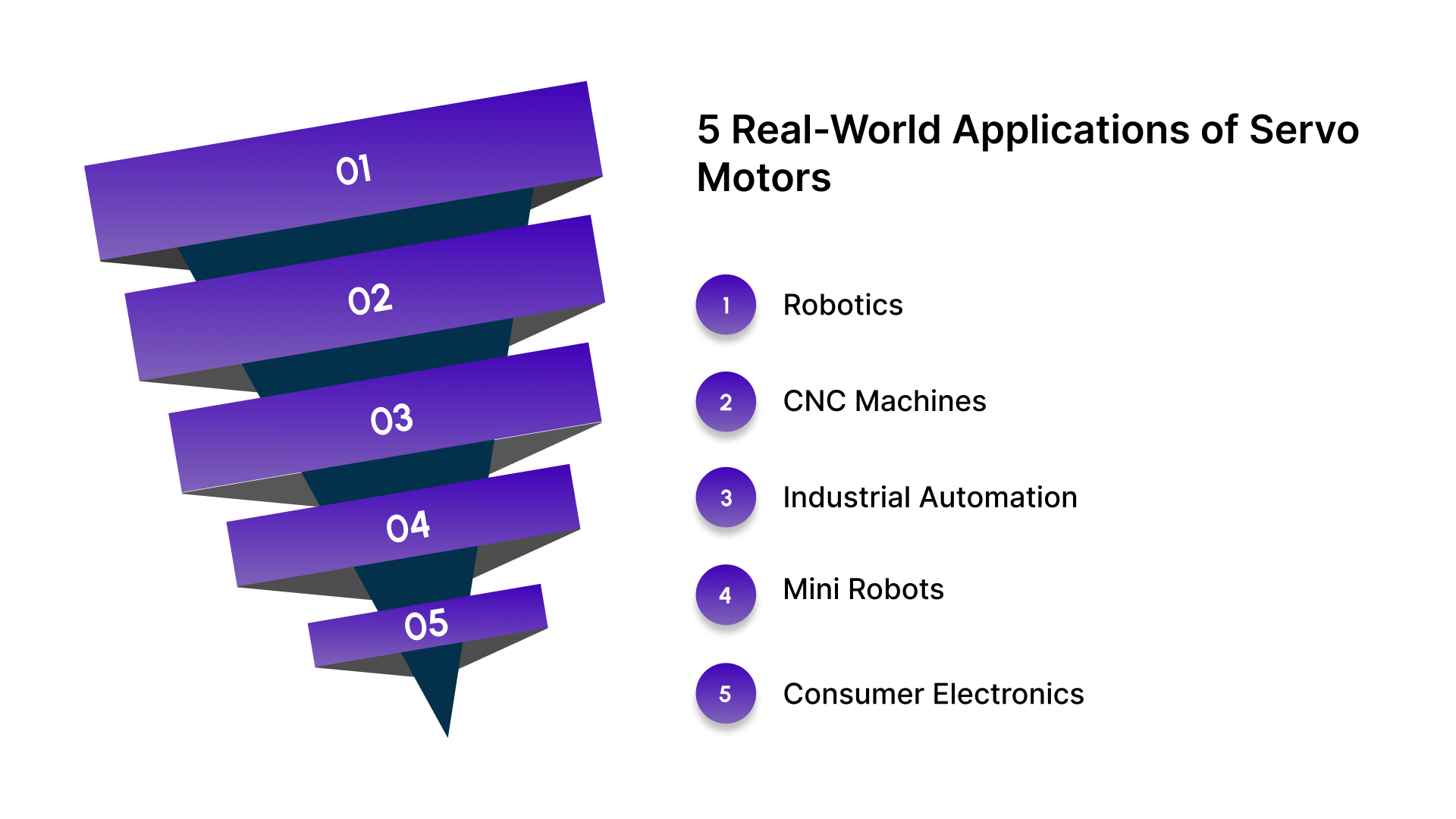
1. Robotics
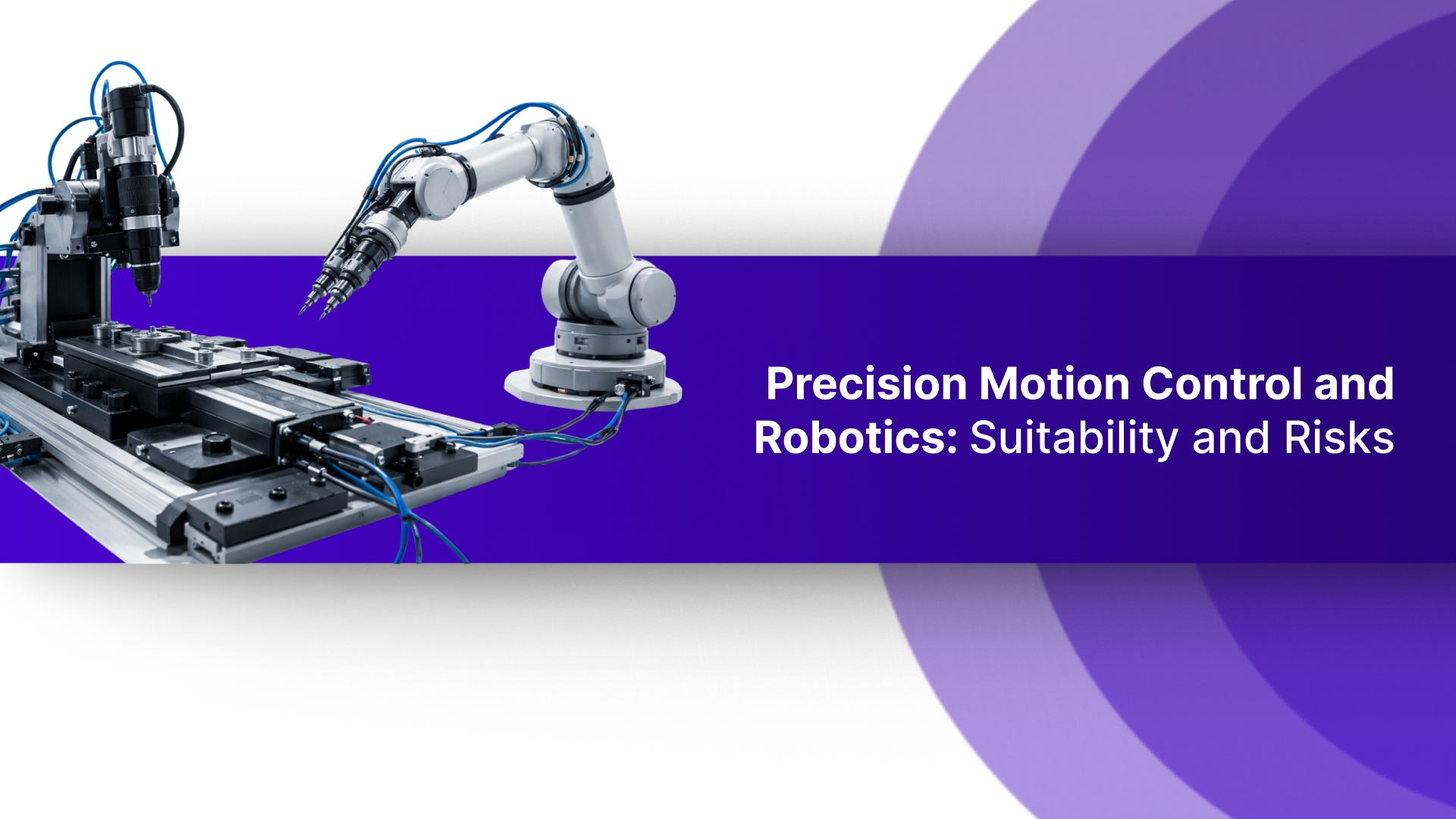
Servo motors power robotic arms, grippers, and end effectors, providing steady, precise movement with no drift. On automotive assembly lines, companies rely on servos to place components with consistent precision, ensuring high-quality output.
2. CNC Machines
Servos control both cutting tools and work tables with micron-level precision. In CNC machining, servo motors follow programmed paths with zero deviation, ensuring high precision in industries like aerospace and automotive manufacturing. These systems allow manufacturers to produce critical components with unmatched accuracy.
3. Industrial Automation
In manufacturing, servo motors power high-speed conveyor belts, packaging systems, and palletizing robots. These systems perform with quick starts, stops, and reversals, keeping up with demanding production schedules and ensuring uniformity across all operations.
4. Mini Robots
Compact servos enable precise movement in smaller robots, making them affordable and easy to control. Servo-driven prototypes are used in swarm robotics, where multiple robots work together in tight coordination. The servo’s ability to report exact position in real time is crucial for these systems.
5. Consumer Electronics
Servo motors are hidden inside many everyday gadgets, providing smooth, accurate motion. Cameras, for example, rely on servos for fast autofocus and steady zooming, enabling photographers to capture sharp images with ease.
In smart homes, servos control automated blinds, locks, and service robots, seamlessly adjusting settings in real-time for convenience and efficiency.
Servo motors are important in driving precise, reliable movement across a wide range of industries.
To incorporate servo motion control into your automation system, Pico Systems offers precision tools like our Universal PWM Controllers. These solutions guarantee top-tier performance and reliability across various applications, from robotics to CNC machining.
Seeing how servo motors are used in real life helps put things into perspective. Now, let’s focus on the key considerations for selecting the right motor for your automation needs.
How to Select a Servo Motor: Key Considerations for Automation Integration
Selecting the right servo motor for your automation application requires understanding key parameters that impact performance, efficiency, and long-term reliability. Below are the critical factors to consider when choosing a servo motor.
1. Load Characteristic Analysis
Inertia Matching: The inertia ratio between load and motor should ideally fall between 3:1 and 10:1 for optimal motor performance. A lower ratio improves response time and ensures more accurate control.
Torque Requirements: Consider the peak torque, continuous torque, and acceleration torque your application requires. These values determine how well the motor handles dynamic load changes and avoids performance issues under varying operational conditions.
Speed Range: Choose a motor that offers both rated speed for normal operation and a maximum operating speed to handle the extreme conditions of your application without risking motor failure.
2. Precision Requirements
Repeat Positioning Accuracy: Look for a motor that provides repeat positioning accuracy within ±1 to ±3 pulses, depending on the application’s precision needs. This ensures your system can consistently return to the desired position.
Resolution: The encoder line count determines resolution. The higher the resolution, the finer the control and smoother the motion. Ensure the motor’s resolution matches your application’s requirement for seamless operation.
Rigidity Requirements: Depending on the precision required for machining or assembly, ensure the motor’s design offers the necessary rigidity to prevent inaccuracies in motion.
3. Environmental Adaptability
Protection Rating: For environments exposed to dust or water, ensure your motor has an IP rating between IP54 and IP67 for reliable performance. This ensures the motor’s durability in harsh conditions without compromising functionality.
Temperature Range: The motor’s operating temperature range typically falls between -20°C to +40°C, which is suitable for most industrial applications. For extreme conditions, consider specialized motors that can tolerate higher or lower temperatures.
Special Environments: If the application involves explosion-proof, cleanroom, or vacuum environments, select motors designed specifically for these challenging conditions to ensure both safety and performance.
4. Other Key Factors to Consider
Motor Size and Integration: Ensure the servo motor fits within your space constraints and integrates seamlessly into your system. In some cases, an integrated servo system might be necessary to optimize space, particularly for compact setups.
5. Cost Considerations
Servo motors are typically more expensive than other motor types, such as AC, DC, or stepper motors, due to the precision and components required to manufacture them. The high cost reflects the motor’s ability to deliver precise control and smooth operation over time.
Cost is also influenced by the quality of bearings, feedback devices (such as encoders or resolvers), connectors, and industrial-grade housing used in the motor’s construction.
Selecting the right servo motor requires a thorough understanding of inertia matching, precision needs, environmental adaptability, and cost considerations.
Pico Systems offers precision products, such as our PWM Servo Controllers and FANUC encoder converters, designed to meet your inertia-matching, precision, and environmental needs, ensuring optimal motor performance and reliability.
Why Choose Pico Systems for Your Servo Motion Control Integration?
When it comes to integrating servo motion control into your automation system, having the right components is crucial for smooth operation and performance. Pico Systems provides a range of high-quality products designed to optimize your servo motor integration. Here’s how we can help:
Universal PWM Servo Controller: A versatile 4-axis controller that integrates seamlessly with LinuxCNC software, offering encoder counters, PWM generators, and digital I/O. This controller provides precise motion control, suitable for a wide range of automation applications.
PWM Servo Amplifiers: Whether you're working with DC brush motors or brushless motors, our PWM Servo Amplifiers deliver the power to drive your motors efficiently, with features such as peak current control and an E-stop for safety.
Encoder Converters: Panasonic and Fanuc encoder converters allow you to integrate different motor feedback signals, ensuring your servo system works smoothly across various motor brands and models. These converters help adapt encoder signals for precise control.
Connector Panels: Our connector panels offer a simplified solution for wiring multiple axes, with AMP circular connectors for easy integration. These panels support both single-ended and differential encoder signals and are compatible with brushless motor commutation signals.
Power Supplies and Heat Sinks: Ensure your system runs smoothly with our 12V power supplies and heat sinks, designed to prevent overheating and maintain optimal system performance during prolonged use.
With Pico Systems’ complete range of products, you can easily build and scale your servo motion control systems.
Conclusion
Integrating servo motion control systems into your automation setup is both exciting and challenging. Understanding key factors such as inertia matching, torque and speed requirements, and environmental considerations lays the foundation for a system that performs reliably and efficiently.
The right components are essential for smooth integration. When these elements are properly selected and fine-tuned, you can expect improved system performance and reduced downtime, ultimately leading to a more efficient operation.
At Pico Systems, we’ve got the products you need to enhance your servo motion control integration. From PWM controllers to servo amplifiers and encoder converters, we offer solutions that help your system run smoothly. Reach out to us to make your automation system work like it’s supposed to!
FAQs
1. What factors should I consider when selecting a servo motor for automation?
Key factors include inertia matching, torque and speed requirements, precision needs, and environmental conditions (e.g., IP rating and temperature range). These parameters ensure optimal motor performance.
2. How do I calculate the torque requirement for my servo motor?
Consider peak torque, continuous torque, and acceleration torque. These values help determine how the motor handles dynamic loads and avoids performance issues.
3. Why is encoder resolution important for servo motors?
Higher encoder resolution improves motion precision and control accuracy. It directly affects position, speed control, and overall system smoothness.
4. How do environmental conditions affect servo motor selection?
Servo motors should be chosen based on IP ratings for dust and water resistance, and temperature tolerance. Ensure the motor suits the operating environment to maintain performance.
5. What are the advantages of using a PWM Servo Controller in my system?
A PWM servo controller regulates power delivery to the motor, ensuring smooth, precise motion. It plays a key role in closed‑loop control by using feedback to adjust performance.