When your machine needs to hit the same position a thousand times in a row, stepper motors make it happen.
They move in precise angular steps when you send electrical pulses. One pulse equals one step. Want to rotate 90 degrees? Send the right number of pulses, and you're there. The motor's construction guarantees it.
This open-loop positioning makes integration simpler. No feedback wiring, no tuning loops, no hunting for stable PID gains.
This way, you get predictable, repeatable motion straight out of the box, which explains why they're standard in everything from laser engravers to automated test equipment.
This guide explains what a stepper motor is, how it works, the main types, stepping modes, advantages, limitations, and the industrial scenarios where stepper motors deliver the most value.
Key Takeaways
Stepper motors rotate in fixed increments - typically 1.8 degrees per step - giving you position control by counting pulses without needing feedback sensors or encoders.
Three motor types serve different needs - permanent magnet designs hold position during power loss, variable reluctance offers higher resolution, hybrid steppers deliver the best overall performance.
Stepping modes trade resolution for torque - full stepping maximizes holding force, half stepping smooths motion, microstepping eliminates vibration but reduces torque at intermediate positions.
Torque characteristics create speed limitations - steppers excel at low speeds with full torque available at standstill, but torque falls off significantly as pulse rates increase.
Open-loop simplicity comes with risk - no feedback means lost steps go undetected, making encoder integration worth considering for applications where positioning errors accumulate over time.
What is a Stepper Motor?
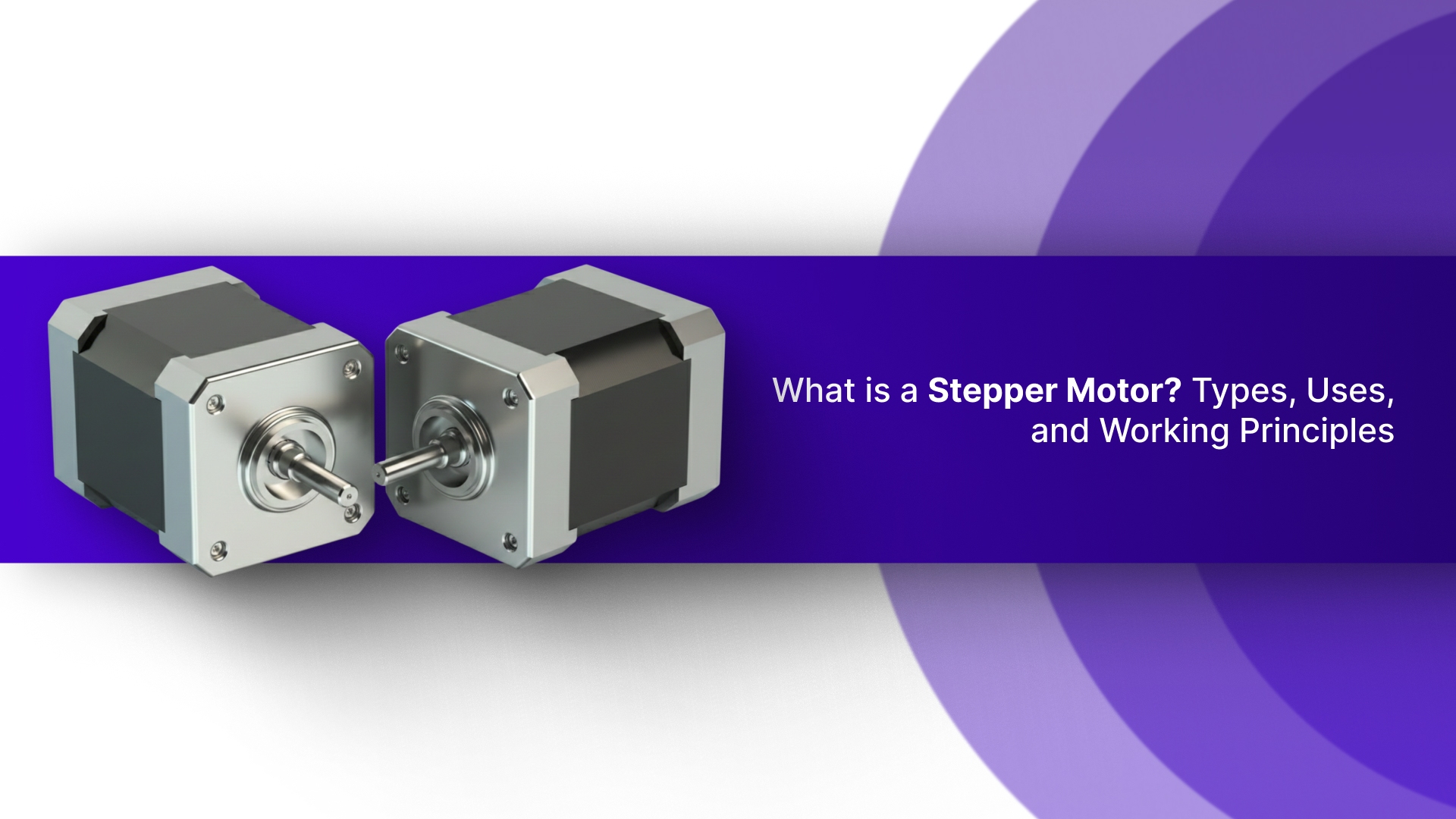
A stepper motor is a brushless DC motor that converts electrical pulses into precise mechanical rotation. Instead of spinning continuously like standard DC motors, it moves in discrete angular increments with each pulse you send.
Most steppers rotate around 1.8 degrees per step, completing 200 steps
for a full rotation. This happens through electromagnetic induction, where switching magnetic fields causes the rotor to step from one position to the next.
The motor's shaft advances in small, repeatable angles, letting you control position by simply counting pulses. This makes steppers reliable for applications where you need accurate positioning without feedback sensors.
Key points to remember about stepper motors:
Precision Motion Control: Stepper motors move in discrete steps, offering precise control over position and speed, crucial for applications like CNC machines and robotics.
Open-Loop Operation: Stepper motors can operate without feedback systems, making them simpler and more cost-effective for many motion control tasks.
High Torque at Low Speeds: These motors provide high torque even at low speeds, making them ideal for applications requiring steady, low-speed operation.
Reliability: With no brushes to wear out, stepper motors are highly durable and require minimal maintenance, ensuring long-term reliability in industrial environments.
Smooth Operation: Stepper motors offer smooth, vibration-free movement, which is important for applications where precision and stability are critical.
Versatile Applications: Stepper motors are used in a wide range of industries, from 3D printing to automation, where accurate and controlled motion is essential.
3 Types of Stepper Motors Explained
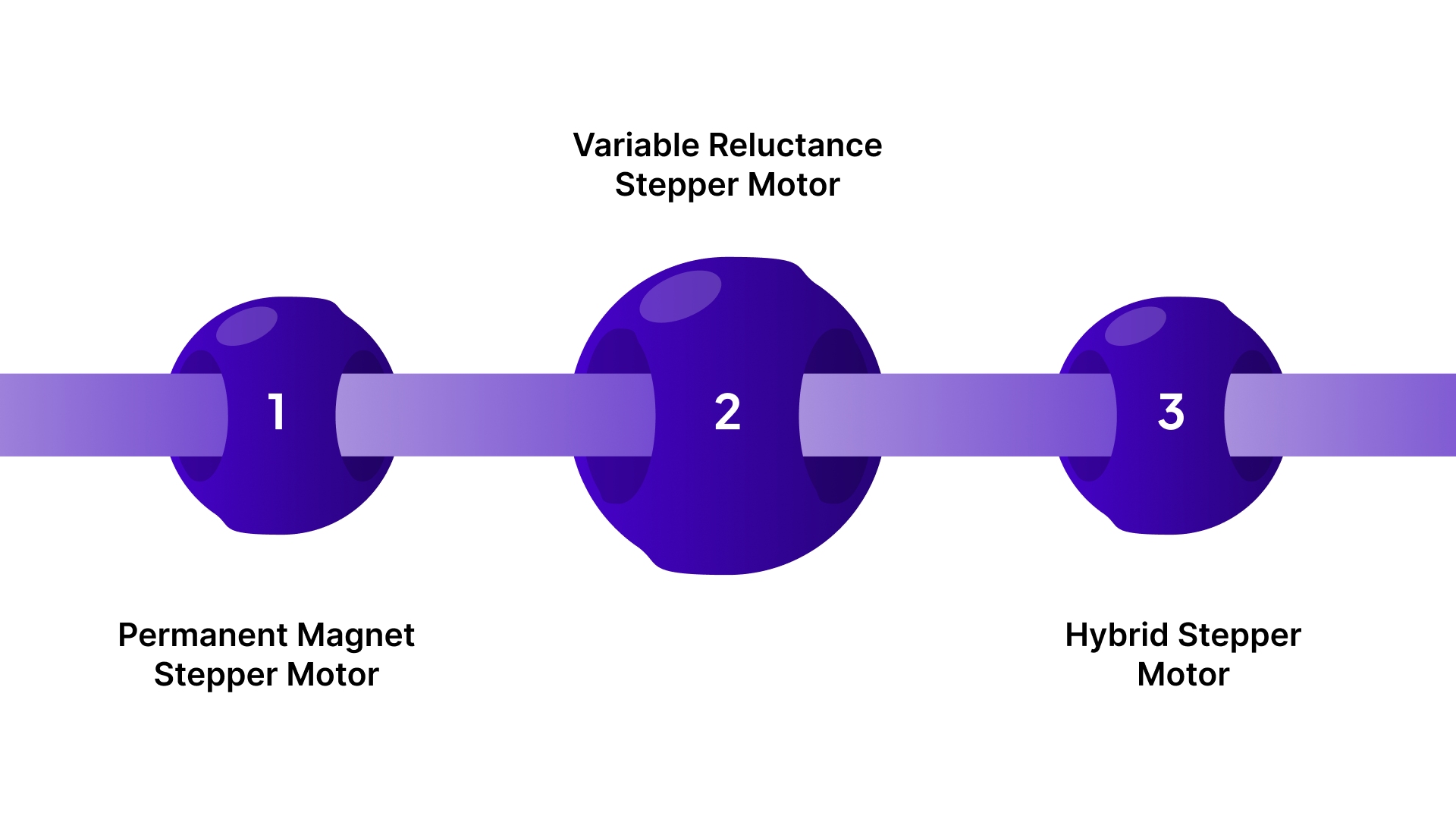
Stepper motors come in three main designs, each using different methods to create the magnetic fields that drive rotation. The type you choose affects holding torque, step resolution, and how the motor behaves when power cuts off.
Permanent Magnet Stepper Motor (PM Stepper)
These motors use a permanent magnet rotor that aligns with electromagnetic fields in the stator. The magnet provides inherent detent torque, meaning the rotor resists movement even without power applied.
What makes PM steppers distinct:
Lower step resolution compared to other types, typically larger step angles
Holding torque remains even when the motor isn't energized
Simpler construction keeps costs down
Works well for applications where you need the shaft to stay locked during power loss
Variable Reluctance Stepper Motor (VR Stepper)
VR steppers use a soft iron rotor with teeth that align with electromagnets in the stator. The rotor contains no magnets, relying entirely on the attraction between the energized stator poles and the iron teeth.
What makes VR steppers distinct:
No detent torque when unpowered, the shaft spins freely.
Higher step resolution possible due to the multi-toothed rotor design.
Lower torque output compared to permanent magnet designs.
A lighter rotor allows faster acceleration and deceleration.
Hybrid Stepper Motor (HB Stepper)
Hybrid steppers combine permanent magnets with toothed rotor geometry. They use an axially magnetized permanent magnet between two toothed rotor caps, merging the advantages of both PM and VR designs.
What makes hybrid steppers distinct:
Highest step resolution among all stepper types, often achieving fine positioning.
Strong holding torque from the permanent magnet component.
Better torque-to-size ratio makes them compact for high-performance applications.
Most common choice for precision motion control in CNC and robotics.
How Do Stepper Motors Work?
Stepper motors operate by energizing electromagnets arranged around a central rotor. When you send electrical pulses to the motor driver, it switches current through different coil combinations in sequence.
This creates rotating magnetic fields that pull the rotor from one position to the next.
The working principle breaks down to:
Multiple electromagnetic coils surround the rotor in a precise arrangement.
Each electrical pulse energizes specific coils according to a programmed sequence.
The energized coils create magnetic poles that attract the rotor's magnetic structure.
The rotor snaps to align with the active magnetic field, completing one step.
The next pulse shifts the magnetic field, pulling the rotor to the next position.
This sequential switching creates controlled rotation without brushes or commutators
Control and Stepping Modes
The way you energize the motor's phases determines the step size, smoothness, and torque output. Most stepper drivers let you switch between modes depending on what your application needs.
Full Step Mode
Two phases stay energized simultaneously, with the rotor positioned halfway between adjacent poles. This delivers maximum holding torque since both coils contribute to the magnetic field. You get the motor's native step angle with strong, decisive movements.
Half Step Mode
The controller alternates between energizing one phase and two phases. When one phase is active, the rotor aligns directly with that pole. When the two phases activate, it sits between them. This doubles your resolution and creates smoother motion, though peak torque drops slightly compared to full stepping.
Microstepping Mode
The driver applies varying current levels to both phases simultaneously, creating intermediate magnetic field positions. Instead of discrete jumps, the rotor moves through a continuous range of positions between full steps.
You gain much finer resolution and nearly eliminate vibration, making this ideal when surface finish or acoustic noise matters. The tradeoff is reduced holding torque at microstep positions.
Additional Control Methods
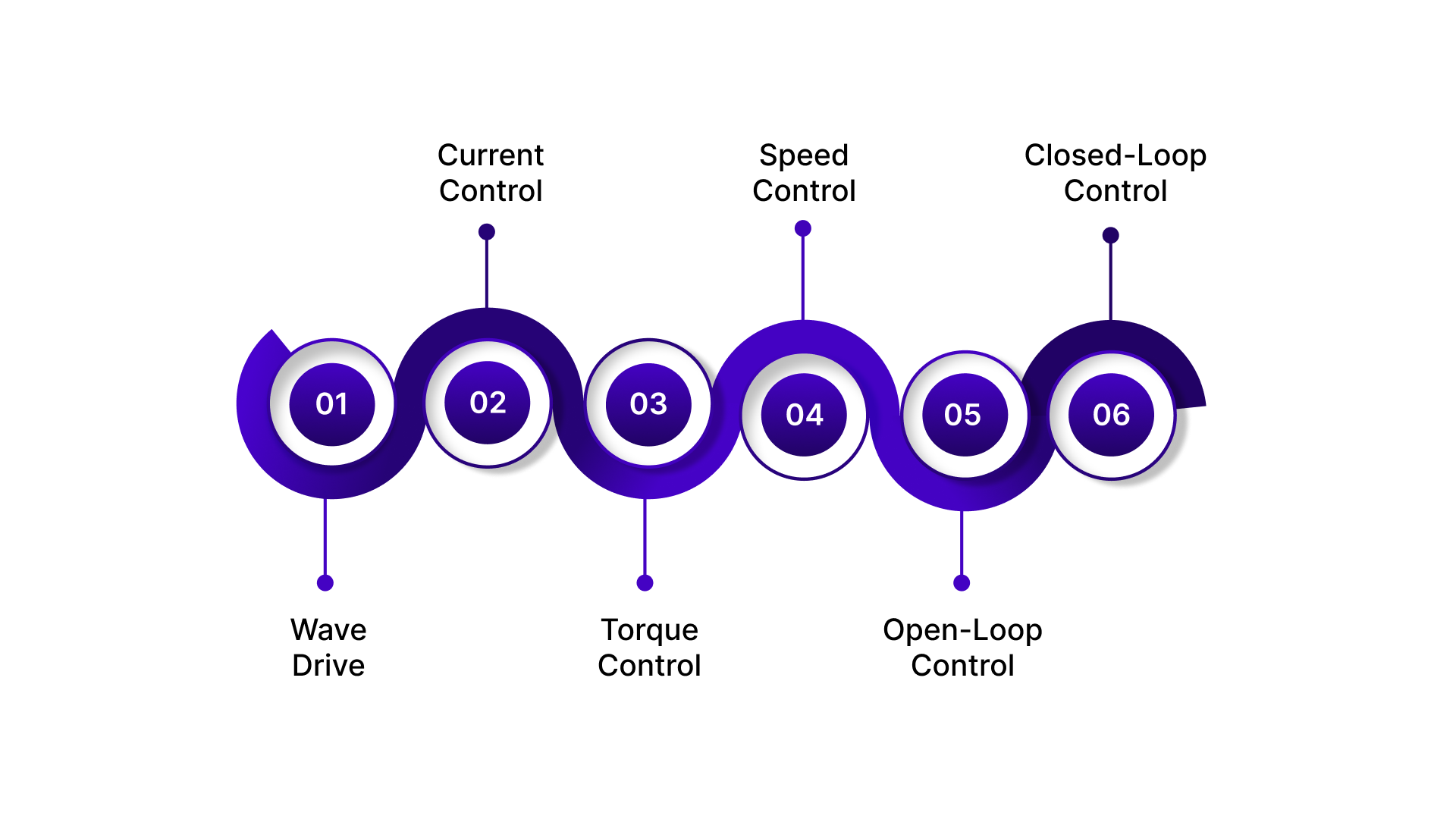
Wave Drive
Energizes one phase at a time, resulting in less torque than full step mode, but providing smoother motion with reduced power consumption, improving efficiency in some applications.
Current Control
Regulates the current through the coils to adjust the motor’s torque output, enhancing performance, preventing overheating, and improving motor longevity under varying loads.
Torque Control
Maintains a constant torque by adjusting the current to the coils, ensuring the motor consistently performs even when external forces or load conditions change.
Speed Control
Alters the pulse frequency to control the motor’s rotational speed, enabling fine-tuned adjustments for applications requiring variable speed or rapid response times.
Open-Loop Control
Operates without feedback systems, relying on the precision of the stepper motor's design. It's simpler and cost-effective for tasks that do not require high accuracy.
Closed-Loop Control
Incorporates feedback mechanisms, such as encoders, to continuously monitor and adjust the motor's performance, ensuring higher precision and correcting any errors in position automatically.
Dealing with motion inconsistencies? Pico Systems’ stepper controllers fix that by providing smoother, more consistent motion.
Our Universal Stepper Controller is a 4-axis solution for stepper and servo motors, offering smoother pulse generation and encoder feedback for real-time position monitoring.
It includes an E-stop controller, 15 opto-isolated inputs, and can be expanded with additional boards for more axes or spindle speed control.
Visit our shop now to find the right motion control solutions for your needs.
Industrial Applications of Stepper Motors
Stepper motors show up across industries where repeatable positioning matters more than high-speed continuous rotation.
Their ability to hold position without feedback and move in precise increments makes them the default choice for applications ranging from consumer electronics to heavy manufacturing.
Application | How Steppers Are Used | Key Advantage |
|---|---|---|
3D Printers | Control X, Y, and Z axes along with extruder feed rates | Precise layer positioning without drift over long print jobs |
CNC Machines | Drive table positioning and tool movement across multiple axes | Repeatable cuts and drilling operations with known coordinates |
Medical Devices | Position surgical instruments, imaging equipment, and fluid dispensing systems | Accurate dosing and movement in sterile environments |
ATMs | Control card readers, cash dispensing mechanisms, and receipt printers | Reliable paper handling and mechanical indexing |
Home Automation | Actuate smart blinds, camera gimbals, and HVAC dampers | Quiet operation with precise angle control |
Conveyor Systems | Index products to specific stations for assembly or inspection | Start-stop positioning without overshoot |
Cutting and Packaging | Position material feed for cutting blades and sealing mechanisms | Consistent cut lengths and package dimensions |
Industrial Robotics | Drive robotic joints and end effectors in pick-and-place systems | Cost-effective positioning for repetitive tasks |
Advantages of Stepper Motors
Stepper motors deliver benefits that make them practical for industrial integration. Their design eliminates common headaches found in other motor types while keeping system complexity manageable.
Open-loop positioning accuracy - You know shaft position by counting pulses sent to the driver, eliminating the need for encoders or resolvers in most applications.
Holding torque at standstill - The motor locks in position when stopped without requiring continuous power adjustments, keeping loads secure during idle periods.
Simplified control architecture - Drive electronics are straightforward compared to servo systems, reducing hardware costs and programming complexity for basic motion profiles.
Predictable response characteristics - Each pulse produces the same angular movement regardless of load variations within the motor's torque rating, making motion planning deterministic.
No brush maintenance - Brushless construction eliminates wear components that require periodic replacement, reducing downtime in continuous-duty applications.
Excellent low-speed torque - Full torque delivery at zero speed enables precise starts and stops without the speed-dependent torque curves of AC induction motors.
Limitations of Stepper Motors
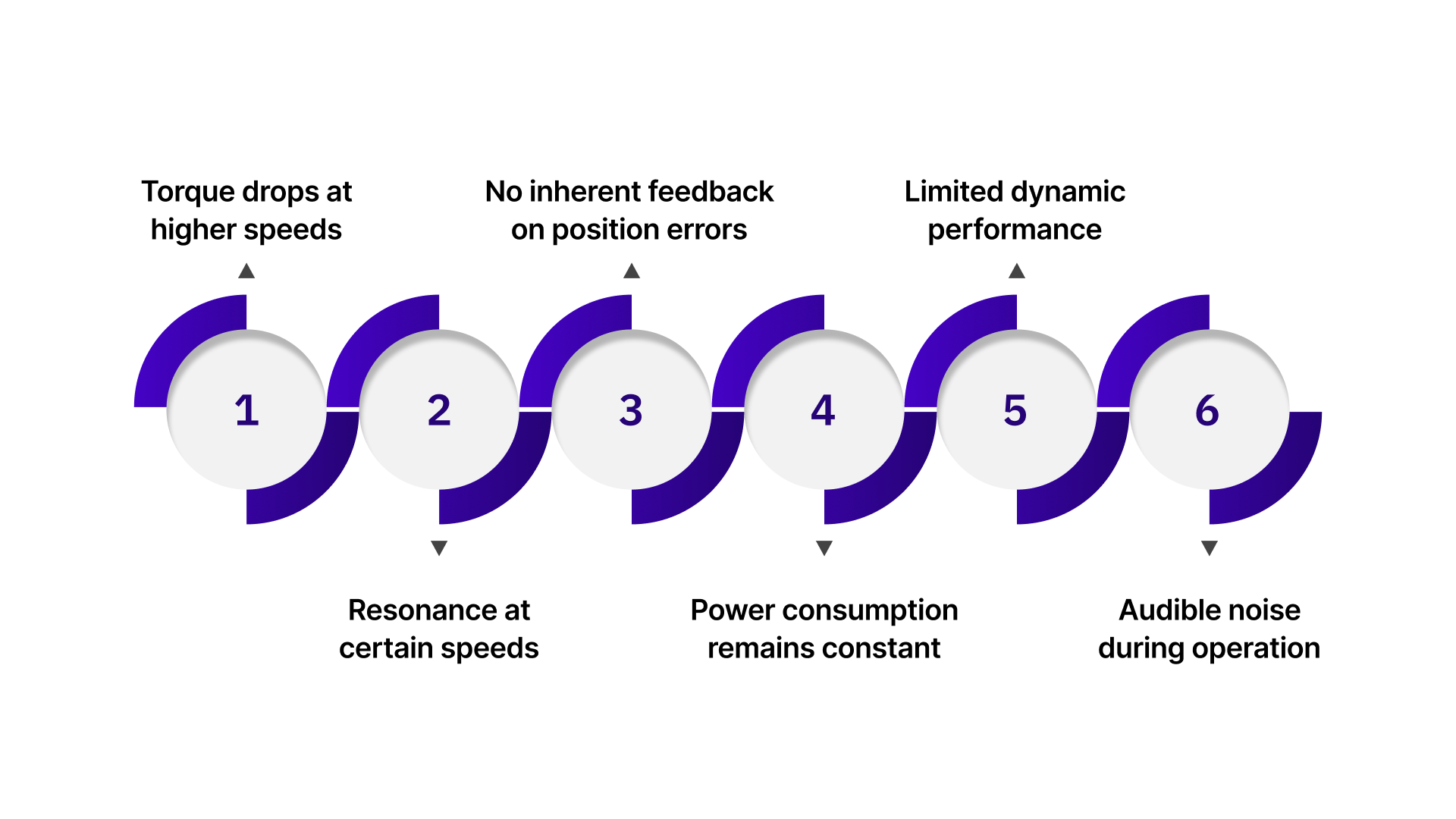
Despite their advantages, steppers have constraints that can affect performance in certain applications. Understanding these limitations helps you design around them or choose alternative motor types when appropriate.
Torque drops at higher speeds - As pulse rate increases, the motor has less time to reach full current in each phase, causing torque to fall off significantly at high RPM.
Resonance at certain speeds - The motor's natural mechanical frequency can cause vibration and positional instability at specific speed ranges, requiring damping or microstepping to mitigate.
No inherent feedback on position errors - Lost steps from excessive load or stalling go undetected in open-loop systems, potentially causing cumulative positioning errors over time.
Power consumption remains constant - Full current flows through the windings even at standstill to maintain holding torque, generating heat and consuming energy when the motor isn't moving.
Limited dynamic performance - Acceleration rates are constrained by rotor inertia and available torque, making steppers slower to respond than servo motors in high-speed point-to-point moves.
Audible noise during operation - The discrete stepping action produces characteristic humming or whining sounds, especially noticeable at lower speeds without microstepping.
Get the Most from Your Stepper Motors With Pico Systems
Even well-specified stepper motors underperform when paired with inadequate control electronics. Resonance issues go unmanaged. Thermal limits get exceeded. Lost steps accumulate during demanding moves.
Pico Systems builds motion controllers that address these exact challenges. Our Universal Stepper Controller handles up to four axes of stepper or servo motors, generating smoother step pulse trains than software-based solutions while supporting encoder feedback for position verification.
For systems using Gecko drives, our interface board adds encoder position reading directly to LinuxCNC, letting you maintain coordinate systems through E-stop cycles.
The system monitors drive faults, manages controlled stops with braking resistors, and keeps encoders powered during emergency stops so you never lose position data.
Whether you're retrofitting existing machines or designing new automation systems, Pico Systems controllers give you the hardware foundation to extract reliable performance from stepper motors.
Connect with us today to discuss which controller configuration fits your motion control requirements.
Frequently Asked Questions
What is a stepper motor used for?
Stepper motors control precise positioning in CNC machines, 3D printers, robotics, medical devices, and automation systems, where you need repeatable movement without continuous feedback sensors.
How does a stepper motor differ from a regular DC motor?
Regular DC motors spin continuously when powered. Stepper motors rotate in discrete angular steps, letting you control exact position by counting the electrical pulses you send to the driver.
Can stepper motors run at high speeds?
Stepper motors work best at low to moderate speeds. As speed increases, available torque drops off significantly, making servo motors a better choice for high-speed applications.
Do stepper motors need encoders?
Most stepper applications run open-loop without encoders. Adding an encoder creates a closed-loop system that detects and corrects lost steps, combining stepper simplicity with servo-like error correction.
Why do stepper motors vibrate at certain speeds?
The motor's mechanical resonance frequency causes vibration bands during operation. Microstepping, dampers, or adjusting acceleration profiles help eliminate these resonance issues in most applications.