Industrial automation demands precise, high-speed motion control to maintain efficiency, reduce defects, and support complex manufacturing workflows. Yet many systems still rely on legacy motor controllers that lack the responsiveness and accuracy required for modern CNC and robotics tasks, resulting in cycle time losses and inconsistent positioning.
The global servo motors and drives market, valued at over $20 billion in 2024 and projected to nearly double by 2034, reflects the industry’s shift toward advanced motion control solutions that deliver tighter regulation and higher throughput.
Servo drives directly address these challenges by regulating torque, speed, and position in real time, enabling deterministic motion profiles, seamless integration with automation controllers, and optimized system performance for precision applications.
In this blog, we’ll explore how industrial automation servo drives can solve the challenges of motion control inefficiency, improving system precision and throughput. You’ll learn how to select the right servo drive for your CNC and automation applications, ensuring optimal performance and seamless integration.
Key Takeaways
Servo Drive Components: A servo drive system includes servo motors, controllers, power stages, feedback systems (encoders), and power supplies, working together for precise motion control in industrial automation.
Types of Servo Drives: AC servo drives (including brushless motors) are preferred for high-precision tasks, while DC servo drives are used in simpler, lower-power applications.
Working Principle: Servo motors use closed-loop feedback to continuously adjust motor performance, ensuring precise motion control in applications like CNC machines and robotics.
Technical Benefits: Servo drives offer high dynamic response, energy efficiency, closed-loop control, and reduced vibration, improving throughput, precision, and equipment longevity.
Choosing the Right Servo Drive: Select the right servo drive by matching motor specifications, power/torque requirements, and feedback compatibility to ensure optimal performance for your automation needs.
What is a Servo Drive?
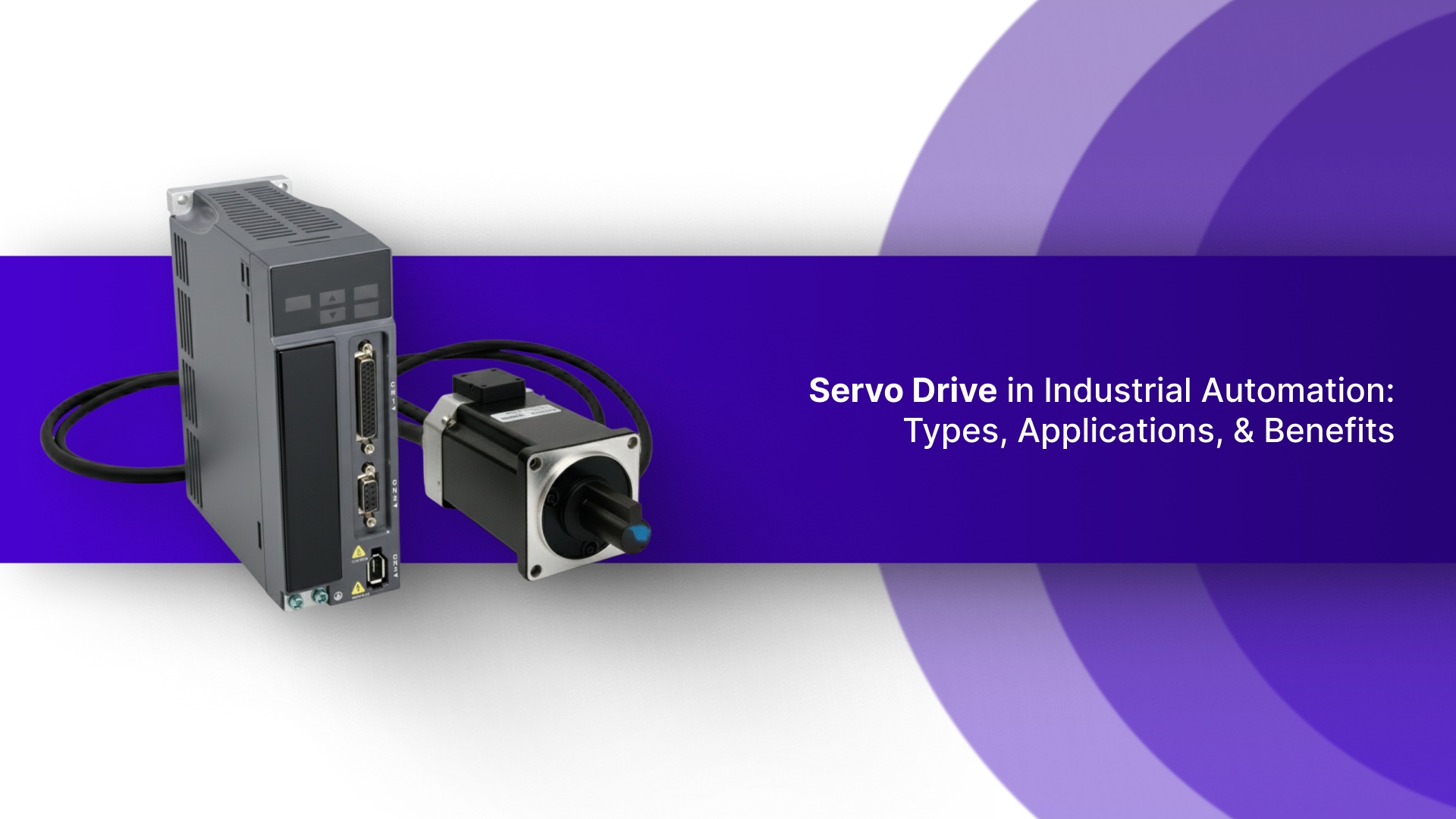
A servo drive is an essential component in industrial automation that controls the operation of a servo motor by regulating torque, speed, and position. It functions as a closed-loop system, providing precise control through feedback mechanisms like encoders, which allow for real-time adjustments.
Servo drives are commonly used in applications requiring high precision, such as CNC machines, robotics, and automated production lines.
Key Components of a Servo Drive System in Industrial Automation
A servo drive system in industrial automation consists of several components that work together to control servo motors with high precision. These include the controller, power stage, feedback system, and power supply, each playing a vital role in achieving precise, reliable motion control.
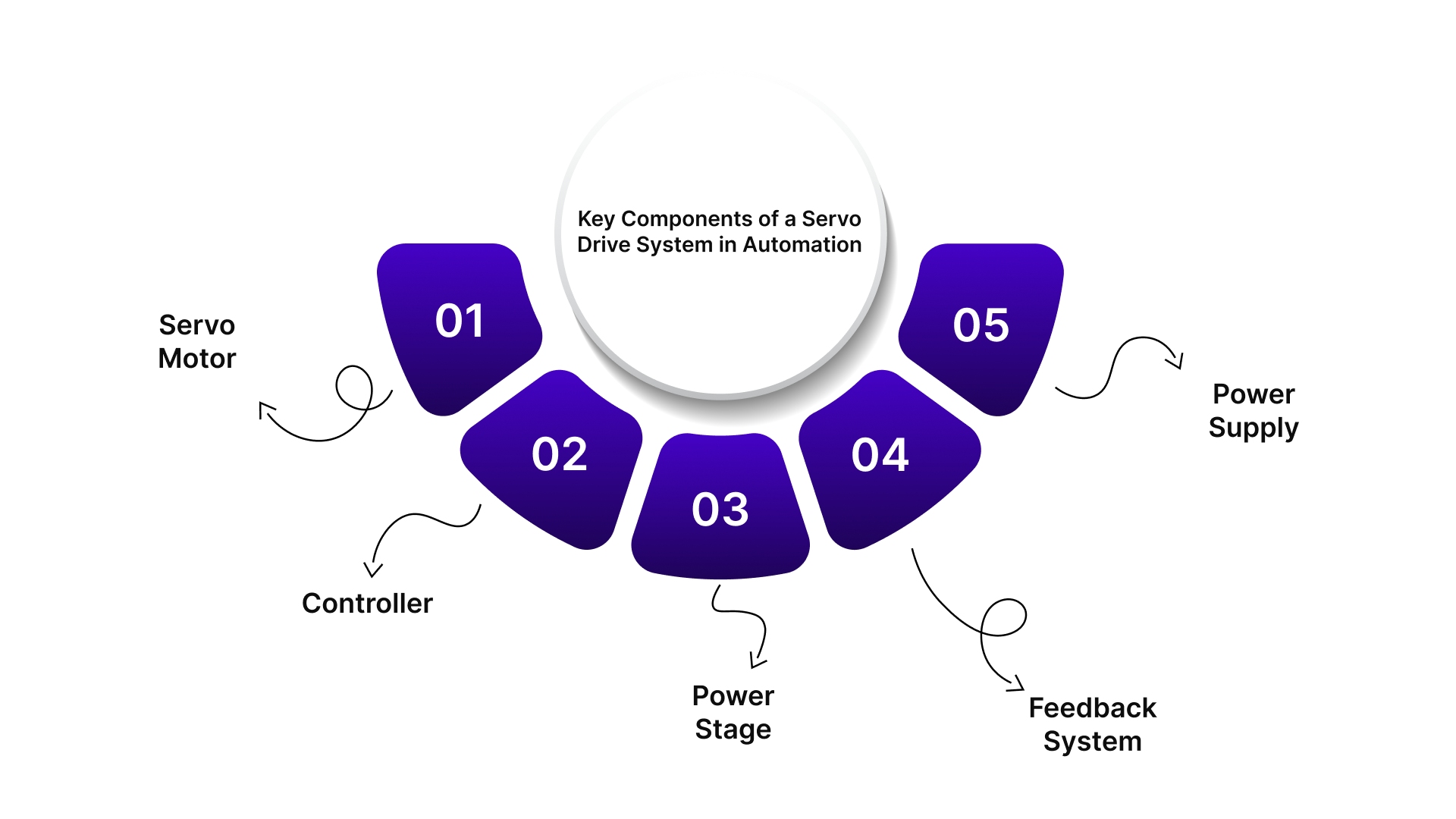
Servo Motor
The servo motor converts electrical energy into mechanical motion, enabling precise movement in applications that require accurate positioning and torque control. It is the core actuator in any servo system, responding to control signals from the controller.
Controller (Universal PWM Controller)
The Universal PWM Controller processes command signals and generates PWM signals that regulate motor speed, position, and torque. It acts as the brain of the system, converting digital input into precise motor actions.
Power Stage (PWM‑Input Servo Amplifier)
The PWM‑Input Servo Amplifier amplifies the PWM signal from the controller and provides the necessary power to the servo motor. It adjusts motor performance in real-time, ensuring optimal operation under varying loads.
Feedback System (Encoder/Commutation Signal Converters)
The Panasonic Encoder Converter monitors the motor’s behavior, providing feedback on position, speed, and torque. This data is sent back to the controller, allowing for precise adjustments and maintaining accuracy through closed-loop control.
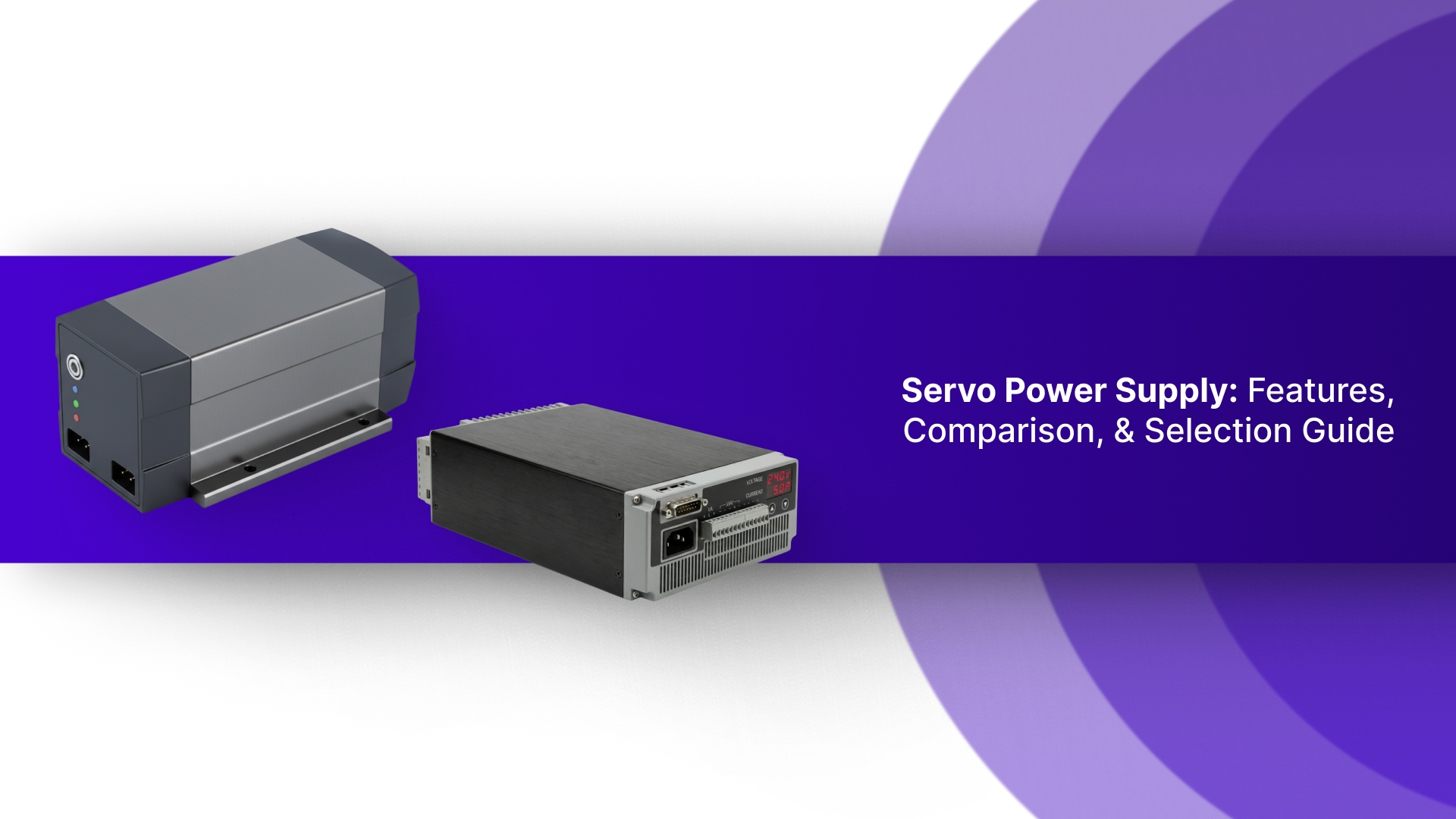
Power Supply (12‑V Power Supply & Triple Output Power Supply)
The 12‑V Power Supply and Triple Output Power Supply provide stable, regulated power to the motor, controller, and amplifier, ensuring consistent system performance and preventing power interruptions.
Types of Servo Drives in Industrial Automation
In industrial automation, servo drives are generally classified based on the power type and application scope they are designed for. The main categories are:
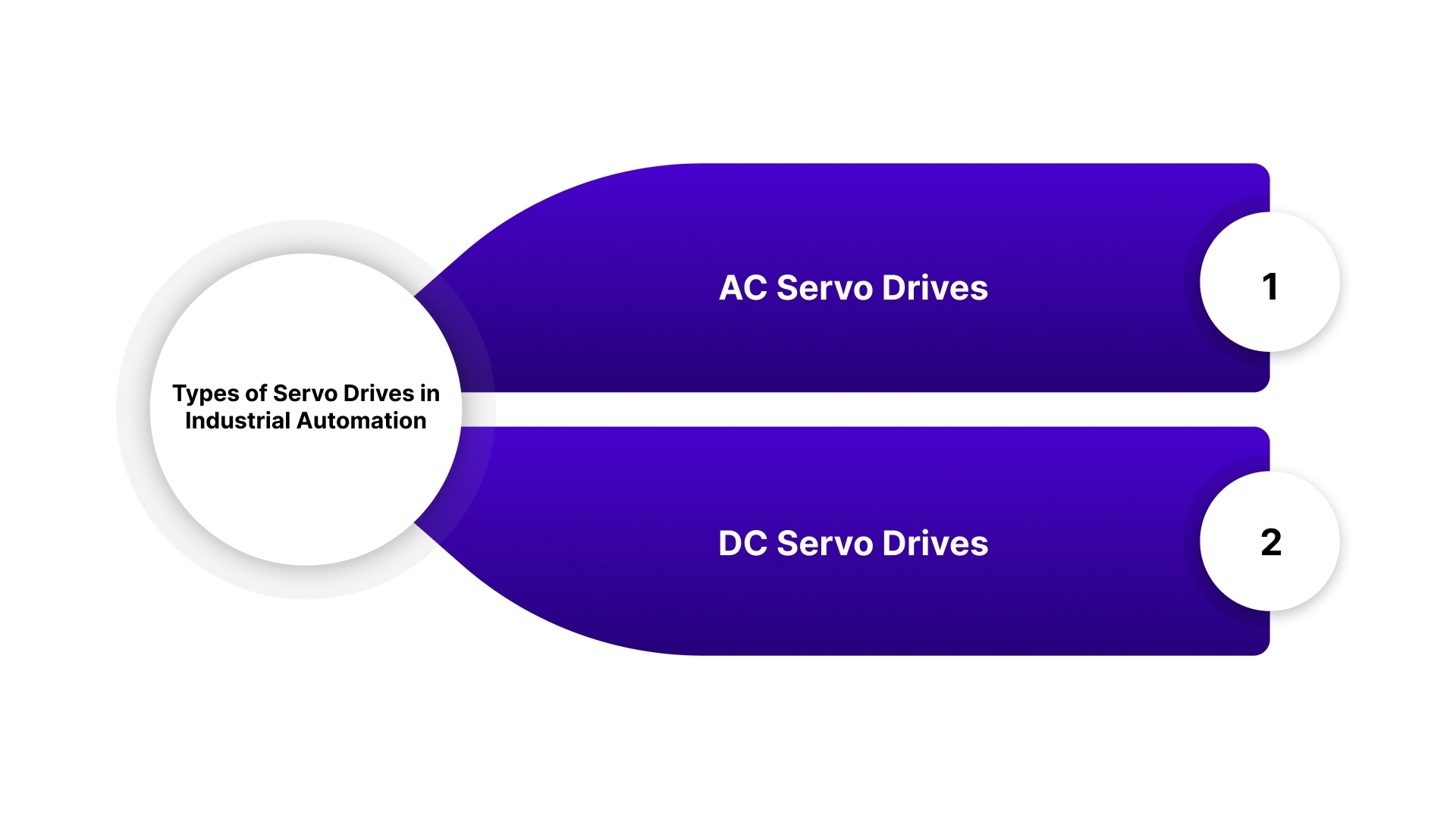
AC Servo Drives
AC servo motors are the preferred choice for industrial automation due to their high power efficiency, precision, and durability. These motors use three-phase AC power for operation, which provides smooth, continuous motion control.
A key subtype of AC servo motors is the brushless motor, which eliminates the need for brushes, offering longer lifespan and reduced maintenance.
Brushless AC servo motors like the Size 23 Brushless Servo Motor from Picosystems provide high torque and precise feedback control, making them ideal for CNC machines, robotics, and automated manufacturing systems where high performance and precision are critical.
These motors are often paired with servo drives that provide real-time control and feedback, enabling high-speed, high-precision applications in industrial automation.
DC Servo Drives
DC servo drives control DC motors, offering precise speed and torque control at lower speeds. These drives are simpler and more cost-effective compared to AC servo drives, but they require more maintenance due to their brushes and commutators.
Key Features:
Used for low-power systems.
Suitable for systems where constant speed or low to moderate torque is required.
Common in legacy applications or smaller-scale automation systems.
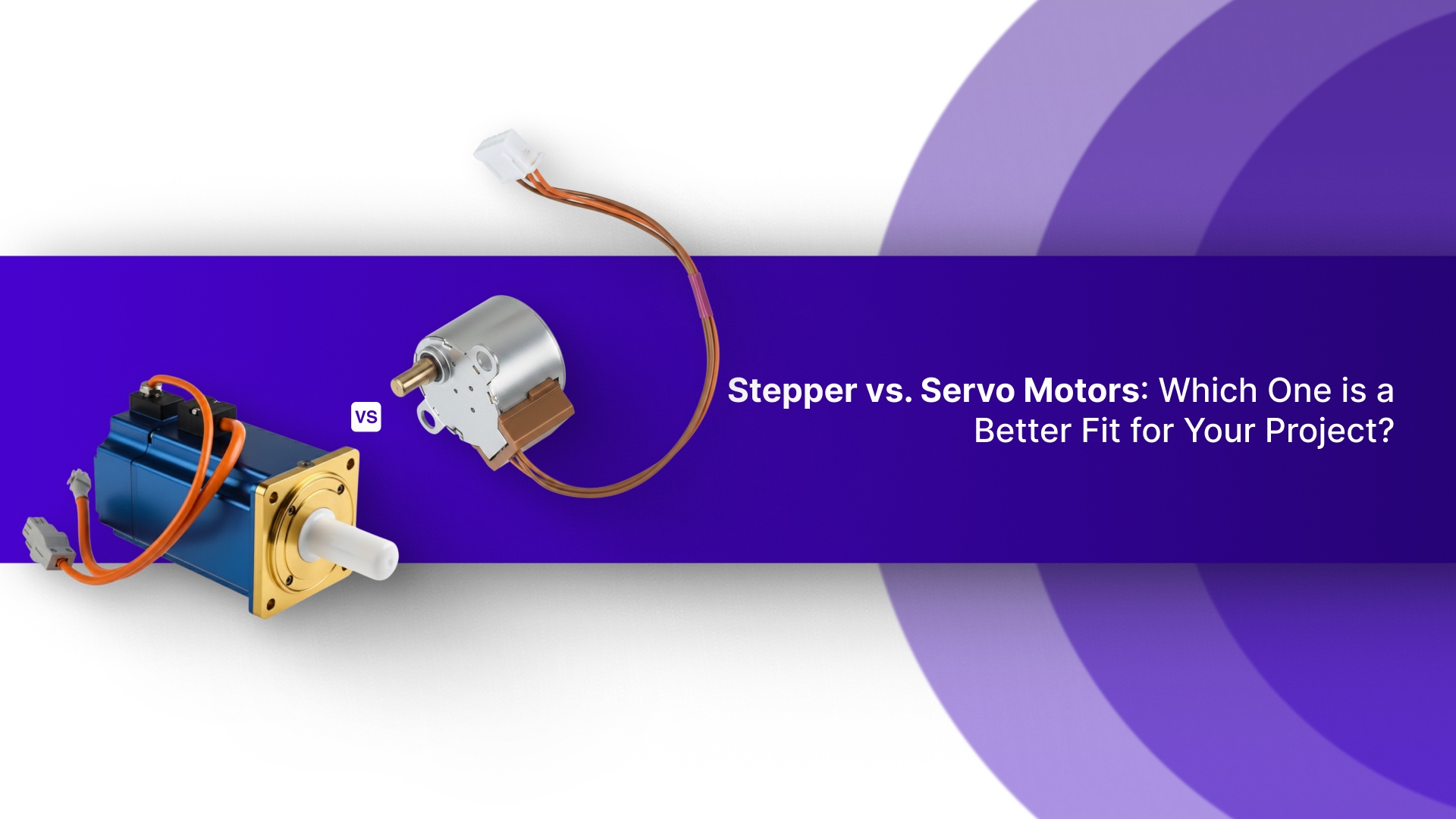
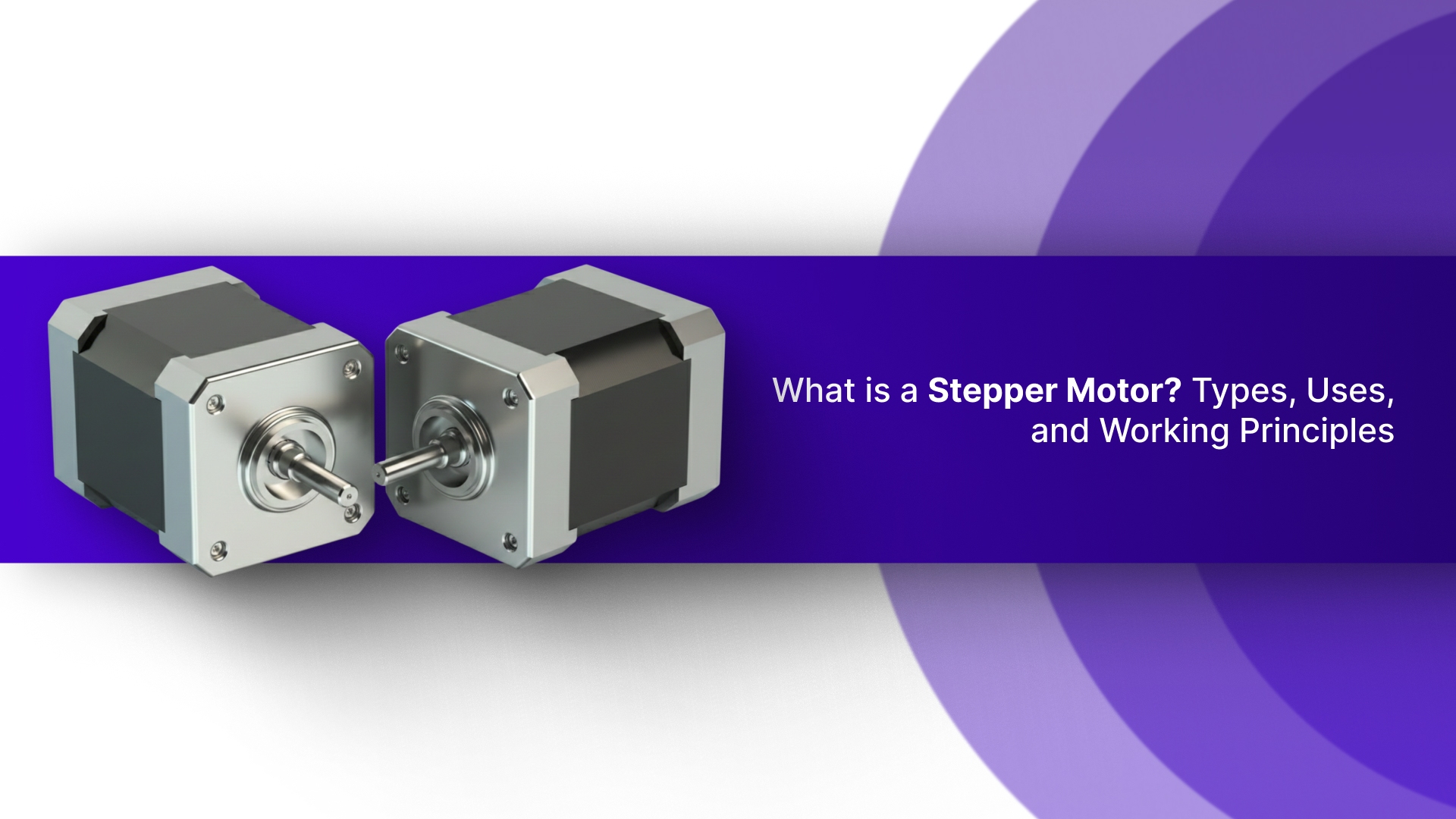
Note: While stepper motors are often confused with servo drives in industrial automation, they are not the same. Stepper motors operate in open-loop systems with discrete steps, lacking the feedback mechanism that defines servo systems.
The Working Principle of Servo Motors in Automation Systems
In industrial automation, a servo motor operates on the principle of closed‑loop feedback control, where real‑time data on position, speed, or torque is continuously compared against a commanded value to achieve precise motion.
The servo controller/drive receives the command, drives the motor, and uses feedback from sensors such as encoders to detect any deviation from the desired state, then adjusts the motor output accordingly.
This feedback loop allows the motor to accurately match the commanded position and speed, which is critical for high‑precision tasks in CNC machining, robotics, and automated production systems.
Key Technical Benefits of Servo Drives for Precision and in Industrial Automation
In industrial automation, choosing the right servo drive delivers measurable improvements in precision, throughput, reliability, and system efficiency. If you are working with CNC machines, robotics, and motion control systems, understanding the core technical benefits helps in specifying and validating drive systems.
Closed‑loop precision control: Real‑time feedback (from encoders) ensures accurate position, speed, and torque regulation for repeatable motion.
High dynamic response: Rapid corrections to error enable smooth starts/stops and fast changes in motion profiles.
Improved throughput: Tighter motion control reduces cycle times and improves machining or robotic task rates.
Energy efficiency: Servo systems optimize power delivery based on load, reducing wasted energy.
Reduced vibration and noise: Controlled motor behavior minimizes mechanical stress and operational noise.
Torque at low speeds: Maintains consistent torque even at slow motion, critical for precision tasks.
Scalability with automation controls: Supports advanced motion protocols and integration with PLC/industrial networks.
How to Choose the Right Servo Drive for Your Application
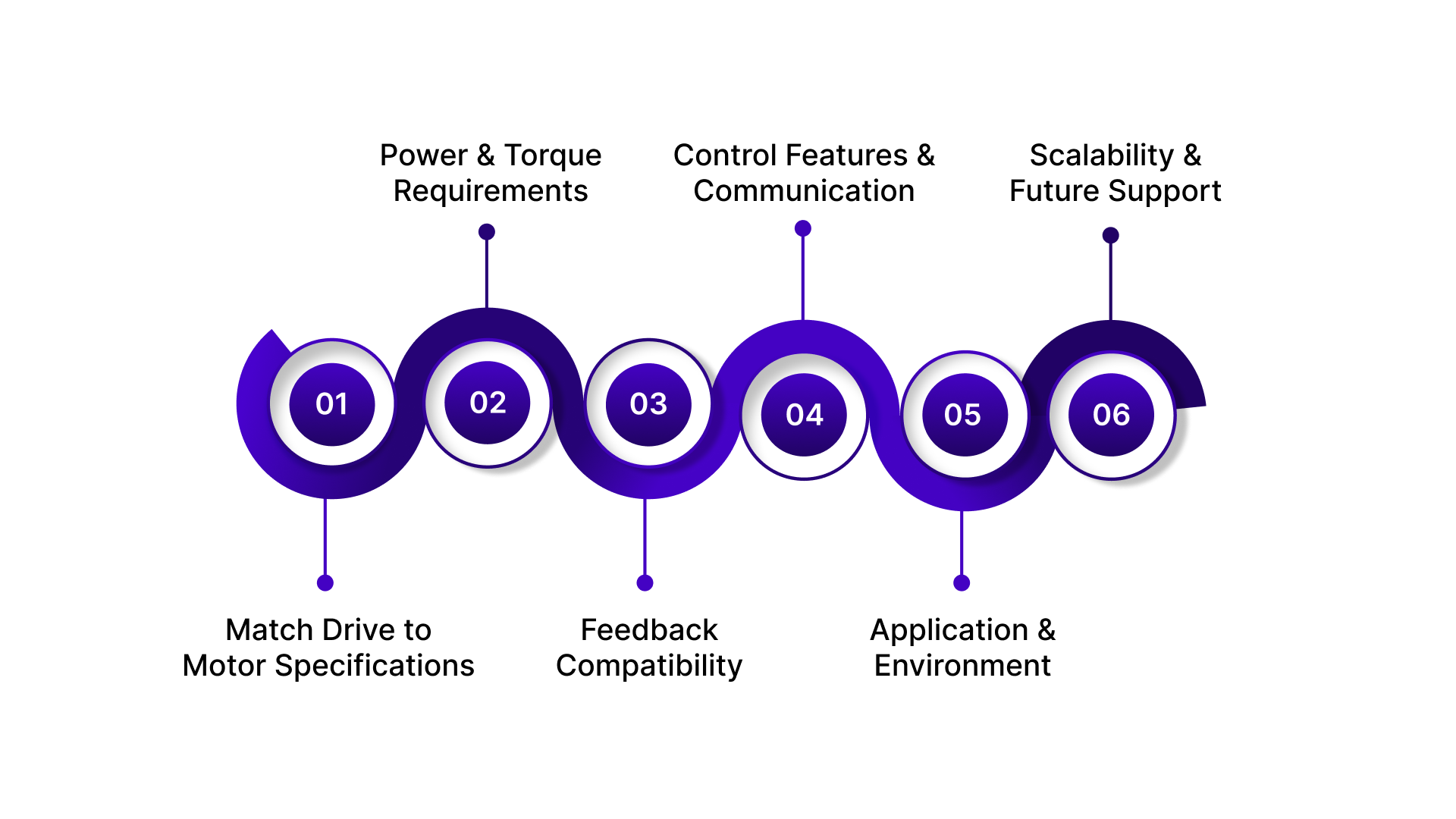
Choosing the correct servo drive not only matches the servo motor’s specifications but also supports the application’s dynamic requirements and system architecture, reducing the risk of system failure and motor wear.
Match Drive to Motor Specifications: Ensure the servo drive’s voltage, current, and power ratings align with the servo motor’s nominal and peak ratings. A mismatch can lead to overload faults or inefficient performance.
Power & Torque Requirements: Define the required torque and speed for your application based on load inertia and motion profile. The drive should be capable of delivering sufficient power for both continuous and peak demands.
Feedback Compatibility: The drive must support the encoder or resolver feedback system used by the motor (incremental, absolute, etc.) to maintain closed‑loop control and high positional accuracy.
Control Features & Communication: Select drives that support required communication protocols (EtherCAT, CANopen, Modbus, etc.) and have the control features necessary for your automation environment.
Application & Environment: Consider the operating environment (temperature, vibration, dust), as well as machine dynamics and motion profiles, to choose a drive with appropriate thermal capacity and robustness.
Scalability & Future Support: Opt for a drive platform that allows expansion or tuning as system requirements evolve, including support for advanced motion profiles or additional axes.
Common Use Cases of Servo Drives in Industrial Automation
These use cases highlight how servo drives are deployed to deliver precise motion, synchronized multi‑axis control, and repeatable accuracy across a wide range of industrial automation tasks. They are especially relevant for CNC machining, robotic systems, packaging, material handling, and automated quality inspection.
CNC Machining and Metalworking
Robotic Arms and Automated Manipulators
Conveyor and Material Handling Systems
Automated Packaging Equipment
Automated Guided Vehicles (AGVs)
Precision Inspection and Quality Control Systems
Textile and Fabric Machinery
Printing and Labeling Machines
Conclusion
Servo drives are essential components in industrial automation, providing precise control over motor speed, position, and torque. By integrating feedback systems like encoders, servo drives enable high-performance applications such as CNC machining, robotics, and automated packaging.
Choosing the right servo drive is crucial for optimizing system efficiency, precision, and throughput. The benefits of servo drives, including closed-loop control, energy efficiency, and high dynamic response, are key to improving productivity and reducing maintenance.
Pico Systems specializes in high-precision motion control solutions, offering servo drives, PWM controllers, amplifiers, and related components that power CNC machines, robotic systems, and complex automation processes.
Contact us for professional products today to enhance your automation systems with Pico Systems' advanced solutions.
FAQs
Is the servo AC or DC?
Servo motors can be either AC or DC. AC servo motors are commonly used in industrial automation due to their higher efficiency and precision, while DC servo motors are used in smaller, lower-power applications.
What is the difference between a servo drive and a VFD?
A servo drive controls the position, speed, and torque of a motor with high precision, typically using a feedback system. In contrast, a VFD (Variable Frequency Drive) controls the speed of an AC motor, but without the high precision and feedback systems found in servo drives.
What are the two types of Servo Motors?
The two main types of servo motors are AC servo motors (commonly used for high performance) and DC servo motors (used for simpler applications and lower speeds).
What is the lifespan of a servo drive?
The lifespan of a servo drive typically ranges from 10 to 15 years, depending on factors like usage, environment, and maintenance. Proper cooling and regular maintenance can extend its service life.
What is the voltage of a servo motor?
The voltage of a servo motor typically ranges from 12V to 400V or more, depending on the motor type. AC servo motors often use higher voltages, while DC servo motors typically operate at lower voltages.