In high‑precision CNC and automation environments, unstable or undersized power to servo systems directly undermines motion accuracy, torque stability, and throughput. As production lines tighten tolerances and cycle times shrink, even minor power irregularities can lead to servo hunting, thermal stress on drives, and unplanned downtime, eroding uptime and part quality.
The industrial automation market is expanding rapidly, with global revenues projected to grow from roughly $198 billion in 2024 to over $280 billion by 2029, driven by robotics and motion‑control integration in manufacturing systems.
This growth highlights the critical role of reliable servo infrastructure, yet many engineers still overlook the engineered design and specification of the servo power supply that feeds their drives and motors.
In this article, we analyze why the right servo power supply matters, how it influences control performance and reliability, and what specifications US manufacturers should prioritize to eliminate power‑related performance bottlenecks.
Key Takeaways
Key Features: Servo power supplies manage peak current demands, regenerative energy (back EMF), and ensure stable voltage during dynamic load changes, vital for precise motion control.
Two Major Functional Tasks: They provide stable DC bus voltage to servo drives and absorb regenerated energy from the motor to maintain system stability.
Technical Requirements: A servo power supply must handle high peak current, voltage regulation, regenerative energy, and inrush current protection to ensure reliable performance.
Linear vs. Switching Power Supply: Linear supplies are stable but inefficient, ideal for low-power, low-noise applications, while SMPS are more efficient, compact, and suited for high-power systems.
Selecting the Right Power Supply: Focus on voltage/current ratings, regen capacity, inrush protection, and environmental durability to match system needs.
What Is a Servo Power Supply?
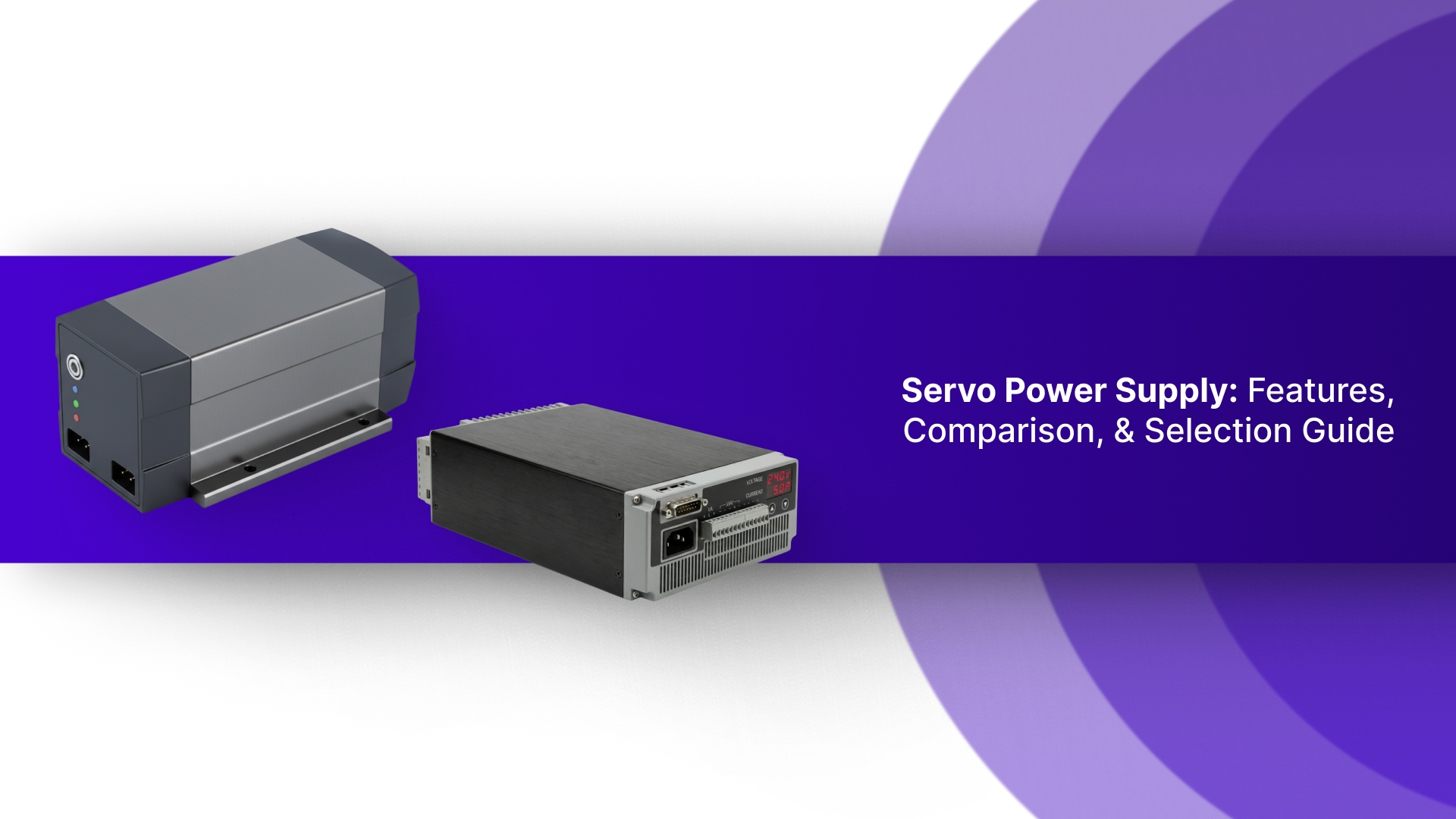
A servo power supply is a specialized electrical unit that provides the required voltage and current to power servo motors in automated systems. Unlike general-purpose power supplies, servo power supplies are designed to meet the precise demands of servo motors for smooth and accurate motion control.
Servo power supplies work by delivering a stable and regulated power source that allows servo motors to maintain consistent torque, speed, and position control.
Key Features that Make Servo Power Supplies Essential for Automation
Servo power supplies are designed to meet the demanding requirements of servo motors in automation, CNC, and robotics systems. Here are three key areas where they outperform general-purpose power supplies, making them critical for high-performance motion control applications:
Peak Current Demands: Servo motors require massive bursts of current to accelerate a load from a standstill. Unlike standard power supplies, servo power supplies are built to handle peak currents, often 200–300% of their continuous rating, for short durations
Regenerative Energy (Back EMF): When a servo motor slows down or stops a heavy load, it can act as a generator, pushing electricity back into the power supply. A standard power supply might shut down or blow a fuse under this condition. However, a servo power supply is designed to handle this surge of energy, using components like large capacitors or braking resistors to absorb and dissipate the excess energy safely.
Dynamic Load Response: In systems like CNC machines and robotics, the load on the motor changes constantly, often in milliseconds. Servo power supplies have fast recovery times, meaning they can maintain a stable voltage even when the motor’s demand spikes or dips.
What Are the 2 Major Functional Tasks of a Servo Power Supply?
A servo power supply in industrial motion systems performs two core functional tasks that are essential for the reliable and precise operation of servo drives and motors. These functions go beyond what standard power supplies deliver and are key to handling the dynamic electrical demands of motion control systems.
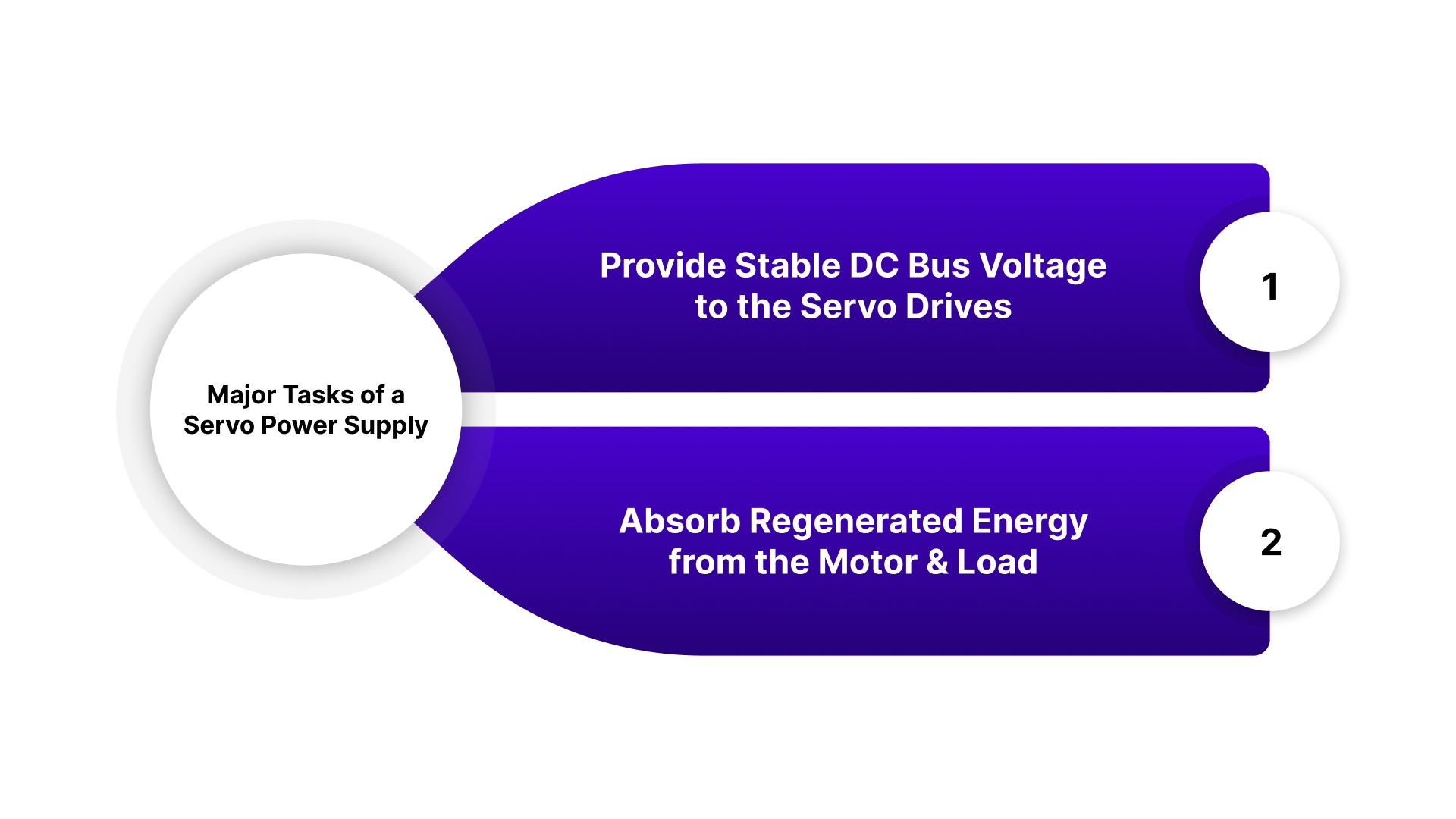
Provide Stable DC Bus Voltage to the Servo Drives
The primary task of a servo power supply is to convert incoming AC power into a controlled DC bus voltage that feeds the servo drives. This DC bus is the energy source that the servo drives use to power servo motors. It must deliver sufficient power to meet both normal and momentary peak loads without unacceptable voltage drops.
Industrial servo systems often draw high currents rapidly to accelerate or reposition loads, and the power supply must be designed to meet these transient demands while maintaining voltage within acceptable limits.
Absorb Regenerated Energy from the Motor and Load
Unlike general power supplies, a servo power supply must also manage bi‑directional energy flow. During braking or deceleration of a servo motor, the motor can act as a generator, feeding energy back into the DC bus. This energy must be absorbed or safely dissipated to prevent overvoltage conditions or damage to components.
Servo power supplies accomplish this through design features such as energy reservoirs, shunt regulators, or braking resistors, allowing them to handle regenerative energy and maintain system stability.
Technical Requirements of Servo Power Supply in Motion Control Systems
Servo power supplies are crucial in maintaining precise and efficient motion control in automation and CNC systems. They must meet specific electrical demands that standard power supplies cannot handle. Here’s a breakdown of the key technical requirements:
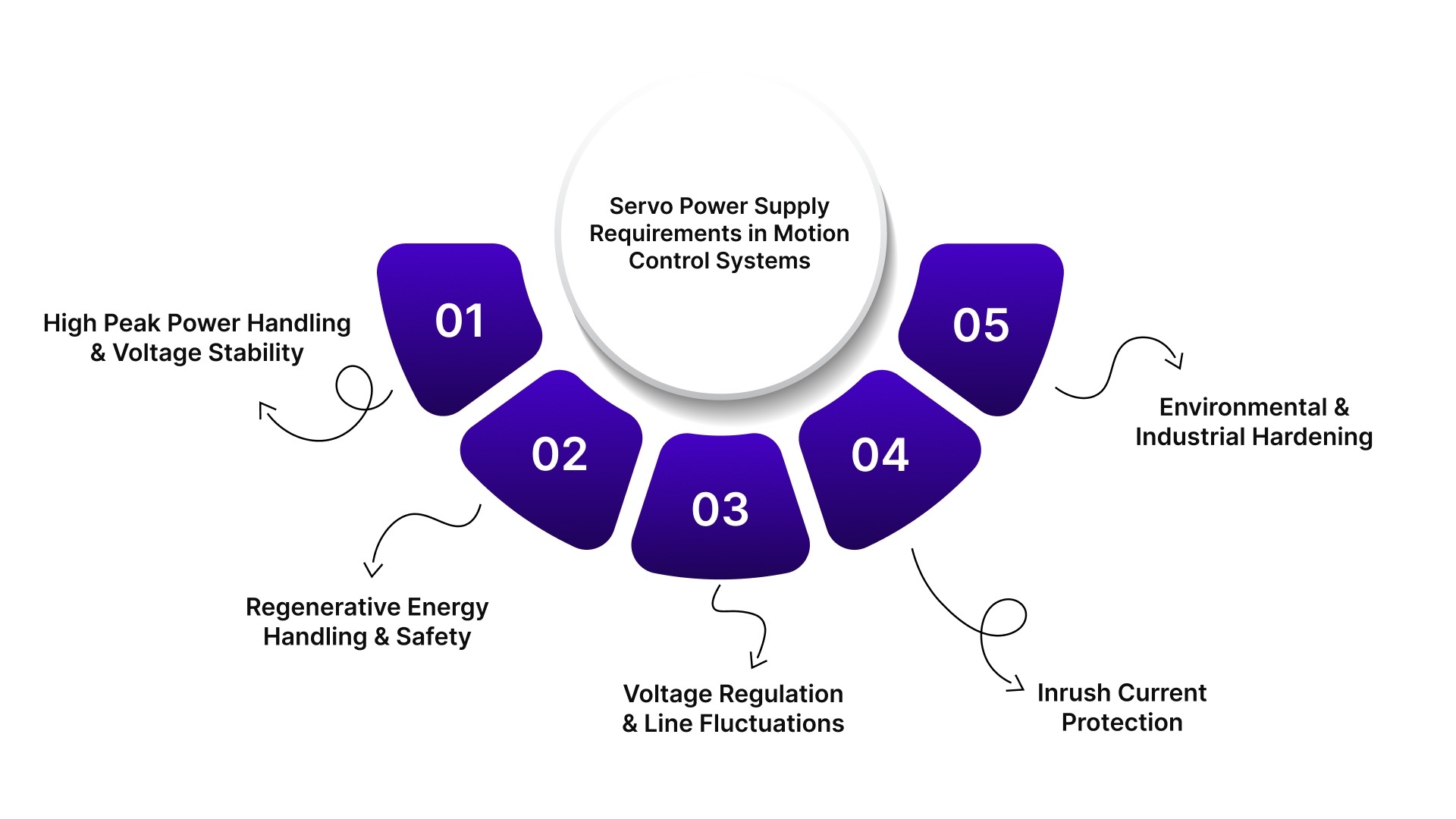
High Peak Power Handling & Voltage Stability
Servo motors require bursts of high current during acceleration and deceleration. A servo power supply must provide peak current, often 200–300% of its continuous rating, for short durations without dropping voltage. This stability is critical for maintaining accurate torque and speed during high-load movements, preventing position errors or stalling.
Regenerative Energy Handling & Safety
When a servo motor decelerates or stops, it acts as a generator, sending electrical energy back into the system. Servo power supplies must absorb this regenerative energy using capacitors or braking resistors, which dissipate the energy safely. Without proper handling, voltage spikes could damage the system, causing failures.
Voltage Regulation & Line Fluctuations
Stable voltage is crucial for precise position and speed control in servo systems. Any voltage fluctuation can lead to torque ripple and loss of motion precision, particularly in CNC applications. Servo power supplies are designed to maintain voltage stability despite fluctuations from external sources or load changes, ensuring smooth motion.
Inrush Current Protection
When the servo system starts, inrush current can be several times higher than the operating current. Inrush current protection circuits are built into servo power supplies to limit the surge, preventing tripping breakers or blowing fuses during startup, which is essential for continuous system operation.
Environmental & Industrial Hardening
Servo power supplies must withstand electromagnetic interference (EMI), vibrations, and temperature extremes in industrial settings. EMI filtering prevents electrical noise from affecting other systems, while power supplies with vibration resistance and temperature tolerance are essential for stable operation in harsh environments.
Comparison of Servo Power Supply Types: Linear (Unregulated) vs. Switching (SMPS)
Understanding the differences between linear and switching power supplies helps provide optimal performance and efficiency in motion control systems. Both power supply types have distinct advantages and trade-offs that directly impact voltage regulation, efficiency, and reliability.
This comparison clarifies which type is better suited for specific applications in servo-driven systems.
Feature | Linear Power Supply (Unregulated) | Switching Power Supply (SMPS) |
Voltage Regulation | Provides steady output but poor regulation under varying loads | Provides excellent regulation across load ranges |
Efficiency | Low efficiency (typically 50–60%), significant heat dissipation | High efficiency (80–90%), minimal heat output |
Size and Weight | Bulkier, heavier due to large transformers | Compact and lightweight, due to high-frequency switching |
Heat Generation | High heat generation requires heatsinks and cooling | Generates less heat, more energy-efficient design |
Cost | Generally cheaper for low-power applications | Higher initial cost, but cost-effective in the long run |
Complexity | Simple design; no switching components | More complex with switching circuits and filters |
Noise and Ripple | Minimal ripple or noise (better for sensitive applications) | Higher ripple and EMI, which may affect precision systems unless properly filtered |
Load Response Time | Slower response to load changes | Faster response to load changes, better for dynamic applications |
Application Suitability | Best for low-power, low-noise applications | Ideal for high-power, energy-efficient systems |
Selection Guide for Servo Power Supplies
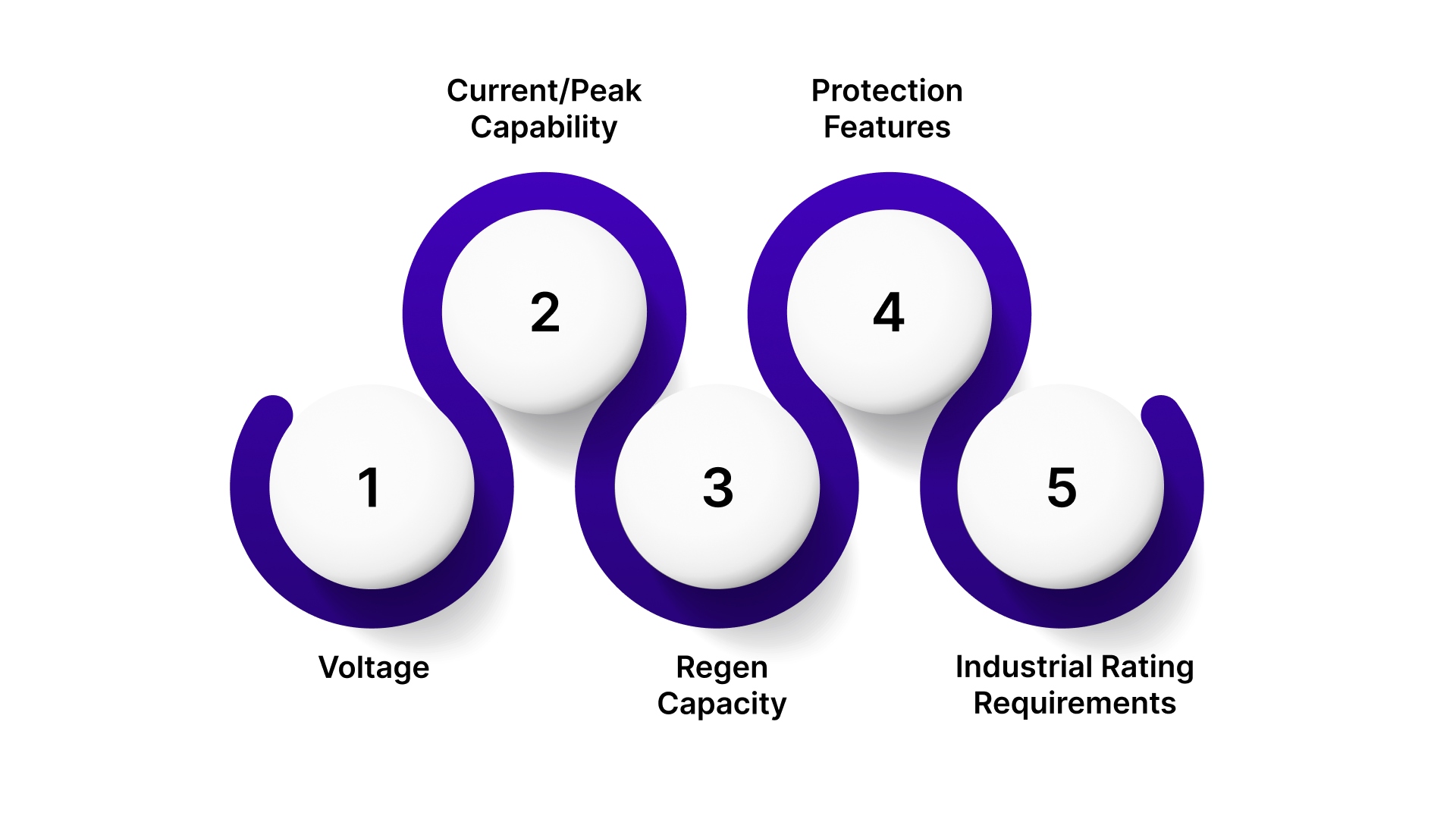
Selecting the right servo power supply is essential for optimal performance in CNC and automation systems. Here's a streamlined step-by-step checklist to help engineers make the right choice:
Voltage
Match the required DC bus voltage for the servo motor, typically 24V, 48V, or 72V DC.
Ensure tight voltage regulation to avoid fluctuations that could affect system accuracy, especially in precision applications like CNC.
Current/Peak Capability
Continuous current: Ensure the power supply meets the average current demand for normal operation.
Peak current: Verify the power supply can handle burst current (200-300% of continuous current) for short durations during acceleration or heavy loads.
Regen Capacity
Regenerative energy handling: Choose a power supply capable of safely absorbing or dissipating back energy generated during deceleration, using braking resistors or capacitors to avoid voltage spikes.
Protection Features
Overcurrent and overvoltage protection: Safeguard the system from short circuits and excess voltage.
Thermal shutdown: Protects against overheating.
Surge and inrush current protection: Reduces damage during startup.
Industrial Rating Requirements
Environmental protection: Ensure appropriate IP rating for dust and moisture resistance.
Vibration resistance: Suitable for high-vibration environments.
Temperature tolerance: Check that the power supply can operate within the required temperature range.
EMI/RFI filtering: Reduces interference from external sources, ensuring stable operation.
PicoSystems: Motion Control Solutions That Complement Your Servo Power Supply Needs
PicoSystems operates an online store offering motion control hardware used in precision machine control applications, particularly with systems like LinuxCNC. The product lineup focuses on electronic interfaces and modules that help control motors, read position feedback, and connect hardware components in motion control systems.
PWM Servo Amplifiers: Digital and brushless PWM servo amplifiers capable of driving motors with PWM inputs from controllers. These amplifiers interface directly with servo motor drives, making them a critical part of motion systems.
Controllers and Interfaces – Universal stepper controllers that provide motion signal generation, encoder counting, and digital I/O for multi‑axis systems. These boards serve as the control interface between a host controller (e.g., LinuxCNC) and the motor drivers.
Power Modules – PicoSystems offers supporting modules like 12 V switching power supplies designed to power control electronics and associated boards, which illustrates they do include supporting power products for control subsystems.
Auxiliary Components – Smaller interface products such as spindle DACs or encoder converters extend system I/O and signal conversion capabilities, which are frequently part of motion control architectures.
Conclusion
In CNC and automation systems, the servo power supply plays a crucial role in ensuring precise motion control and system reliability. With its ability to handle peak current demands, regenerative energy, and voltage stability, the servo power supply ensures smooth operation even under high-performance conditions.
By considering factors such as voltage regulation, efficiency, and environmental hardening, engineers can select the right power supply to avoid performance bottlenecks and maximize uptime.
For motion control systems that require reliable and efficient servo power, PicoSystems offers a range of motion control hardware, like PWM servo amplifiers, controllers, and power modules that integrate seamlessly with your servo systems.
Contact us for professional products today to optimize your automation solutions.
FAQs
How to supply power to a servo?
Servo motors require a stable DC power supply that matches their voltage and current ratings. The power supply should handle peak current demands during acceleration and deceleration for reliable performance.
Can a servo motor run on 3.3 V?
Most servo motors require higher voltages, typically 5V to 24V DC, depending on their type. A 3.3V supply may not provide enough power for proper operation, especially for motors with higher torque demands.
Can a DC motor be used as a servo?
A DC motor can be used as a servo if it is paired with a suitable feedback system, like an encoder, and controlled with a servo drive that can regulate its position, speed, and torque.
How do you test a servo with a multimeter?
To test a servo with a multimeter, check the resistance of the motor windings for continuity, ensuring no short circuits. You can also measure the supply voltage and check for consistent output at the servo's control pins during operation.
Are servo motors 3-phase?
Some servo motors are 3-phase, typically in industrial applications where high power and efficiency are required. These motors use three separate AC power lines, providing more torque and smoother operation compared to single-phase motors.