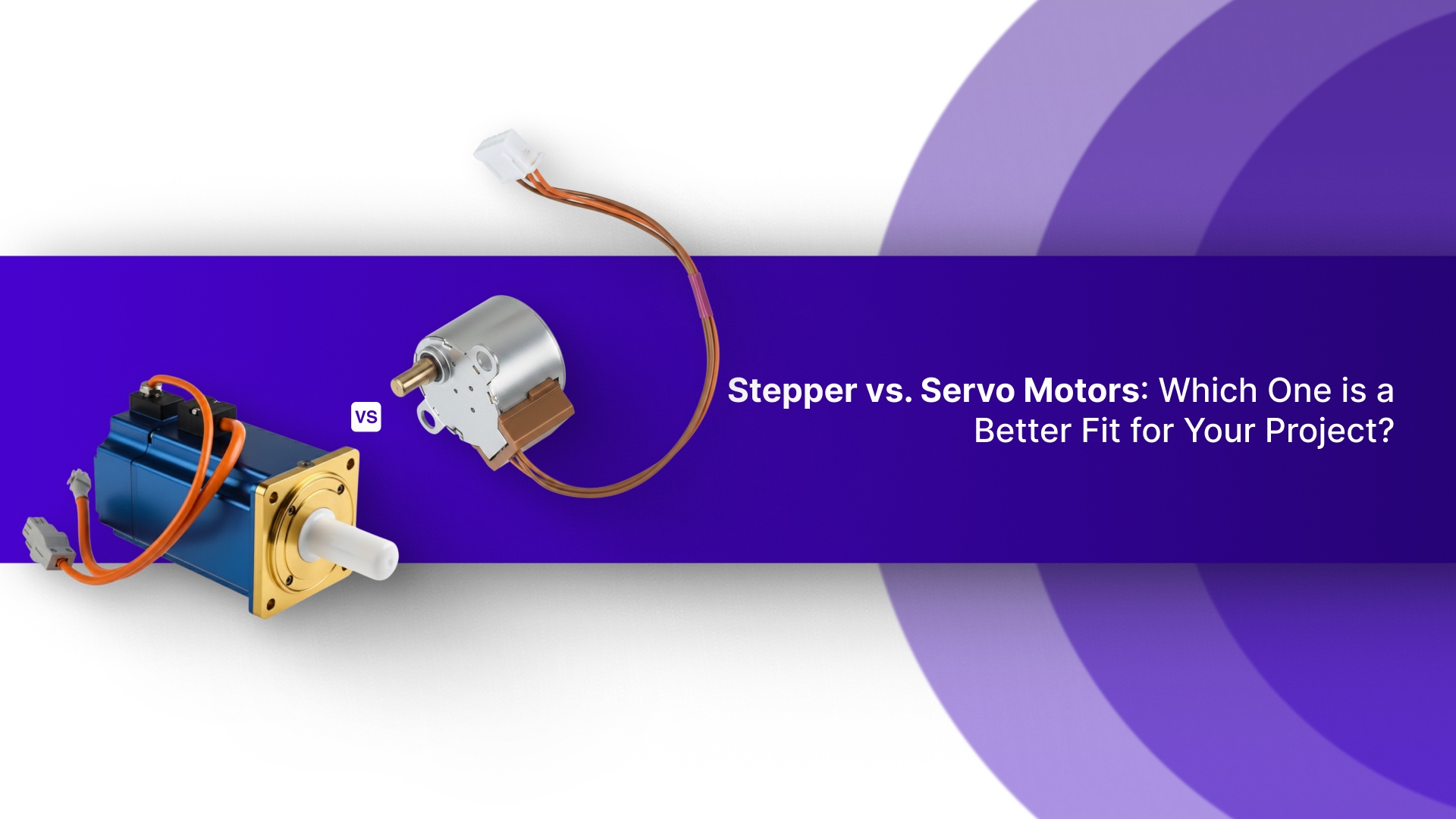
Most motion control debates eventually circle back to this question: stepper or servo?
The answer depends on what you're actually building. A CNC router has different requirements than a pick-and-place system. A 3D printer needs something different than an industrial conveyor.
Steppers offer simplicity and predictable positioning. Servos deliver speed and adaptability. But these benefits come with corresponding tradeoffs in cost, complexity, and control requirements.
Learning the core differences will help you avoid common mistakes, such as oversizing motors or choosing control systems that don't meet your performance needs.
This article will walk you through the key differences and considerations for each motor type, helping you make an informed decision for your automation needs.
Key Takeaways
Steppers trade speed for simplicity – High torque at low speeds with straightforward setup, but performance drops sharply as speed increases.
Servos require investment upfront but pay back in performance – Higher initial cost and tuning complexity, but superior dynamic response and energy efficiency.
Lost steps are invisible in steppers – Open-loop control means position errors accumulate undetected until you rehome the system.
Inertia matching matters more with servos – Steppers tolerate mismatches better, while servos need careful load-to-motor inertia calculations for optimal performance.
Speed requirements often make the decision – If your application needs sustained high speeds with maintained torque, servos are typically your only viable option.
Servo Motor vs Stepper Motor: Quick Comparison Table
Parameter | Servo Motors | Stepper Motors |
|---|---|---|
Operating Principles | Closed-loop (with feedback) – used in systems requiring precision and dynamic control | Open-loop (no feedback) – works well in simple systems with predictable loads |
Motion Characteristics | Continuous rotation – perfect for high-speed, dynamic applications with smooth motion | Discrete steps – great for applications requiring precise, repeatable movement at low speeds |
Accuracy & Repeatability | Superior accuracy with feedback – used in applications requiring precision over time, such as robotic arms and machining centers | Excellent for low-speed, constant loads – ideal for applications like 3D printing and CNC routers |
Torque Profile | Consistent torque across the speed range – ideal for high-speed, high-performance applications | High torque at low speeds, drops off at higher RPM – suitable for low-speed, high-torque tasks |
Speed Range | Wide speed range – used in applications requiring both high speed and torque, like pick-and-place systems | Limited speed – works best for applications where speed is not a primary concern |
Control Complexity | Requires setup and tuning – used in complex systems where performance optimization is crucial | Simple setup with minimal tuning – best for applications where ease of integration is key |
Size & Inertia Matching | Compact, needs precise inertia matching – ideal for space-constrained systems requiring high performance | Larger, less sensitive to inertia – great for applications that can tolerate larger motors and simpler setups |
Energy Efficiency | Energy-efficient, proportional to load – used in systems where power savings and performance are both important | Constant power draw, even at rest – suitable for low-cost, low-energy applications where efficiency isn’t critical |
Cost | Higher cost, more components – justified by the need for high precision, dynamic response, and versatility | Lower cost, fewer components – ideal for cost-sensitive projects or simpler systems |
Application Fit | Best for high-speed, dynamic loads like CNC machining centers, robotic arms, and packaging systems | Best for low-speed, predictable loads like 3D printers, CNC machines, and laboratory automation |
Stepper vs Servo Motors: Detailed Comparison
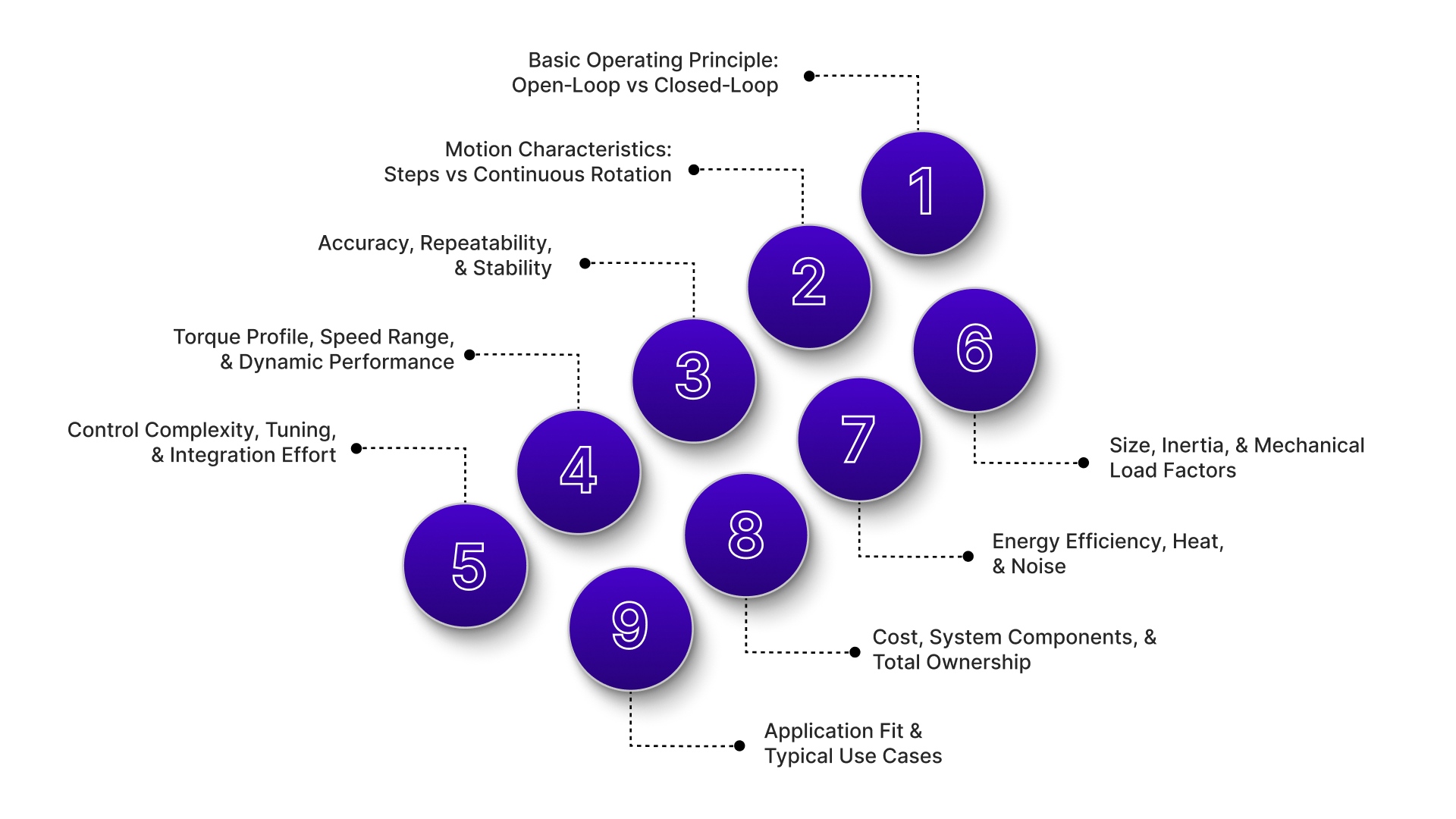
Both stepper and servo motors have their unique strengths, making them suited to different applications. In this comparison, we’ll explore their key differences to help you choose the right motor for your system.
Basic Operating Principle: Open‑Loop vs Closed‑Loop
The operating principle of a motor determines how it controls and adjusts its position. Stepper motors use open-loop control, while servo motors rely on closed-loop systems with continuous feedback to ensure precision. This fundamental difference shapes how each motor performs in real-world applications.
Stepper Motor: Open-Loop Operation
Stepper motors operate without feedback, moving in discrete steps based on electrical pulses. They assume that each pulse results in exact movement, making them simple and cost-effective for applications where precision at low speeds is key.
Servo Motor: Closed-Loop Operation
Servo motors, in contrast, use a feedback loop, constantly adjusting their position based on encoder data. This closed-loop system ensures high precision and performance, making it ideal for applications that require dynamic adjustments and high stability.
Motion Characteristics: Steps vs Continuous Rotation
Understanding how a motor moves in discrete steps or smooth, continuous rotation helps you pick the right motor for a specific application.
Stepper motors move in fixed steps, while servo motors provide continuous, fluid motion, offering different advantages depending on your system's needs.
Stepper Motor: Discrete Step Movement
Stepper motors move in distinct, fixed steps, making them ideal for applications that need precise low-speed control. They are commonly used in systems like 3D printers, CNC machines, and robotics, where precise, repeatable motion is crucial.
Servo Motor: Continuous Rotation
Servo motors offer smooth, continuous rotation, which makes them perfect for high-speed and high-torque applications. Their ability to maintain smooth motion across varying loads makes them a go-to choice for robotics, industrial automation, and conveyor systems.
Accuracy, Repeatability, and Stability
The precision of movement and the ability to maintain stability under varying conditions are critical in motion control systems. Stepper and servo motors approach accuracy, repeatability, and stability differently, depending on their operating principles and feedback mechanisms.
Stepper Motor: Moderate Accuracy
Stepper motors provide reliable accuracy at low speeds but can lose precision under varying loads or high-speed conditions. Their repeatability is high for basic applications, but stability may degrade with fluctuating loads.
Servo Motor: High Accuracy
Servo motors offer superior accuracy and repeatability due to continuous feedback. Their ability to correct for position errors ensures high stability, even under varying loads, making them ideal for precise, dynamic applications.
Torque Profile, Speed Range, and Dynamic Performance
How a motor delivers torque and handles changes in speed and load is crucial for determining its suitability in different applications.
Stepper motors provide high torque at low speeds, while servo motors excel at handling both speed and torque across a broad range of operational conditions.
Stepper Motor: Low-Speed Torque
Stepper motors provide high torque at low speeds but experience a significant drop in torque as speed increases. This makes them ideal for applications that require precise low-speed positioning but limits their use in high-speed operations.
Servo Motor: High-Speed Torque
Servo motors maintain high torque across a wide speed range and adapt to varying loads, making them perfect for high-speed, high-torque applications. Their dynamic performance allows for smooth and aggressive motion control.
Control Complexity, Tuning, and Integration Effort
The complexity of controlling and integrating a motor into a system can significantly impact project timelines and costs. Stepper motors are easier to set up and require minimal tuning, while servo motors require a more complex setup and expertise for optimal performance.
Stepper Motor: Simple Control
Stepper motors are relatively simple to control, requiring minimal setup and tuning. Their open-loop design makes them easier to integrate into basic systems, making them a good choice for projects where cost and simplicity are priorities.
Servo Motor: Complex Control
Servo motors require more complex control systems, including tuning and integration of feedback mechanisms.
The closed-loop control system requires specialized knowledge and expertise to optimize performance, making them better suited for demanding applications where precision and dynamic response are essential.
Looking for easy integration? Our Universal Stepper Controller simplifies stepper motor setups, ensuring efficient operation with minimal tuning.
For servo motors, our Brushless PWM Servo Amplifier provides precise control and smooth performance.
Visit Pico Systems today to optimize your motor control with our reliable, advanced solutions.
Size, Inertia Matching, and Mechanical Load Considerations
When selecting a motor, matching the motor size and inertia to the mechanical load is critical to system efficiency and performance. Stepper motors tend to be larger and less sensitive to inertia, while servo motors are more compact but require precise inertia matching.
Stepper Motor: Larger Size, Higher Inertia
Stepper motors are typically larger for equivalent torque output and less sensitive to inertia mismatches. They are suitable for lighter loads and systems where space isn’t as critical, but may be a disadvantage in more compact setups.
Servo Motor: Smaller Size, Lower Inertia
Servo motors are more compact and offer higher power density. However, they require careful matching of load and motor inertia, making them more suitable for high-performance applications where size and precision are key.
Energy Efficiency, Heat, and Noise
Energy efficiency and thermal management are important considerations for long-term operational costs. Stepper motors tend to waste energy even when idle, while servo motors are more energy-efficient, adjusting their power consumption based on load.
Stepper Motor: Less Energy Efficient
Stepper motors consume power continuously, even when stationary, leading to higher energy consumption and heat generation. They are also noisier, especially when operating at resonant frequencies.
Servo Motor: More Energy Efficient
Servo motors consume power only when required, based on load and position, making them more energy-efficient. Their operation generates less heat, and they are generally quieter, improving both performance and long-term sustainability.
Cost, System Components, and Total Ownership
The initial cost of the motor is only one part of the financial equation. System components, maintenance, energy consumption, and downtime all factor into the total ownership cost, which can be significantly different for stepper and servo motors.
Stepper Motor: Lower Cost
Stepper motors are less expensive to purchase and integrate, with fewer components needed. They are cost-effective for simpler systems but may incur higher operating costs due to constant power draw and reduced efficiency over time.
Servo Motor: Higher Cost
Servo motors require a higher initial investment due to their complex design and components. However, their efficiency and performance benefits, especially in dynamic applications, often justify the higher upfront cost in the long term.
Application Fit and Typical Use Cases
The motor you choose depends largely on the specific requirements of your application. Stepper motors are ideal for precise low-speed tasks, while servo motors excel in high-speed, high-torque applications.
Stepper Motor: Precise Low-Speed Applications
Stepper motors are well-suited for applications that require precise, low-speed positioning, such as 3D printers, CNC machines, and laboratory automation. They are ideal when precision is needed, but speed is not a critical factor.
Servo Motor: High-Speed, High-Torque Applications
Servo motors are the preferred choice for high-speed, high-torque applications. They are commonly used in robotics, CNC machining, and automated manufacturing systems, where performance, speed, and torque are critical to the success of the operation.
How to Choose Between a Servo Motor and a Stepper Motor?
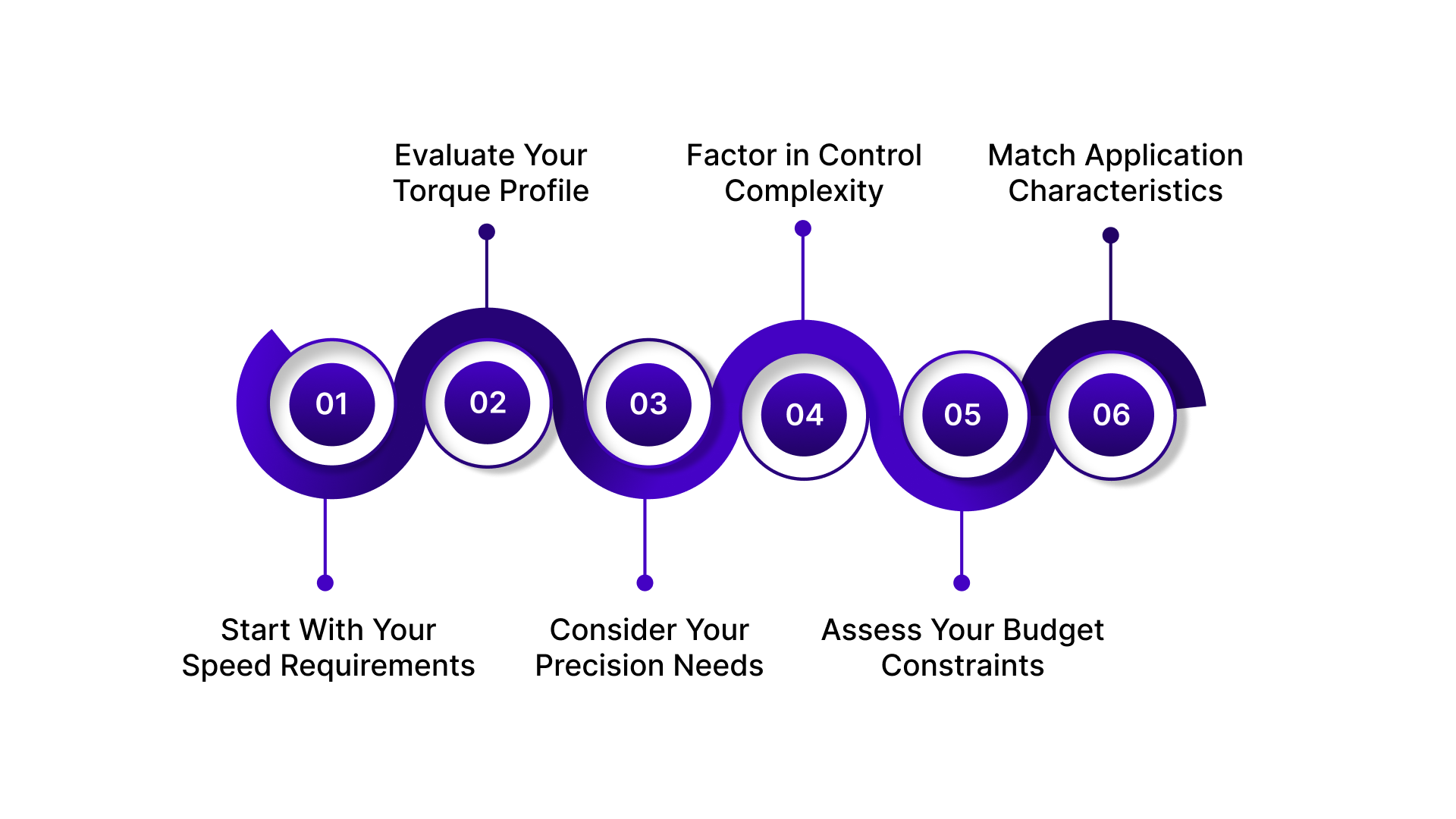
Your application requirements will tell you which motor to choose.
Start with your speed and torque needs, then factor in precision requirements and budget constraints. The right motor emerges from matching your operating conditions to the motor's capabilities.
Here's how to make that decision systematically.
Start With Your Speed Requirements
Speed is often the first differentiator. Your operating velocity determines whether steppers are even viable.
Choose Steppers When:
Your application runs primarily at lower speeds
You need maximum torque at standstill or low velocities
Speed variations are minimal during operation
Your cycle time isn't constrained by motor acceleration
Choose Servos When:
You need sustained high-speed operation
Rapid acceleration and deceleration are critical
Speed must vary significantly during the work cycle
Throughput depends on minimizing motion time
Evaluate Your Torque Profile
How your load changes during operation matters as much as peak torque requirements.
Choose Steppers When:
Load remains relatively constant throughout the cycle
You need high holding torque without power consumption
Peak torque occurs at low speeds
Torque demands are predictable and within stepper range
Choose Servos When:
Load varies significantly during operation
You need torque maintained across a wide speed range
Unpredictable disturbances require immediate compensation
Your torque needs exceed what steppers can deliver at operating speeds
Consider Your Precision Needs
Position accuracy and repeatability requirements guide your choice, but so does how you verify that accuracy.
Choose Steppers When:
Open-loop repeatability meets your needs
You can tolerate occasional lost steps with homing cycles
Position verification isn't required for your process
Your mechanical system has minimal compliance or backlash
Choose Servos When:
You need verified position accuracy for every move
Lost motion must be detected and corrected immediately
Your application requires position logging or quality documentation
Mechanical backlash or compliance needs electronic compensation
Factor in Control Complexity
Your team's capabilities and available commissioning time matter.
Choose Steppers When:
Your team lacks motion control tuning experience
Time-to-market pressure demands quick deployment
Multiple machines need identical, predictable behavior
Ongoing tuning support isn't available
Choose Servos When:
You have motion control expertise in-house or available
Performance optimization justifies tuning investment
Application complexity benefits from adaptive control
You can support ongoing system maintenance and updates
Assess Your Budget Constraints
Total system cost includes more than just the motor price.
Choose Steppers When:
Initial budget is tightly constrained
Simple applications don't justify servo complexity
Energy costs aren't a significant factor
You're building multiple similar machines
Choose Servos When:
Performance requirements justify higher investment
Energy efficiency matters over the system lifetime
Downtime costs exceed the servo premium
Production throughput creates rapid ROI
Match Application Characteristics
Some applications clearly favor one motor type over the other.
Application Type | Recommended Motor | Key Reason |
|---|---|---|
3D Printers | Stepper | Cost-effective precision at moderate speeds |
Pick and Place | Servo | High acceleration and throughput critical |
Laboratory Equipment | Stepper | Precise positioning, predictable loads |
CNC Machining | Servo | Variable cutting forces, high speeds |
Conveyor Systems | Stepper or Servo | Depends on speed and load variation |
Packaging Machines | Servo | Rapid cycle times, dynamic loads |
Textile Equipment | Stepper | Consistent loads, moderate speeds |
Robotic Arms | Servo | Dynamic movement, precise control |
Medical Devices | Stepper or Servo | Depends on speed vs. simplicity needs |
Printing Presses | Servo | High speed synchronization required |
Decision Framework
Use this quick assessment to narrow your choice:
You Probably Need a Stepper If:
Operating speeds stay moderate throughout your cycle
Loads are predictable and consistent
Budget constraints are significant
Setup simplicity is important
Your team lacks servo tuning experience
You Probably Need a Servo If:
High speeds are required for throughput
Loads vary or are unpredictable
Position verification is mandatory
Acceleration rates determine cycle time
Performance justifies the investment
Common Decision Mistakes to Avoid
Don't Choose Steppers When:
You're hoping to push them beyond their speed/torque limits
Load variations will likely cause lost steps
Your application will eventually need servo performance
Cycle time requirements are aggressive
Don't Choose Servos When:
Simple positioning would work fine with steppers
You lack resources for proper tuning and commissioning
The application doesn't benefit from closed-loop control
Budget constraints make the investment difficult to justify
Hybrid Approaches Worth Considering
Sometimes the best solution combines both motor types.
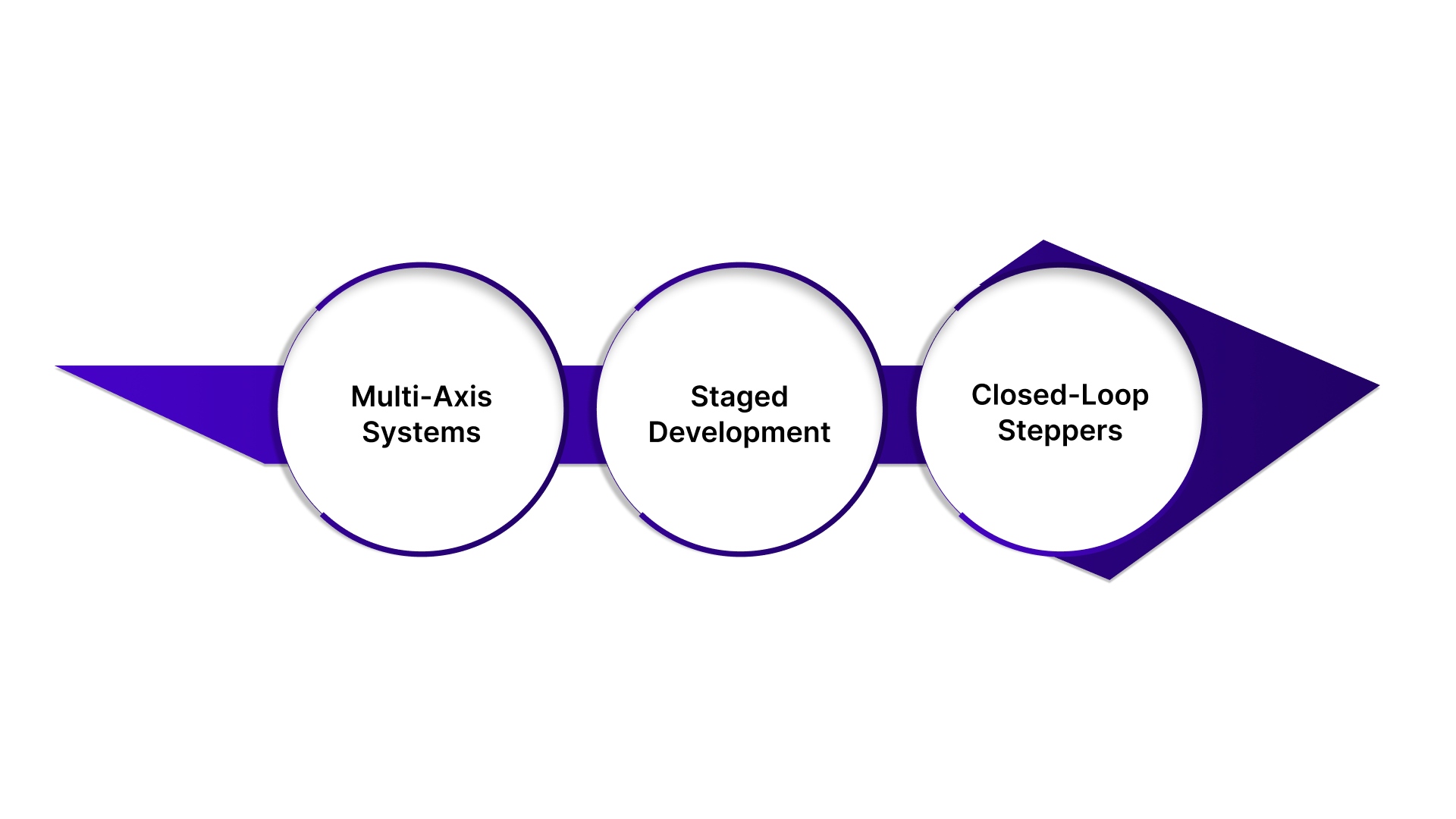
Multi-Axis Systems: Use servos for high-speed or high-load axes, steppers for positioning-only axes. A CNC router might use servos for X and Y, steppers for Z.
Staged Development: Prototype with steppers for speed and cost, then upgrade to servos for production if performance demands it. This validates your design before committing to higher investment.
Closed-Loop Steppers: Some modern stepper systems add encoders for position verification. You get simpler stepper simplicity with servo-like feedback at a cost between the two technologies.
When in Doubt
If your application sits on the borderline, consider these tiebreakers:
Lean Toward Steppers If:
This is your first motion control project
You're building a prototype or proof-of-concept
Maintenance simplicity matters more than peak performance
You might not need the full capability immediately
Lean Toward Servos If:
Your application might grow or evolve
Performance headroom provides future flexibility
Downtime or quality issues are costly
You have support resources available
The choice isn't always clear-cut, but matching your specific requirements to the motor's capabilities makes the decision straightforward in most cases.
How Pico Systems Can Help
We make motion control simpler for engineers and machine builders.
At Pico Systems, our universal stepper controllers handle complex motion profiles without the usual headaches. Our brushless servo motors deliver reliable torque when your application demands it. We've built solutions that just work.
What We Offer:
Universal Stepper Controllers – Flexible control for diverse motion applications
Universal PWM Controllers – LinuxCNC-compatible control with built-in encoder counters and digital I/O
NEMA 23 Brushless Servo Motors – Compact power with verified feedback
PWM Servo Amplifiers – Drive brushless motors up to demanding specifications
Technical Support – Real engineers who understand your integration challenges
Visit Pico Systems today to find the motor control solution that fits your project. We're here to help you get moving.
FAQs
1. What is the main difference between a servo motor and a stepper motor?
Servo motors use feedback to adjust their position, providing high precision, while stepper motors operate in discrete steps without feedback, offering simplicity.
2. Can a stepper motor handle high-speed applications?
No, stepper motors lose torque at higher speeds and are best suited for low-speed, precision applications like 3D printing or CNC routers.
3. Are servo motors more energy-efficient than stepper motors?
Yes, servo motors consume power only as needed based on load, making them more energy-efficient compared to stepper motors, which consume power continuously.
4. Which motor is easier to integrate into a system?
Stepper motors are simpler to integrate with minimal tuning, while servo motors require more complex setup and tuning for optimal performance.
5. What applications are servo motors best for?
Servo motors excel in high-speed, high-torque applications, such as robotics, industrial automation, and CNC machining, where dynamic performance and precision are critical.