The right FANUC encoder converter board solves this problem elegantly. It eliminates the need to replace expensive servo motors, reduces downtime during retrofits, and extends machine life in upgrade projects. For integrators working with aging CNC equipment or multi-brand automation systems, these boards are not optional accessories—they're critical retrofit components that determine project success or failure.
This article profiles the top ten manufacturers of FANUC encoder converter boards, covering key specifications, differentiators, and selection criteria to help you make an informed sourcing decision.
Key Takeaways
- FANUC encoder converter boards translate proprietary Pulsecoder signals into standard outputs compatible with non-FANUC drives
- Most valuable in CNC retrofits, motion control upgrades, and multi-brand automation integrations
- Key selection criteria: supported Pulsecoder models, output signal type, LinuxCNC compatibility, power requirements
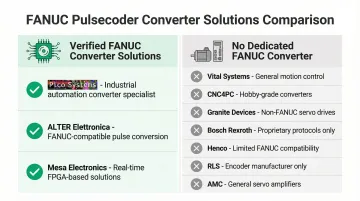
- Verified off-the-shelf solutions come from three manufacturers — Pico Systems, ALTER Elettronica, and Mesa Electronics — with Pico Systems focused on LinuxCNC-compatible interfaces for North American retrofits
What Is a FANUC Encoder Converter Board?
A FANUC encoder converter board—also called a Pulsecoder interface or transducer converter—is a hardware module that decodes FANUC's proprietary serial encoder signal and re-outputs it in a standard format. The output typically includes TTL quadrature, differential ABZ, or Hall sector signals that third-party servo drives and controllers can read for motor position and speed feedback.
The primary use case is retrofitting or repurposing FANUC servo motors (such as αi and βi series) in machines where the original FANUC drive is being replaced. This approach avoids costly motor swaps and preserves existing mechanical assemblies, which is why retrofit projects typically cost one-third to one-half of purchasing a new machine.
Two conversion scenarios account for most applications:
- FANUC Pulsecoder to TTL/quadrature output for general servo drives
- FANUC Pulsecoder to LinuxCNC or FPGA-based motion controller input
Supported Pulsecoder types vary by manufacturer. Some boards handle only incremental encoders, while others support both incremental and absolute variants.
The αi and βi series use a proprietary serial protocol rather than standard quadrature pulses, which is why passive wiring adapters don't work—active decoding hardware is mandatory.
Top Ten FANUC Encoder Converter Board Manufacturers
These ten manufacturers were selected based on product reliability, breadth of supported Pulsecoder models, output signal versatility, technical documentation quality, and market presence in industrial automation and CNC retrofit applications. Note that product availability varies significantly, and only three manufacturers offer verified, off-the-shelf converter boards specifically designed for FANUC's proprietary protocol.
Pico Systems
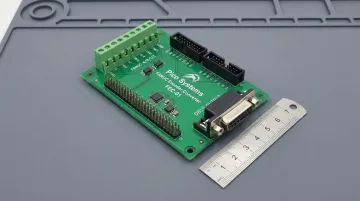
Pico Systems, based in Kirkwood, MO, is a specialized U.S. motion control supplier known for designing interface boards that bridge FANUC servo systems with LinuxCNC and third-party servo amplifiers. Their encoder interface products are used by industrial automation integrators, CNC machine builders, and motion control system developers throughout North America.
Key differentiators include:
- Direct LinuxCNC software compatibility with HAL-level integration
- Position tracking maintained during emergency stops
- Two distinct FANUC encoder converter products at $150 each, used by Copley Controls and Gecko
| Specification | Details |
|---|---|
| Supported Pulsecoder Models | Red-cap encoders (A860-0304-T111), ABS encoders (A860-0320-T111), FANUC Serial pulse coders (both absolute and incremental), resolutions from 1,000 to 1,024,000 counts/rev |
| Output Signal Type | TTL quadrature with Hall sector signals; differential line driver capability for ABZ signals |
| Key Application | CNC retrofits and motion control system upgrades using third-party servo amplifiers (Copley, AMC, Servo Dynamics) and LinuxCNC-based controllers |
ALTER Elettronica
ALTER Elettronica is an Italian motion control manufacturer offering the 13/013 "Serial Encoder to TTL Encoder Converter" module as part of its multifunction transducer converter line. The company positions itself as "the alternative in motion control" and serves European retrofit and drive replacement markets with a focus on FANUC compatibility.
The 13/013 module supports a wide range of FANUC αi and βi Pulsecoders and outputs TTL signals with Hall sectors, allowing FANUC brushless motors to run on virtually any servo drive. It is PC-configurable via USB with anomaly signaling and frequency/direction output options, offering more software-based flexibility than jumper-configured alternatives.
| Specification | Details |
|---|---|
| Supported Pulsecoder Models | αi64, αiAR128, αiA1000, αiA16000, α64iA, αA64, αA1000, βiA128 |
| Output Signal Type | 5V TTL line driver output with simulated Hall sector signals; USB-configurable via PC software |
| Key Application | Replacing FANUC servo drives with third-party drives while retaining original FANUC brushless servo motors in European markets |
Mesa Electronics
Mesa Electronics is a U.S.-based designer of FPGA-based motion control and I/O boards, widely used in LinuxCNC environments. Their 7I44 and related FANUC Pulsecoder interface cards allow FANUC serial encoder signals to be read by Mesa's motion control hardware through the HostMot2 firmware configuration.
Mesa's tight integration with LinuxCNC's HAL (Hardware Abstraction Layer) and active open-source community support make it a strong choice for builders working with salvaged FANUC servo components. That said, it suits those already comfortable with FPGA configuration — it's not a plug-and-play converter.
| Specification | Details |
|---|---|
| Supported Pulsecoder Models | FANUC αi and βi series via HostMot2 firmware; RS-422/RS-485 serial interface capability |
| Output Signal Type | FPGA-based interface outputting position data to LinuxCNC via parallel port or Ethernet; exposes encoder data as HAL pins |
| Key Application | Custom CNC machine builds and LinuxCNC retrofits using salvaged or surplus FANUC servo motors; open-source control systems |
Vital Systems (CNC Motion Technology)
Vital Systems is a U.S. motion control company offering the CNCPC platform and related interface hardware for CNC retrofits. However, research into their official product offerings, including the HiCON motion controller lines, did not yield a dedicated FANUC Pulsecoder converter board product.
Their Ethernet-based motion controllers accept standard encoder inputs, but none are designed to decode FANUC's proprietary αi/βi serial protocol. This is a general-purpose CNC retrofit platform, not a FANUC-specific conversion solution.
| Specification | Details |
|---|---|
| Supported Pulsecoder Models | No dedicated FANUC Pulsecoder converter product identified |
| Output Signal Type | Standard encoder inputs on motion controllers; no proprietary FANUC conversion |
| Key Application | General CNC retrofit with standard encoders; not specialized for FANUC proprietary protocol |
CNC4PC
CNC4PC is a U.S.-based supplier of CNC breakout boards, motion control components, and interface hardware, offering products commonly used in hobby and professional CNC machine conversions. The company targets hobbyists, small shops, and OEMs with products compatible with Mach3, Mach4, and UCCNC software.
Their catalog — which includes boards like the C94 and C11G — covers standard stepper/servo interfaces and general breakout applications. FANUC proprietary serial protocol conversion is outside their product scope entirely.
| Specification | Details |
|---|---|
| Supported Pulsecoder Models | No dedicated FANUC Pulsecoder converter product identified |
| Output Signal Type | Standard breakout boards for stepper/servo control; no FANUC protocol conversion |
| Key Application | Small-shop CNC retrofits with standard encoders and Mach3/Mach4 software |
Granite Devices
Granite Devices is a Finnish motion control company known for the IONI and Argon servo drive series and the SimpleMotion protocol. While the company offers high-performance servo drives with configurable encoder inputs, they do not offer a standalone FANUC Pulsecoder converter board.
Official documentation explicitly states that "Serial data communication based encoders are not currently supported" for IONI drives. The drives support incremental quadrature, SinCos, and BiSS/SSI encoders, but not FANUC's proprietary serial protocol. Serial encoders with incremental output signals might work, but this requires the encoder itself to output standard signals.
| Specification | Details |
|---|---|
| Supported Pulsecoder Models | No native FANUC Pulsecoder support; serial communication encoders not supported |
| Output Signal Type | Drives accept incremental quadrature, SinCos, BiSS, SSI—not FANUC serial protocol |
| Key Application | High-performance servo applications with standard encoder protocols; not suitable for FANUC proprietary conversion |
Bosch Rexroth
Bosch Rexroth manufactures the IndraDrive series of industrial drive systems, supporting multi-encoder interfaces including EnDat and Hiperface. No dedicated standalone FANUC Pulsecoder converter board for third-party use appears in official documentation.
Rexroth motors pair with IndraDrive controllers within their own closed ecosystem. No separate product exists to convert FANUC encoders for non-Rexroth drives — their focus is integrated enterprise systems, not niche retrofit hardware.
| Specification | Details |
|---|---|
| Supported Pulsecoder Models | No dedicated FANUC Pulsecoder converter product for third-party use |
| Output Signal Type | IndraDrive controllers support EnDat, Hiperface, and standard protocols within their own ecosystem |
| Key Application | Enterprise-scale automation with Rexroth integrated systems; not focused on third-party FANUC conversion |
Henco Industries
Research indicates that Henco Industries is a service provider focused on industrial machinery repairs, machining, and fabrication services rather than a manufacturer of encoder converter electronics. The company is often associated with Hanco, Ltd. in search contexts regarding industrial repair.
No evidence was found of Henco Industries manufacturing or selling a FANUC Pulsecoder converter board. Their business model centers on repair services and component replacement rather than specialized motion control interface hardware development.
| Specification | Details |
|---|---|
| Supported Pulsecoder Models | No FANUC encoder converter product identified; company focuses on repair services |
| Output Signal Type | Not applicable—no converter product offered |
| Key Application | Industrial machinery repair and component replacement services; not a converter board manufacturer |
RLS (Renishaw Subsidiary)
RLS (Rotary and Linear Motion Sensors) is a Slovenian company and an associate company of Renishaw. They specialize in designing and manufacturing magnetic encoders that support standard protocols like BiSS, SSI, and incremental TTL.
Their official product range covers RLS-designed magnetic encoders with BiSS, SSI, and incremental TTL outputs. RLS builds its own encoders — it doesn't convert or retrofit competitor products, and no FANUC Pulsecoder conversion offering exists in their catalog.
| Specification | Details |
|---|---|
| Supported Pulsecoder Models | No FANUC Pulsecoder converter product; RLS manufactures their own encoders with standard protocols |
| Output Signal Type | RLS encoders output BiSS, SSI, incremental TTL—not designed to convert FANUC signals |
| Key Application | Precision industrial automation with RLS magnetic encoders; not a FANUC conversion solution |
Advanced Motion Controls (AMC)
Advanced Motion Controls (AMC) manufactures high-performance servo drives with a strong focus on configurable, multi-protocol drives for industrial and defense applications. Their DigiFlex Performance drives support various feedback types, including incremental encoders, Hall sensors, EnDat, and BiSS.
FANUC's proprietary αi/βi serial protocol is not supported — on the drives themselves or via a separate converter. AMC's DigiFlex drives carry UL, cUL, CE, and TÜV Rheinland certifications, but encoder compatibility stops at industry-standard protocols.
| Specification | Details |
|---|---|
| Supported Pulsecoder Models | No native FANUC Pulsecoder support or dedicated converter product |
| Output Signal Type | Drives accept incremental, Hall, EnDat, BiSS—not FANUC proprietary serial protocol |
| Key Application | Industrial servo and defense motion control with standard encoder protocols; not specialized for FANUC conversion |
How We Chose the Best FANUC Encoder Converter Board Manufacturers
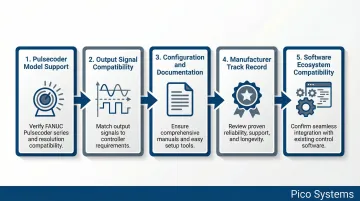
Selection was based on evaluating five core criteria:
Breadth of supported FANUC Pulsecoder models — Verify support for both incremental and absolute variants, across αi and βi series. Specific model compatibility (such as αiA1000 or βiA16000) matters more than generic claims.
Output signal compatibility — Confirm the board outputs TTL quadrature, differential RS-422, and Hall sector signals that match your target drive's input specifications.
Ease of configuration and documentation quality — Configuration method (jumpers, USB software, or FPGA firmware) should match your team's skill level, and pinout diagrams plus setup guides must be readily available.
Manufacturer track record and market presence — Look for companies with a proven history in the CNC retrofit market, active customer support, and evidence of ongoing product updates.
Software ecosystem compatibility — Integration with LinuxCNC, Mach4, or your target platform matters. HAL driver support should be documented and actively maintained.
Choosing on price alone — without confirming Pulsecoder model compatibility — is the most common mistake in this space. A mismatched board causes encoder communication errors, unexpected downtime, and wiring changes that derail project timelines.
Conclusion
Selecting the right FANUC encoder converter board manufacturer requires matching technical specifications—Pulsecoder type, output signal, power supply—to your specific retrofit or integration project. Brand reputation alone should not drive the decision, especially given that only three manufacturers (Pico Systems, ALTER Elettronica, and Mesa Electronics) offer verified, off-the-shelf solutions for FANUC's proprietary protocol.
Before finalizing a supplier for production-critical CNC environments, evaluate:
- Multi-axis scalability — confirm the board supports your full axis count now and at future capacity
- Firmware and software support — ongoing updates matter when CNC environments evolve
- Total cost of ownership — factor in integration labor, not just the board price
The cost savings of retrofit projects—typically 33-50% compared to new machine purchases—only materialize when the converter board performs reliably in the field.
For North American industrial automation integrators and CNC machine builders seeking a reliable, LinuxCNC-compatible FANUC encoder interface solution, Pico Systems offers specialized motion control interface products backed by hands-on expertise in servo and stepper control systems. Contact them at elson@pico-systems.com or +1 314-965-5523 to get guidance on your FANUC encoder interface application.
Frequently Asked Questions
What are the different types of FANUC encoders?
FANUC encoders fall into four main types: incremental (pulse-based, position lost on power loss), absolute (retains position data after power loss), linear (for straight-line motion feedback), and specialty variants including optical, magnetic, and multi-turn absolute models. The αi and βi series Pulsecoders use a proprietary serial protocol rather than standard quadrature output.
What is a FANUC encoder converter board used for?
It translates FANUC's proprietary Pulsecoder serial signal into standard output formats such as TTL quadrature or differential ABZ, allowing FANUC servo motors to operate with non-FANUC servo drives and motion controllers. This is primarily used in CNC retrofits and machine upgrades to avoid costly motor replacements.
What output signal types do FANUC encoder converter boards typically support?
Common output types include TTL quadrature (A/B/Z pulses), differential line driver signals (RS-422), and Hall sector signals for brushless motor commutation. The output type must match the input specification of your target servo drive or controller—confirm this before purchasing.
Are FANUC encoder converter boards compatible with LinuxCNC?
Pico Systems and Mesa Electronics both design their boards specifically for LinuxCNC. Mesa's HostMot2 firmware exposes encoder data as HAL pins; Pico Systems outputs standard signals LinuxCNC can interpret directly. Verify HAL driver availability for any board before purchasing.
Can a FANUC Pulsecoder be used with a non-FANUC servo drive?
Yes, via a converter board that decodes the FANUC serial Pulsecoder protocol and re-outputs standard encoder signals. However, the motor's electrical specifications—voltage, current, pole count—must also be compatible with the replacement drive.
How do I choose the right FANUC encoder converter board for my application?
Start by confirming your exact Pulsecoder model (check the motor nameplate), the output signal type your drive requires, and whether you need absolute position support. Then shortlist only manufacturers that explicitly list your Pulsecoder model as compatible—and verify power supply requirements before ordering.