
Introduction
The motion controller board is the nerve center of any CNC system — the component that translates software commands into precise, real-time physical motion. Choose the wrong one, and even the finest mechanical components and powerful motors won't save your machine from poor performance, lost steps, or outright failure.
The market spans from global industrial giants delivering multi-axis systems for aerospace production lines to niche players serving open-source communities and retrofit integrators. That range makes selection genuinely difficult.
Knowing what you're evaluating helps. A basic breakout board simply routes signals without onboard processing. A true motion control board includes dedicated real-time pulse generation, closed-loop feedback, and deterministic timing — a meaningful distinction when your application demands it. This guide breaks down ten manufacturers leading this space, covering what they build, who they serve, and where they stand out.
Key Takeaways
- Motion controller boards bridge CNC software and motor drives, handling real-time pulse generation and multi-axis coordination
- Manufacturers span industrial-grade systems (FANUC, Siemens), open-source-friendly solutions (Mesa Electronics), and standalone controllers (Centroid, MASSO)
- Choose based on axis count, software compatibility (LinuxCNC, Mach3/4, or proprietary), pulse frequency, and closed-loop servo support
- Pico Systems supplies LinuxCNC-compatible servo and stepper interfaces for industrial automation and CNC retrofit applications
What Is a CNC Motion Controller Board?
A CNC motion controller board is a dedicated hardware interface that accepts high-level commands from CNC software and generates precise step/direction pulses (or analog/encoder signals) to drive motor amplifiers.
Unlike a simple breakout board — which only routes signals from a PC's parallel port without onboard processing — a true motion controller board contains its own processor or FPGA. That onboard logic handles real-time timing and trajectory generation independently from the host machine.
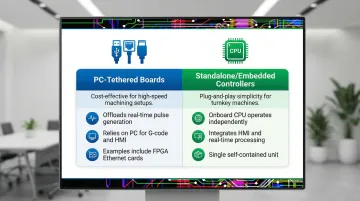
Two primary architectures dominate the motion controller market:
- PC-tethered boards (USB, Ethernet, or PCIe-based) offload real-time pulse generation from the host PC while relying on the computer for G-code interpretation and HMI
- Standalone/embedded controllers feature onboard CPUs that operate independently of a PC, integrating control logic, HMI, and real-time processing into a single robust unit
As CNC applications have grown more demanding — higher speeds, more axes, tighter tolerances — the motion controller board has become a defining factor in system capability. Which architecture fits your build, and who makes it, shapes what your machine can realistically achieve.
Top 10 CNC Motion Controller Board Manufacturers
These manufacturers were selected based on market presence, technological capability, product range, software ecosystem support, and suitability across industrial and prosumer CNC applications.
FANUC (Japan)
Founded in 1956, FANUC holds over 20% of the global CNC market and maintains a dominant position in automotive, aerospace, and high-volume manufacturing. Its motion controller boards are embedded within SINUMERIK-class CNC systems known for near-zero downtime.
Its proprietary FSSB (FANUC Serial Servo Bus) architecture uses optical fiber communication for ultra-fast servo control with minimal noise interference. The Series 30i/31i/32i-MODEL B Plus controllers support simultaneous 5-axis interpolation with millisecond-level cycle times and can coordinate up to 96 axes (72 feed axes, 24 spindles) across 10 paths.
| Feature | Details |
|---|---|
| Key Features | High-speed CPU, FSSB serial servo bus, 5-axis interpolation, Ethernet/Profibus support |
| Supported Axes / Compatibility | Up to 96 axes; compatible with FANUC servo amplifiers and spindle drives |
| Best For | High-volume industrial machining centers, automotive and aerospace production lines |
Siemens SINUMERIK (Germany)
Siemens' SINUMERIK CNC line spans entry-level (808D) to high-end (840D sl) controllers and is widely regarded as the standard for Industry 4.0-integrated CNC motion control in Europe and among global OEM machine builders.
Differentiators include integrated PLC and CNC on a single platform, Digital Twin simulation support for realistic machining simulation before cutting metal, and AI-assisted tool path optimization. The 840D sl supports up to 93 axes/spindles in multi-channel configurations and features native OPC UA connectivity for structured data exchange across smart factory networks.
| Feature | Details |
|---|---|
| Key Features | Integrated PLC+CNC, Digital Twin, AI path optimization, PROFINET/PROFIBUS |
| Supported Axes / Compatibility | Up to 93 axes (840D sl); compatible with SINAMICS servo drives |
| Best For | Aerospace, automotive, mold manufacturing, and Industry 4.0 smart factory deployments |
Mitsubishi Electric (Japan)
Mitsubishi Electric's CNC division produces the MELDAS/M800 series motion controller boards with strong presence in Asia-Pacific markets and growing global share in high-speed machining and electronics manufacturing.
The M800 series utilizes SSCNET III/H, a fiber-optic servo bus that virtually eliminates noise interference in demanding industrial environments. It supports 5-axis simultaneous control with nano-interpolation for micron-level surface finish and OMR-FF (Optimal Machine Response - Feed Forward) vibration suppression control to handle mechanical resonances.
| Feature | Details |
|---|---|
| Key Features | SSCNET III/H fiber-optic servo bus, nano-interpolation, vibration suppression control |
| Supported Axes / Compatibility | Up to 32 axes; compatible with Mitsubishi MR-J4/J5 servo amplifiers |
| Best For | High-speed die/mold machining, electronics manufacturing, and precision multi-axis applications |
Centroid CNC (USA)
Centroid CNC is a US-based manufacturer known for its Acorn and ALLIN1DC motion controller boards targeted at CNC retrofit projects, manual-to-CNC machine conversions, and prosumer machine builders. The company has built a strong reputation in the Bridgeport knee mill retrofit community.
Centroid's Ethernet-based motion controllers include onboard I/O, built-in PLC, and are paired with Centroid's own software — creating a tightly integrated, plug-and-play ecosystem that lowers setup time significantly. The ALLIN1DC features a built-in 3-axis DC servo drive (15 amps per axis) specifically designed to reuse existing DC motors on legacy machines.
| Feature | Details |
|---|---|
| Key Features | Ethernet connectivity, onboard PLC, integrated Centroid CNC software, built-in I/O |
| Supported Axes / Compatibility | Up to 6 axes; compatible with stepper and servo motor drives |
| Best For | CNC retrofit projects, manual machine conversions, small-to-mid-size job shops |
Mesa Electronics (USA)
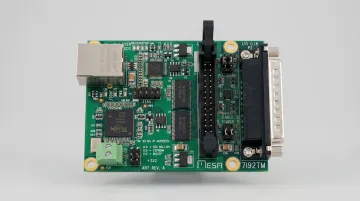
Mesa Electronics, based in California, produces FPGA-based motion controller cards (5i20, 7i76E, 7i92) that have become the go-to hardware choice among LinuxCNC builders for their reconfigurable FPGA architecture. The company has a strong following among open-source CNC developers and machine builders.
Mesa's FPGA architecture allows fully reconfigurable I/O and extremely high step rates — the 7i76E can generate step rates exceeding 10 MHz, far exceeding what software-based step generation can achieve. Its Ethernet cards enable real-time motion control without a parallel port, making it ideal for modern PC builds that lack legacy ports.
| Feature | Details |
|---|---|
| Key Features | FPGA-based real-time processing, high step rates, reconfigurable I/O, Ethernet and PCIe options |
| Supported Axes / Compatibility | Up to 8 axes typical; LinuxCNC (HAL driver support); stepper and servo |
| Best For | LinuxCNC builds, DIY industrial machines, high-performance open-source CNC projects |
Pico Systems (USA)
Pico Systems, based in Kirkwood, Missouri, specializes in motion control interface boards designed specifically for LinuxCNC. Its product range includes servo interface boards (USC, PPMC) that connect directly between LinuxCNC's HAL layer and servo amplifiers or stepper drives.
The boards are engineered for precision position tracking even through emergency stop events — a critical capability for industrial safety. The Universal Stepper Controller delivers up to 250,000 steps per second per axis, while the PPMC system's modular architecture supports up to 32 axes through daisy-chaining. Interfaces are compatible with major servo amplifier brands including Copley Controls, AMC, and Gecko, and support closed-loop feedback via encoder inputs.
| Feature | Details |
|---|---|
| Key Features | LinuxCNC HAL-compatible, encoder feedback, emergency-stop position tracking, servo and stepper interfaces |
| Supported Axes / Compatibility | Multi-axis configurations up to 32 axes; compatible with Copley Controls, Gecko, AMC, and other servo/stepper amplifiers |
| Best For | LinuxCNC-based CNC machine builds, servo-driven retrofit systems, industrial automation integrators |
Galil Motion Control (USA)
Galil Motion Control is a US pioneer in standalone motion controllers. Its DMC series boards are widely used in OEM automation equipment, semiconductor manufacturing, and multi-axis precision instruments.
Galil controllers are programmable via their own embedded language (GalilSuite) and can operate independently of a host PC once programmed. They support simultaneous coordinated motion across up to 32 axes and are available in PCI, Ethernet, and USB form factors. The DMC-52xx0 EtherCAT Master controller offers particularly high performance for demanding industrial applications.
| Feature | Details |
|---|---|
| Key Features | Standalone operation, embedded GalilBasic language, 32-axis coordination, PCI/Ethernet/USB |
| Supported Axes / Compatibility | 1 to 32 axes; compatible with analog ±10V servo amplifiers and stepper drives |
| Best For | OEM automation equipment, semiconductor handling, multi-axis precision instruments |
Dynomotion KFlop (USA)
Dynomotion's KFlop is a compact, FPGA+DSP-based USB motion controller board popular among advanced DIY CNC builders and small OEMs seeking high performance at a mid-range price point.
KFlop's onboard 32-bit DSP runs C-language user programs for custom motion profiles, enabling highly flexible control logic that isn't possible with fixed-firmware controllers. It integrates with Mach4 and LinuxCNC and supports up to 8 axes with encoder feedback, making it suitable for closed-loop servo systems on a budget. The 1.2 GFLOP DSP coupled with 100k Gate FPGA delivers impressive performance for its $250 price point.
| Feature | Details |
|---|---|
| Key Features | FPGA+DSP architecture, C-language programmable, USB interface, encoder feedback |
| Supported Axes / Compatibility | Up to 8 axes; Mach4 and LinuxCNC compatible; stepper and servo |
| Best For | Advanced DIY CNC machines, small OEM equipment, custom closed-loop servo applications |
CNCdrive UCCNC / UC300 (Hungary)
CNCdrive is a European manufacturer of USB and Ethernet motion controller boards (UC100, UC300, UC400ETH) paired with its own UCCNC software. The company has earned a following among Mach3/Mach4 migrators seeking an affordable, high-performance USB/Ethernet alternative to the parallel port.
The UC400ETH supports 6 axes over Ethernet with up to 400 kHz step frequency, resolving the timing limitations inherent in USB-only designs. UCCNC software offers a clean modern UI and plugin architecture, and the boards are competitively priced for small machine shops and hobby-to-prosumer builders.
| Feature | Details |
|---|---|
| Key Features | Ethernet and USB options, up to 400 kHz step frequency, UCCNC software integration, 6-axis support |
| Supported Axes / Compatibility | Up to 6 axes; UCCNC software; stepper and servo (step/dir) |
| Best For | Small machine shops, Mach3/Mach4 migration projects, cost-conscious prosumer CNC builders |
Delta Tau / Omron (USA)
Delta Tau (acquired by Omron Corporation in 2015) is a high-end motion controller board manufacturer whose PMAC (Programmable Multi-Axis Controller) boards have been the standard in demanding OEM applications — laser systems, medical devices, semiconductor equipment — for decades.
PMAC boards feature an onboard motion co-processor running Delta Tau's own real-time OS, enabling deterministic multi-axis control with sub-microsecond jitter. They support virtually any motor type (stepper, servo, linear) and feedback device (encoder, resolver, SSI), making them the most versatile option at the high end of the market. The Power PMAC can control up to 128 axes simultaneously.
| Feature | Details |
|---|---|
| Key Features | Onboard motion co-processor, sub-microsecond jitter, multi-motor and multi-feedback support |
| Supported Axes / Compatibility | Up to 128 axes; compatible with analog, digital, and network-based servo drives |
| Best For | Medical devices, semiconductor equipment, laser systems, and high-precision OEM automation |
How We Chose These CNC Motion Controller Board Manufacturers
Selecting the right CNC motion controller board manufacturer is where buyers commonly make costly mistakes: defaulting to the most recognizable brand name without checking whether the board's architecture, axis count, and software ecosystem actually match their application.
Overbuying industrial-grade complexity for a small retrofit project wastes capital. Underbuying with a basic breakout board for a demanding servo application leads to poor performance and potential equipment damage.
Evaluation Criteria
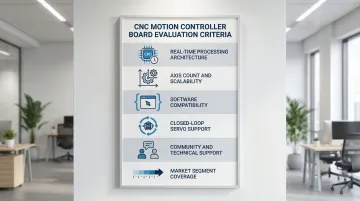
This list was built using specific technical and market criteria:
- Real-time processing architecture and achievable step/pulse rates (FPGA, DSP, embedded CPU)
- Axis count and scalability: from 4-axis routers to 32+ axis multi-technology machines
- Software compatibility with LinuxCNC, Mach3/4, and proprietary industrial platforms
- Closed-loop servo support and encoder feedback capability for precision applications
- Community and technical support ecosystem — critical for long-term viability and troubleshooting
- Market segment coverage: DIY prosumer through full industrial OEM
Each manufacturer on this list has demonstrated documented market presence, a verifiable customer base, and products that address distinct segments of the motion control market. Use this list to shortlist candidates, then cross-reference each against your specific axis count, software platform, and performance requirements before committing.
Conclusion
The motion controller board is a foundational investment in any CNC system. The right choice directly determines achievable precision, axis scalability, and long-term reliability — making it worth evaluating against actual application requirements rather than cost alone.
Prioritize software compatibility, real-time processing architecture, and closed-loop feedback capability when shortlisting manufacturers. Verify that the board you select has an active support community or direct vendor support before committing.
The global CNC controller market is projected to reach $7.2 billion by 2033, driven by networked manufacturing and precision automation demands. A well-matched motion controller puts your system in position to meet those demands as they grow.
For CNC machine builders and automation integrators working within a LinuxCNC environment who need reliable servo and stepper interfaces with proven emergency-stop position tracking, Pico Systems offers specialized motion control interface boards built for that environment. Reach out at elson@pico-systems.com or +1 314-965-5523 to discuss your requirements.
Frequently Asked Questions
What is the difference between a CNC motion controller board and a breakout board?
A breakout board simply routes signals from a PC's parallel port to motor drives without onboard processing, while a motion controller board contains its own processor or FPGA that generates precise real-time step pulses independently. This results in higher performance, better reliability, and compatibility with modern PCs that lack parallel ports.
Which CNC motion controller board is best for LinuxCNC?
Mesa Electronics (7i76E, 7i92) and Pico Systems (USC, PPMC series) are the most widely used options in the LinuxCNC ecosystem. Mesa is favored for FPGA flexibility; Pico Systems is valued for dedicated servo amplifier interfaces and emergency-stop position tracking. Both use HAL-compatible drivers and support closed-loop servo control.
How many axes can a CNC motion controller board support?
Entry-level boards typically support 3–4 axes — sufficient for most router and mill applications. Mid-range boards cover 6–8 axes, while high-end industrial controllers from FANUC, Siemens, or Galil can coordinate 32 or more. Select based on current needs plus planned expansion to avoid costly upgrades.
What is the difference between open-loop and closed-loop motion control?
Open-loop control sends commands without position feedback, relying on the motor not losing steps. Closed-loop control uses encoder feedback to verify and correct position in real time. The latter is preferred for high-speed, high-load, or precision applications where step loss would cause scrap or damage.
Can a single CNC motion controller board drive both servo and stepper motors?
Many modern boards — including those from Mesa Electronics, Pico Systems, and CNCdrive — support both servo and stepper motors simultaneously. Servo outputs use ±10V analog or step/dir signals; stepper outputs use step/direction pulses. Match the board's output type to the drive's input type during system design.
What factors matter most when choosing a CNC motion controller board for industrial use?
For industrial use, prioritize:
- Real-time determinism (jitter under 1ms)
- Step pulse frequency (higher frequency enables faster speeds with fine resolution)
- Axis count headroom for future expansion
- Closed-loop encoder support and software compatibility
In production environments, MTBF rating and vendor support longevity are as important as raw specifications.