
The servo interface board is the critical link in any CNC retrofit: it translates commands from the control software into precise analog or digital signals that servo amplifiers can act on, directly impacting accuracy, response time, and machine reliability. Without the right interface board, even the best software and servo drives cannot communicate effectively.
With a growing number of manufacturers offering retrofit-ready servo interface boards — each with different software compatibility, axis counts, and signal types — choosing the right one requires more than a quick price comparison. This guide examines the top ten manufacturers and helps you select the board that matches your specific retrofit requirements.
Key Takeaways
- A CNC retrofit servo interface board bridges control software (LinuxCNC, Mach3/4) and servo amplifiers, translating motion commands into analog or step/direction signals
- The right board depends on your software platform, number of axes, signal type required, and whether you need encoder feedback or closed-loop position tracking
- Top manufacturers span FPGA-based motion controllers, LinuxCNC-compatible analog interfaces, and industrial-grade multi-axis boards
- Software compatibility, I/O count, latency, and access to technical support are the factors that separate a good fit from a frustrating one
What Is a CNC Retrofit Servo Interface Board?
A servo interface board is a hardware component that sits between CNC software and servo amplifiers, translating high-level motion commands into the signal format the servo drive expects.
Unlike a simple breakout board that routes signals from a parallel port to motor drives with basic isolation, a servo interface board actively generates precise analog ±10V or digital servo commands and handles encoder feedback. This makes it suitable for closed-loop servo systems rather than basic stepper drive control.
Signal Types: Analog vs. Step/Direction
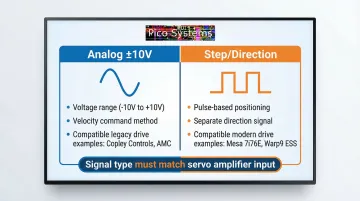
Two dominant signal types define the servo interface landscape:
Analog ±10V output is common in legacy industrial servo systems where velocity is commanded directly. The board outputs a voltage ranging from -10V to +10V to control the motor's speed and direction. This approach remains critical for retrofits preserving existing analog-input servo drives from manufacturers like Copley Controls and AMC.
Step/direction works with modern digital servo drives. One signal line carries pulses (steps) to determine position and speed, while another carries a high/low signal for direction. Boards like the Mesa 7i76E and Warp9 Ethernet SmoothStepper can generate step frequencies up to 4 MHz, supporting high-performance digital drives.
Signal type must match the existing or planned servo amplifier. A mismatch here is the most common source of integration failure.
The CNC Retrofit Use Case
CNC retrofits typically involve replacing an obsolete OEM controller while retaining existing servo drives, motors, and mechanics. The servo interface board makes this possible without replacing the entire drive system, preserving substantial capital investment while updating the control system.
Top 10 CNC Retrofit Servo Interface Board Manufacturers
These manufacturers were selected based on their established presence in the CNC retrofit market, compatibility with widely-used control software platforms, available axis counts, signal type support, and evidence of active user communities or professional deployments.
Pico Systems
Pico Systems, based in Kirkwood, Missouri, is a specialized provider of motion control interfaces for industrial automation and CNC retrofit applications. The company offers servo interface boards purpose-built for compatibility with LinuxCNC and analog servo amplifiers.
The PPMC (Parallel Port Motion Control) architecture provides modular, expandable motion control through an 8-slot motherboard system. Key capabilities include:
- Analog ±10V velocity command output to servo amplifiers via the DAC16 board
- Closed-loop position tracking during emergency stop conditions
- Purpose-built compatibility with existing analog-input servo drives
The company's Gecko Interface enables encoder position reading during E-stop mode, allowing LinuxCNC to function as a DRO (Digital Read Out) while maintaining coordinate system integrity. This is particularly valuable for safe machine resumption and accurate position recovery after a fault.
| Aspect | Details |
|---|---|
| Key Features | 4 axes (DAC16), analog ±10V output, 16-bit resolution, encoder feedback inputs, PPMC modular architecture, native LinuxCNC HAL driver support |
| Compatible Drives | Copley Controls, AMC, Gecko 320-series (with dedicated interface), nearly all velocity servo amplifiers |
| Target Use Case | CNC machine retrofits using LinuxCNC with existing analog servo drive infrastructure, parallel port connectivity |
Mesa Electronics
Mesa Electronics is a California-based manufacturer that has earned a strong following in the LinuxCNC community for its FPGA-based motion control cards. The company offers a broad range of servo interface boards including the 7i77 and 7i76E that support both analog and step/direction servo systems.
Mesa's FPGA architecture enables deterministic real-time pulse generation, relieving the host PC of timing-critical tasks. The 7i77 analog interface supports up to 6 axes with ±10V output and includes 48 isolated I/O points (32 sinking inputs, 16 sourcing outputs). The 7i76E provides 5-axis step/direction control via Ethernet connectivity.
The HostMot2 FPGA firmware offloads real-time tasks like encoder counting and pulse generation from the host PC, ensuring low latency and high-speed processing. Mesa boards feature active integration with LinuxCNC's HAL layer through native drivers (hm2_pci and hm2_eth), making them a preferred choice for multi-axis industrial retrofits.
| Aspect | Details |
|---|---|
| Key Features | FPGA-based, 6 axes (7i77 analog), 5 axes (7i76E step/dir), 48 I/O points (7i77), six ±10V analog outputs with individually configurable encoder inputs |
| Connectivity | Ethernet (7i76E), PCI, PCIe interface options |
| Software Compatibility | LinuxCNC (HAL-native via HostMot2 drivers) |
Vital Systems (CSMIO)
Vital Systems, maker of the CSMIO series, produces Ethernet-based motion controllers widely used for CNC retrofits with Mach3 and Mach4 software. The product line offers both analog servo output (CSMIO/IP-A) and step/direction (CSMIO/IP-S) variants.
The CSMIO line eliminates parallel port dependency through plug-and-play Ethernet, runs a motion kernel independent of PC OS scheduling, and supports spindle encoder feedback. The IP-A variant delivers 6-axis ±10V analog control with 24 digital inputs, 16 digital outputs (all optically isolated, 24V compliant), and 6 encoder inputs accepting incremental TTL (RS422) differential signals up to 6 MHz.
The CSMIO/IP-S variant controls up to 6 axes using step/direction signals with step frequencies up to 4 MHz, providing 32 digital inputs and 16 digital outputs. The Ethernet connection (10/100Mb) provides galvanic isolation and reliable transmission in industrial environments.
| Aspect | Details |
|---|---|
| Key Features | 6 axes, analog (IP-A) or step/dir (IP-S) variants, 24/32 digital inputs, 16 outputs, 6 encoder inputs (IP-A), up to 4 MHz step frequency (IP-S) |
| Connectivity | Ethernet-based (10/100Mb), galvanic isolation |
| Software Compatibility | Mach3, Mach4, CS-Lab simCNC |
Centroid
Centroid is a U.S.-based CNC retrofit specialist offering both complete retrofit systems and standalone interface hardware. Their Acorn and Oak boards support servo motor control, and the company is well known for providing end-to-end retrofit services for Bridgeport mills, knee mills, and industrial machining centers.
Centroid's strengths include proprietary CNC12 software optimized for servo-based retrofits, an onboard motion CPU (BeagleBone-based on Acorn), phone support with a certified installer network, and a demonstrated track record of cost savings versus new machine purchases. The Acorn works with any drive accepting step/direction signals, including Yaskawa, Delta, and Teknic Clearpath.
The CNC12 software comes in tiered versions: the "Free" version is limited to 50KB G-code files, while "Pro" and "Ultimate" licenses unlock unlimited file sizes and advanced features. Licenses are perpetual, meaning users own the software version indefinitely.
| Aspect | Details |
|---|---|
| Key Features | BeagleBone-based (Acorn), step/direction support, compatible with digital servos and steppers, tiered software versions (Free/Pro/Ultimate) |
| Support & Services | Full retrofit services, phone support, certified installer network, documented ROI for machine tool retrofits |
| Software | Centroid CNC12 (proprietary), perpetual licensing model |
Galil Motion Control
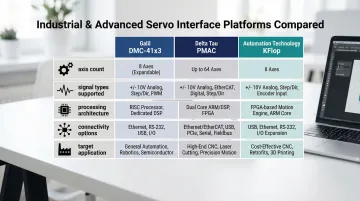
Galil Motion Control, founded in 1983 and headquartered in Rocklin, California, is an industrial motion controller manufacturer whose DMC-series boards are used in high-performance CNC retrofit and automation applications requiring multi-axis coordinated servo control.
Galil controllers run onboard processing independently of the host PC, supporting a wide range of servo drive interfaces for demanding multi-axis applications. The DMC-41x3 series covers 1 to 8 axes in stepper or servo configurations, with ±10V analog outputs and step/direction signals. For larger systems, the DMC-52xx0 operates as a pure EtherCAT master controlling up to 32 axes.
Galil controllers use a proprietary two-letter intuitive command language (e.g., "BG" for Begin Motion) but also support G-code execution for CNC applications. The company's product line references compliance with IEC and ISO standards, positioning it for industrial applications requiring functional safety.
| Aspect | Details |
|---|---|
| Key Features | 1-8 axes (DMC-41x3), up to 32 axes (DMC-52xx0 EtherCAT), ±10V analog and step/dir support, onboard programmable motion language, uncommitted analog inputs, optically isolated I/O |
| Connectivity | USB, 10/100Base-T Ethernet, PCI, EtherCAT options |
| Target Use Case | High-performance industrial CNC retrofits, custom automation, semiconductor equipment, precision manufacturing |
Delta Tau / Novanta (PMAC)
Delta Tau, now part of Novanta (acquired by Omron in 2015), produces the PMAC (Programmable Multi-Axis Controller) series — a longstanding industrial-grade servo interface and motion control platform used in CNC retrofits, semiconductor equipment, and precision manufacturing systems requiring advanced trajectory control.
The PMAC platform uses DSP-based architecture for high-speed real-time motion, supports analog, step/dir, and fieldbus servo interfaces, and offers programmable motion programs. The platform achieves 16.6 µs servo update times per axis. Modern units like the CK3E and Power UMAC support EtherCAT and Ethernet connectivity.
PMAC controllers interface with virtually any motor type through analog ±10V, pulse/direction, and direct PWM commands. The platform is used extensively in semiconductor manufacturing, LCD production, and laser processing, where compliance with IEC 62061 and ISO 13849-1 safety standards is often required.
| Aspect | Details |
|---|---|
| Key Features | DSP-based processing, 16.6 µs servo update times, analog ±10V/step-dir/PWM support, multi-axis trajectory control, programmable motion programs |
| Industry Applications | CNC retrofits, precision manufacturing, semiconductor equipment, LCD production, laser processing |
| Software Compatibility | Proprietary programming environment, G-code support, EtherCAT and Ethernet connectivity |
Automation Technology Inc. (KFlop / KMotionCNC)
Automation Technology Inc. produces the KFlop motion control board — an FPGA/DSP-based servo interface board running the KMotionCNC software, popular in the DIY and semi-professional CNC retrofit community for its open-source firmware and strong analog servo support.
KFlop combines a 1.2 GFLOP TMS320C6722 DSP with a 100k Gate FPGA for capable onboard processing at an entry-level price point (~$299). Core capabilities include:
- 8-axis control with all axes sampled every 90 microseconds
- Analog ±10V servo output via the Kanalog expansion board
- Open-source C-based programming through the KMotion environment
The KMotionCNC software is a complete G-code CNC application included with the board. The system is highly open, with C-code libraries and source code for the interpreter and coordinated motion planners provided. Active community forums support integration and troubleshooting.
| Aspect | Details |
|---|---|
| Key Features | 8 axes, DSP (1.2 GFLOP) + FPGA (100k Gate), 90 µs sample rate, step/dir native, analog ±10V via Kanalog expansion, open C-based programming |
| Software | KMotionCNC (included), open-source firmware, C-code libraries provided |
| Community & Support | Active forums, open-source development model, entry-level pricing (~$299) |
Granite Devices
Granite Devices, a Finnish motion control company, manufactures the IONI and Argon servo drives alongside the SimpleMotion serial interface — offering an integrated approach to CNC retrofit where the interface board communicates with servo drives over a proprietary high-speed serial bus rather than analog wiring.
The SimpleMotion V2 protocol enables daisy-chained multi-axis servo control over a single cable — a practical advantage for compact retrofits where wiring complexity is a constraint. The protocol runs over RS-485 using standard RJ45 Ethernet cables, allowing robust differential signaling across long cable runs.
The default bitrate is 460.8 kbps, capable of delivering over 1,000 motion commands per second. High-speed modes (4 Mbps) allow up to 20,000 commands/sec. The protocol supports multidrop bus topology, allowing up to 32 devices (axes) on a single link. The integrated drive+interface approach reduces wiring complexity substantially.
| Aspect | Details |
|---|---|
| Key Features | Up to 32 axes via daisy-chain, SimpleMotion V2 serial bus (RS-485), 460.8 kbps default (4 Mbps high-speed), IONI/Argon servo drives, Safe Torque Off (STO) support |
| Interface Type | SimpleMotion V2 serial bus over RJ45, open protocol with PC adapters available |
| Target Use Case | Compact multi-axis CNC retrofits requiring reduced wiring complexity, integrated drive+interface systems |
Warp9 Tech Design (Ethernet SmoothStepper)
Warp9 Tech Design produces the Ethernet SmoothStepper — a motion control interface board designed to replace the parallel port in Mach3/Mach4-based CNC systems, supporting both step/direction and analog servo configurations through external breakout board combinations.
The SmoothStepper's Ethernet motion kernel operates independently of Windows scheduling, delivering step frequency output up to 4 MHz. The board supports up to 6 motors (Step/Dir, Quadrature, or CW/CCW) and provides three parallel-port-style ports totaling 51 I/O pins. Its large installed base in the Mach3/Mach4 community reflects broad compatibility with existing breakout boards and servo drives.
The Ethernet connection provides electrical isolation between the PC and CNC hardware, improving noise immunity. A USB version exists but is not recommended for new builds by the manufacturer due to the superior features of the Ethernet version.
| Aspect | Details |
|---|---|
| Key Features | 6 axes, up to 4 MHz step frequency, 51 I/O pins (3 parallel-port-style ports), real-time Ethernet kernel, supports Step/Dir, Quadrature, CW/CCW |
| Connectivity | Ethernet (recommended), USB variant available but not recommended for new builds |
| Software Compatibility | Mach3, Mach4 (requires plugin) |
Rutex
Rutex manufactures servo drive and interface board solutions for CNC retrofit applications, with boards that accept encoder feedback and provide analog command outputs compatible with standard servo amplifiers used in legacy industrial machine upgrades.
The R2040 Interface combines servo drive and interface functions in a single board. It provides an optoisolated ±10V analog output to drive third-party analog servo amplifiers, accepts standard Step & Direction signals from the host CNC, and includes 5V incremental differential encoder inputs.
Product documentation dates back to the mid-2000s, making Rutex a legacy option suited primarily to maintaining or replicating specific older setups rather than new deployments.
| Aspect | Details |
|---|---|
| Key Features | Analog ±10V output (R2040), Step/Dir input acceptance, 5V incremental differential encoder inputs, combined drive/interface functionality |
| Compatible Systems | Legacy CNC software platforms, 3rd party analog servo amplifiers |
| Target Use Case | Legacy CNC machine retrofits requiring analog servo interface, maintaining older system configurations |
How We Chose the Best CNC Retrofit Servo Interface Board Manufacturers
Manufacturers were assessed on software platform compatibility (LinuxCNC, Mach3/4, proprietary), signal type support (analog ±10V vs. step/direction), axis count scalability, connectivity (Ethernet vs. USB vs. PCI), and quality of documentation or community support. Buyers often make the mistake of selecting a board based on price alone without verifying servo amplifier signal compatibility — a critical error that can derail an entire retrofit project.
For retrofit applications specifically, two factors are often underweighted:
- Closed-loop position tracking during E-stop events — Boards like those from Pico Systems maintain encoder tracking through emergency stop events, recording the exact final position of each axis. This allows safe machine resumption without losing positional reference or requiring re-homing.
- Latency and pulse generation performance — The board's pulse output must match the servo drive's bandwidth requirements. FPGA-based boards (Mesa, KFlop) and dedicated hardware like SmoothStepper deliver deterministic, low-jitter pulse generation — a clear advantage over software-generated pulses from a standard PC parallel port. Mesa's 7i77 supports six encoder inputs individually configurable for differential or single-ended mode, while the Warp9 ESS can generate step frequencies up to 4 MHz.
Long-term supportability matters. Boards with active communities, available HAL drivers (for LinuxCNC), or backed by manufacturers offering direct technical support reduce integration risk on complex retrofit projects. Safety standards like ISO 13849-1 and IEC 62061 are increasingly referenced in industrial-grade controllers from manufacturers like Galil and Delta Tau, while entry-level boards often require the integrator to build external safety circuits.
Conclusion
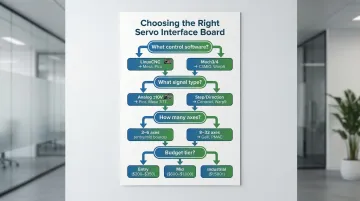
The right servo interface board for a CNC retrofit is not a universal choice — it depends on the control software in use, the type of servo amplifiers already installed, the number of axes, and whether the application demands industrial-grade real-time determinism or is suited to a community-supported open-source solution.
Verify signal-type compatibility with your existing servo drives before purchasing. A step/direction board cannot drive an analog-only servo amplifier without complex converters, and vice versa. Assess whether the manufacturer provides ongoing firmware/driver support and factor in integration time as part of total cost — not just the board price.
Price tiers break down roughly as follows:
- Entry-level ($200–$350) — Mesa and KFlop deliver strong value for 3–6 axis machines with active community support
- Mid-range ($600–$1,000) — CSMIO and Centroid add integrated features and manufacturer-backed support
- Industrial ($1,500+) — Galil and Delta Tau provide large-scale axis counts and specialized features for complex automation
For engineers retrofitting CNC machines with analog servo amplifiers and running LinuxCNC, Pico Systems offers purpose-built servo interface boards with proven compatibility with Copley Controls and Gecko drives. Contact them at elson@pico-systems.com or +1 314-965-5523 to discuss your specific retrofit requirements.
Frequently Asked Questions
What is the difference between a servo interface board and a CNC breakout board?
A breakout board simply routes signals from a parallel port to motor drives and I/O, providing basic isolation and pin access. A servo interface board actively generates precise analog (±10V) or digital servo commands and handles encoder feedback through FPGA, DSP, or microcontroller processing — making it suitable for closed-loop servo systems.
What signal types do CNC retrofit servo interface boards support?
The two main types are analog ±10V (velocity command to legacy servo amplifiers) and step/direction (for digital servo drives). The correct type must match the input specification of the servo amplifier being used in the retrofit, as this is the most common source of integration failure.
Which servo interface boards are compatible with LinuxCNC?
Well-known LinuxCNC-compatible boards include Mesa Electronics (7i77, 7i76E) and Pico Systems (PPMC boards). Compatibility depends on whether a Hardware Abstraction Layer (HAL) driver exists for the board — Mesa uses the HostMot2 driver, Pico uses the PPMC driver.
How many axes can a typical CNC retrofit servo interface board support?
Most retrofit-grade boards support 3 to 6 axes (Mesa 7i77 supports 6, CSMIO supports 6, Warp9 ESS supports 6). Industrial controllers like Galil DMC-52xx0 or PMAC can scale to 32 axes or more for complex automation applications.
Can a servo interface board maintain position during an emergency stop?
Some boards — including Pico Systems' PPMC line — track encoder position during E-stop events through continuous encoder power and signal isolation. Without this capability, a machine must re-home after every fault, adding downtime and introducing positioning risk.
What is the typical cost range for a CNC retrofit servo interface board?
Pricing breaks down roughly by tier:
- Entry-level ($200–$350): Community-supported boards such as Mesa, KFlop, and Warp9 ESS
- Mid-range ($600–$1,000): Packaged kits like CSMIO and Centroid Acorn
- Industrial-grade ($2,000+): High-axis controllers from Galil and PMAC
Factor in integration complexity and support availability alongside the sticker price — cheaper boards can carry hidden costs in setup time.