Introduction
Engineers retrofitting CNC machines, robotics systems, and industrial automation equipment face a persistent challenge: legacy resolver-equipped motors don't speak the same language as modern motion controllers built for encoder inputs. That signal mismatch can stall an entire retrofit project before it gets off the ground.
Resolver to quadrature converter boards solve this problem by translating analog resolver feedback—sine and cosine signals that vary with shaft angle—into digital quadrature signals (A/B/Z) that standard controllers recognize. This eliminates the need to replace resolvers, cutting retrofit costs and downtime without swapping out hardware that's still working fine.
The global resolver interface IC market is projected to grow from $691.7 million in 2025 to $1.44 billion by 2034, reflecting surging demand across industrial automation, aerospace, and CNC machine tool markets. Below, we break down the top manufacturers in this space — what they build, who they build it for, and what sets them apart.
Key Takeaways
- Resolver-to-quadrature converters let encoder-input controllers read resolver feedback—no hardware replacement needed
- Top manufacturers differ in resolution (PPR or bits), temperature range, and application focus, spanning aerospace-grade to LinuxCNC-compatible designs
- Key selection factors: output resolution, excitation frequency compatibility, quadrature output format, and integration support
- Leading names include Pico Systems, Data Device Corporation, Analog Devices, Tamagawa Seiki, and Renesas Electronics
- Always verify output format, resolution, and interface protocol match your motion controller before purchasing
What Is a Resolver to Quadrature Converter Board?
Resolver to quadrature converter boards accept analog sine/cosine output from a resolver and convert it into incremental quadrature encoder signals (A, B, and optionally Z index pulse) that standard motion controllers, PLCs, and CNC systems recognize.
R/D vs. R/Q Converters
Two converter types are often confused, but they serve different purposes:
| R/D Converter | R/Q Converter | |
|---|---|---|
| Output type | Digital word (parallel or serial) | Pulse-train quadrature (A/B/Z) |
| Position data | Absolute | Incremental |
| Best use case | Systems requiring digital position readout | Retrofits expecting standard encoder input |
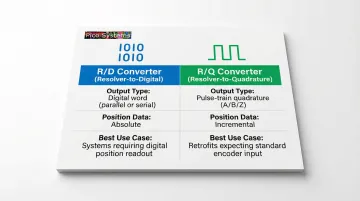
R/Q converters are the right choice when you need to keep an existing resolver in place but feed its signal into a controller that expects encoder pulses — no resolver swap required.
Key Applications Driving Demand
The primary industries using these converters include:
- CNC machine tool retrofits: Upgrading older machines with modern controllers while retaining resolver-equipped motors
- Servo motor control: Interfacing resolver feedback with encoder-based servo drives
- Emergency stop position retention: Leveraging resolvers' absolute position capability during power interruptions
- Open-source motion control: Enabling compatibility with platforms like LinuxCNC
Resolvers excel in high temperatures, extreme vibration, and electrical noise—conditions where optical encoders often fail. R/Q converters let you keep that durability advantage without rearchitecting the control side of your system.
Top 10 Resolver to Quadrature Converter Board Manufacturers
This list evaluates leading manufacturers on technical capability, product range, industry reputation, and application breadth. Note that several entries supply ICs rather than complete boards — those distinctions are called out in each profile so you can match the right vendor to your integration approach.
Pico Systems
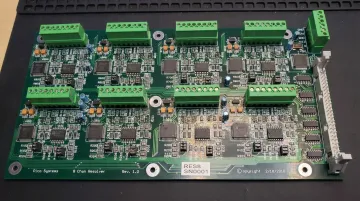
Pico Systems, based in Kirkwood, Missouri, specializes in motion control interfaces and components for industrial automation and CNC systems. Their resolver-to-quadrature converter boards are designed specifically for CNC and servo applications, with strong compatibility with LinuxCNC and servo amplifiers from manufacturers like Copley Controls and Gecko.
Key Differentiators:
- Specialized resolver interface expertise for CNC retrofits
- Enables position tracking during emergency stops
- Interfaces between disparate control hardware without motor replacement
- Direct LinuxCNC compatibility via parallel port PPMC architecture
Technical Specifications:
| Specification | Details |
|---|---|
| Resolution / Output Format | 4096 PPR fixed resolution; differential A/B/Z quadrature output with index pulse |
| Input Compatibility | Jumper-selectable signal amplitudes for different resolver transformation ratios; configurable for various resolver types |
| Key Applications | CNC machine retrofits, LinuxCNC integration, servo amplifier interfacing, emergency stop position retention |
| Pricing | Single-channel: $150; 8-channel: $1,250 |
Pico Systems offers both single-channel and 8-channel versions, with the latter providing independent conversion for multi-axis systems through a single 50-pin ribbon cable connector.
Data Device Corporation (DDC)
DDC manufactures high-reliability data bus and motion feedback components, including the RD-19231 series of 16-bit R/D converters with built-in encoder emulation for aerospace, industrial, and commercial positioning systems.
Key Differentiators:
- Internal encoder emulation outputting incremental quadrature signals
- User-programmable resolution (10/12/14/16-bit)
- Synthesized reference eliminating tracking errors from up to 45 degrees of phase shift
- Wide operating temperature range: -40°C to +85°C
Technical Specifications:
| Specification | Details |
|---|---|
| Resolution / Output Format | 10, 12, 14, or 16-bit switchable; encoder emulation outputs A-quad-B signals |
| Input Compatibility | Differential resolver inputs with easy filtering in noisy environments; accepts Synchro, Resolver, Inductosyn, LVDT, RVDT, MR, and Hall Sensor inputs |
| Key Applications | Servo motor controls, antenna positioning, aerospace position feedback, machine tool and robotic positioning |
The synthesized reference is the standout feature for installations with long cable runs — systems exceeding roughly 50 meters often see enough phase shift to degrade tracking accuracy in converters without this capability.
Analog Devices (AD2S Series)
Analog Devices produces the AD2S series of R/D converter ICs, which—particularly the AD2S1210—represents industry-standard R/D converter ICs widely integrated into resolver-to-quadrature converter boards by OEMs and system integrators worldwide.
Key Differentiators:
- 10–16 bit programmable resolution
- On-chip fault detection for loss of resolver signals and tracking errors
- Programmable excitation frequency (2–20 kHz)
- Broad adoption in motor control reference designs
Technical Specifications:
| Specification | Details |
|---|---|
| Resolution / Output Format | 10, 12, 14, or 16-bit user-selectable; A-quad-B encoder emulation with direction output; SPI and parallel digital output |
| Input Compatibility | Programmable sinusoidal oscillator providing 2 kHz to 20 kHz excitation; accepts standard resolver inputs |
| Key Applications | Industrial servo drives, motor control boards, robotics, position feedback systems |
Note: Analog Devices primarily sells the AD2S1210 as an IC component rather than complete board-level products. OEMs like Pico Systems use the AD2S1210 chip to create complete resolver-to-quadrature converter boards.
Tamagawa Seiki
Tamagawa Seiki is a Japanese manufacturer with deep expertise in resolvers, encoders, and resolver-to-digital converter modules, offering complete feedback system solutions for industrial and automotive applications.
Key Differentiators:
- Integrated resolver and R/D converter module offerings
- Automotive-grade reliability
- Extreme temperature operation: -40°C to +125°C
Technical Specifications:
| Specification | Details |
|---|---|
| Resolution / Output Format | 12-bit (4,096 counts/revolution); A, B, Z pulse outputs plus 12-bit binary parallel and serial interface |
| Input Compatibility | Integrated constant current excitation amplifier (selectable 10 mArms or 20 mArms); ±45° phase adjustment tolerance |
| Key Applications | Automotive servo systems, industrial automation, precision positioning |
The Smartcoder AU6805's selectable current excitation levels make it adaptable to resolvers with different impedance characteristics — useful when retrofitting into systems where the original resolver spec is undocumented.
Renesas Electronics
Renesas is a major semiconductor manufacturer offering R/D converter ICs (RAA306400xGFP series) used extensively in resolver interface board designs for motor control in automotive and industrial markets.
Key Differentiators:
- High integration with low power consumption
- Strong reference design ecosystem
- Programmable excitation frequencies: 5 kHz, 10 kHz, or 20 kHz
Technical Specifications:
| Specification | Details |
|---|---|
| Resolution / Output Format | Up to 16,000 pulses/rotation capability; rectangular wave output with phase delay proportional to resolver angle; SPI interface (max 1 MHz) |
| Input Compatibility | Integrated exciter amplifier with selectable 5 kHz, 10 kHz, or 20 kHz excitation |
| Key Applications | EV traction motor control, industrial servo systems, HVAC and pump motor drives |
Renesas supplies ICs rather than complete board-level products — OEMs integrate the RAA306400xGFP into finished converter hardware, often alongside Renesas's own reference schematics for motor control applications.
HEIDENHAIN
HEIDENHAIN is a German precision measurement and motion feedback technology company known for encoder and resolver interface solutions used in high-accuracy machine tool and metrology applications.
Key Differentiators:
- High accuracy and robust industrial construction
- Compatibility with HEIDENHAIN numerical controls and third-party CNC systems
- Focus on signal conversion for their own encoder products
Technical Specifications:
| Specification | Details |
|---|---|
| Resolution / Output Format | Signal converters primarily for HEIDENHAIN encoders (1 Vpp, EnDat, SSI) to TTL square-wave |
| Input Compatibility | No specific resolver-to-quadrature products identified; focus on encoder signal adaptation |
| Key Applications | Machine tool CNC, precision manufacturing, metrology systems |
Note: HEIDENHAIN's product line focuses on signal converters for their own encoder technologies rather than resolver-to-quadrature conversion specifically.
Parker Hannifin (Electromechanical Division)
Parker Hannifin's Electromechanical and Drive Technology division integrates resolver interface and feedback conversion directly into their servo drive systems for industrial and aerospace markets.
Key Differentiators:
- Integration with Parker servo drive ecosystem
- Encoder emulation providing 16-bit resolution per electrical revolution (equivalent to 1024-line encoder)
- Global service and support network
Technical Specifications:
| Specification | Details |
|---|---|
| Resolution / Output Format | 16-bit per electrical revolution; emulated pulse encoder with differential A, B, Z outputs (RS-422) |
| Input Compatibility | Differential inputs (~2 kΩ impedance, ±12V peak max); 7Vrms carrier at 8kHz |
| Key Applications | Industrial servo systems, aerospace actuators, packaging machinery |
Note: Parker does not offer standalone R/Q converter boards; functionality is embedded within their 890 series drives via 8902/RR modules.
Moog Inc.
Moog is a precision motion control manufacturer serving aerospace, defense, and industrial markets, with resolver-based feedback interface capabilities integrated into their drive and control product lines.
Key Differentiators:
- Aerospace-grade reliability and high-temperature performance
- Use in safety-critical applications
- Programmable resolution from 128 ppr to 16,384 ppr
Technical Specifications:
| Specification | Details |
|---|---|
| Resolution / Output Format | 128 to 16,384 ppr programmable; RS422 differential outputs (A, A/, B, B/, MARKER, MARKER/) |
| Input Compatibility | Integrated resolver decoding in T164 Series and MicroDS drives |
| Key Applications | Aerospace actuators, defense systems, industrial motion control |
Note: Like Parker, Moog integrates resolver decoding into their servo drives rather than offering standalone converter boards.
Renishaw
Renishaw is a UK-based metrology and position feedback specialist whose encoder interfaces are widely used in manufacturing and machine tool applications.
Key Differentiators:
- Extremely high accuracy output
- Strong presence in machine tool markets
- Comprehensive encoder interface portfolio
Technical Specifications:
| Specification | Details |
|---|---|
| Resolution / Output Format | Focus on optical and magnetic encoder interfaces (BiSS C, SSI, 1 Vpp Sin/Cos to digital) |
| Input Compatibility | No specific resolver interface products identified; specialization in encoder signal conversion |
| Key Applications | CNC machine tools, coordinate measuring machines, precision manufacturing |
Note: Renishaw's portfolio centers on their own encoder technologies rather than resolver-to-quadrature conversion.
Zettlex (Celera Motion)
Zettlex (now part of Celera Motion) is a UK-based specialist in non-contact position sensing technology, offering inductive position sensor solutions for demanding industrial and defense environments.
Key Differentiators:
- Rugged, non-contact inductive encoder design
- Compact form factor with IP68 rated versions
- Suitability for harsh environments
Technical Specifications:
| Specification | Details |
|---|---|
| Resolution / Output Format | IncOder inductive encoders with A/B/Z pulse interfaces (RS422, Push-Pull TTL, Push-Pull HTL); up to 17-bit resolution |
| Input Compatibility | IncOders are inductive angle sensors, not resolver converters; use laminar circuits instead of wound wire |
| Key Applications | Defense, subsea, heavy industrial, harsh-environment motion control |
Note: Zettlex positions IncOders as modern alternatives to resolvers rather than converters for traditional resolver signals.
How We Chose the Best Resolver to Quadrature Converter Board Manufacturers
Selection criteria combined technical capability, industry reputation, application breadth, and documentation availability. That said, resolution alone doesn't tell the whole story — many engineers overlook excitation frequency compatibility or output signal voltage levels until they're already mid-integration.
Critical Evaluation Factors
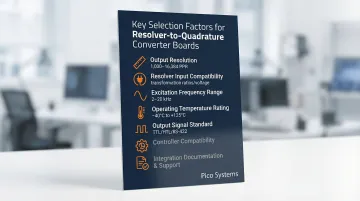
Key specs to verify before purchasing:
- Output resolution of 1,000–16,384 PPR (or equivalent bit depth) matched to your application's accuracy needs
- Resolver input compatibility — transformation ratios and acceptable voltage ranges vary by manufacturer
- Excitation frequency range (typically 2–20 kHz); programmable frequency support adds flexibility for multi-resolver setups
- Operating temperature rating: -40°C to +85°C for industrial, up to +125°C for automotive or aerospace environments
- Output signal standard — TTL (5V), HTL (10–30V), or differential RS-422 — matched to your controller's input spec
- Confirmed compatibility with your motion controller or CNC platform, not just generic "industrial" claims
- Quality of integration documentation and availability of actual technical support
Special Considerations for CNC and LinuxCNC Users
For open-source CNC platforms, hardware specs alone don't tell the full story. Interface type—parallel port, USB, EtherCAT, Mesa FPGA cards—adds another layer of selection complexity. LinuxCNC users benefit from boards like Pico Systems' resolver converters that integrate directly via parallel port PPMC architecture, while others may require Mesa 7i49 FPGA boards for SPI-based resolver interfaces instead.
Conclusion
The resolver to quadrature converter board market serves a critical niche: preserving investment in resolver-equipped legacy motors while enabling integration with modern encoder-based controllers. Choosing the right manufacturer requires matching technical specifications to your system requirements rather than defaulting to the best-known brand.
Before making a final decision, evaluate:
- Whether the board can handle future resolution or axis count upgrades
- Whether the product ships from standard inventory or requires a custom order
- Full integration cost, including wiring, mounting hardware, and software setup time
Pico Systems manufactures resolver-to-quadrature converter boards for CNC and servo control applications, with direct compatibility for LinuxCNC and platforms from Copley Controls and Gecko. To discuss your application requirements, contact Pico Systems at elson@pico-systems.com or +1 314-965-5523.
Frequently Asked Questions
What is the difference between a resolver-to-digital (R/D) converter and a resolver-to-quadrature (R/Q) converter board?
R/D converters output digital position data (parallel word or serial) representing absolute position, while R/Q converter boards output incremental quadrature pulse trains (A/B/Z) that mimic optical encoders. R/Q boards are specifically suited for motion controllers expecting encoder inputs.
Do I need to replace my resolver if I upgrade to an encoder-based motion controller?
No. A resolver-to-quadrature converter board eliminates the need to replace the resolver by interfacing the existing resolver output with the new controller's encoder input. This significantly reduces retrofit cost and downtime while preserving the resolver's advantages in harsh environments.
What output resolution should I look for in a resolver to quadrature converter board?
Resolution requirements depend on your application's precision needs. Most industrial CNC applications require at least 1,000–4,096 PPR, while high-precision servo systems may need 8,192 PPR or higher — a 12-bit R/D stage delivers 4,096 positions per revolution (≈0.088° accuracy). Match the converter's bit depth to your positioning tolerance before specifying.
Are resolver to quadrature converter boards compatible with LinuxCNC?
Yes, some boards are specifically designed for LinuxCNC compatibility. Pico Systems' resolver converters integrate via parallel port PPMC architecture, while Mesa FPGA cards like the 7i49 provide SPI-based resolver interfaces. Confirm your LinuxCNC HAL configuration supports the board's interface type before ordering.
What industries use resolver to quadrature converter boards most commonly?
Primary applications include CNC machine tool retrofits, industrial servo automation, aerospace actuator control, robotics, and military/defense systems. Resolvers are preferred in harsh environments with high temperatures, vibration, and electrical noise where encoders would fail, making R/Q converter boards especially valuable in these settings.
What happens to position data during a power failure or emergency stop with a resolver system?
Resolvers are absolute sensors that retain position data during power loss, unlike incremental encoders which lose position and require homing. Certain R/Q converter boards—such as those from Pico Systems—are specifically designed to maintain and output accurate position data during emergency stops, a critical feature for safety-sensitive applications.