Introduction
Thousands of manufacturing companies are sitting on aging CNC equipment that still has mechanically sound frames but failing electronics. The choice between a costly new machine purchase and a strategic retrofit is one of the most consequential financial decisions a shop floor manager faces today. When control systems fail but the iron remains solid, the question isn't whether to act—it's which retrofit path delivers the best return.
CNC retrofits extend machine life and restore full production capacity—often at 20–40% of the cost of new equipment. Real business outcomes include reduced unplanned downtime, faster operator training, and capital expenditures deferred by years. With the global machine tool retrofit market valued at $3.8 billion in 2024 and projected to reach $5.4 billion by 2030, the case for upgrading over replacing has never been stronger.
This guide covers ten proven retrofit solutions—from motion control hardware swaps to full CNC system overhauls—so you can match the right approach to your machine, budget, and production goals.
Key Takeaways
- CNC retrofits replace outdated controllers, drives, and motors while retaining the mechanical frame
- Solutions range from open-source platforms to industrial-grade controllers suited to different budgets
- Key selection criteria include machine compatibility, parts availability, and long-term vendor support
- Retrofit costs typically run 30-50% less than new machine purchases
- This article evaluates the top 10 retrofit solutions across performance, cost, and vendor support
Overview of CNC Retrofits in Manufacturing
A CNC retrofit involves replacing obsolete control systems—controllers, servo amplifiers, drives, and motors—on an existing machine while retaining the mechanical structure. This matters when the machine frame still has years of usable life but the electronics are end-of-life or unsupported. Post-pandemic surveys show that 74% of manufacturing and engineering companies rely on legacy systems and spreadsheets, highlighting a massive installed base of aging equipment.
The retrofit market is growing for three reasons:
- Capital expenditure constraints push shops to extend machine life rather than fund six-figure replacements
- Supply chain disruptions have stretched new machine lead times to 18–24 months in some categories
- Skilled labor shortages make modern, intuitive controls a practical necessity for onboarding new operators
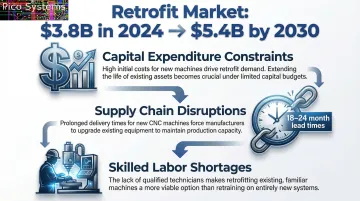
In many cases, retrofitting costs 30–50% less than purchasing new equipment with comparable capability.
The 10 retrofit solutions covered here are evaluated across machine type coverage, integration complexity, parts availability, and total cost of ownership.
Top 10 CNC Retrofit Solutions for Manufacturing Companies
These solutions span controller-only upgrades, full turnkey retrofit packages, and open-architecture platforms. Manufacturers with different machine types, budgets, and in-house technical capabilities will find relevant options here.
MachMotion CNC Retrofit Systems
MachMotion is a US-based specialist in full turnkey CNC retrofit packages for routers, lathes, mills, grinders, and waterjets. They offer both self-install and expert installation options, making them accessible to shops with varying technical resources.
What sets MachMotion apart: their production-ready guarantee, the breadth of machine types they support (including specialty machines like centerless grinders and boring mills), and their track record with well-known manufacturers including Andersen Windows and Dayton Lamina. Dynatect Manufacturing returned their waterjet to production within one week after a full MachMotion turnkey install.
| Best For | Multi-machine shops needing turnkey retrofit support across routers, grinders, lathes, and waterjets |
|---|---|
| Installation Options | Self-install kits and full expert turnkey installation |
| Key Differentiator | Production-Ready Guarantee; broad machine-type coverage |
FANUC Retrofit Platform
FANUC is the world's largest CNC control manufacturer, with approximately 65% global market share and over 4 million CNC systems installed worldwide. Their retrofit-compatible controllers (0i-MF Plus, 31i-B, 35i-B) are purpose-built for industrial CNC applications including multi-axis machining centers.
FANUC's standout advantage: guaranteed lifetime parts availability (unlike PC-based systems that can become obsolete again), upward-compatible controls, and industry-leading MTBF of more than 50 years. They maintain a stock of over 3.5 million repair parts covering 19,000 types, making it a long-term investment rather than a short-term fix.
| Best For | High-production mills, machining centers, and multi-axis CNC machines requiring long-term parts support |
|---|---|
| Notable Models | FANUC 0i-MF Plus, FANUC 31i-B, FANUC 35i-B |
| Key Differentiator | Guaranteed lifetime parts availability; ~65% global market share |
Siemens Sinumerik CNC Retrofit
The Siemens Sinumerik line (808D, 828D, 840D sl) is an Industry 4.0-compatible retrofit platform that integrates PLC and CNC control into a single system. Widely adopted in aerospace, automotive, and large-scale production environments, the 840D sl supports up to 93 axes in 30 machining channels.
Siemens differentiates through connectivity and intelligence: the platform supports Ethernet/IP, OPC UA, and MindSphere connectivity, enabling robust data collection for manufacturers pursuing smart factory initiatives. While Digital Twin capabilities exist in their NX environment, these are primarily for new machine designs rather than standard retrofit features.
| Best For | Aerospace, automotive, and large-scale production facilities requiring smart manufacturing integration |
|---|---|
| Notable Models | Sinumerik 808D (entry), 828D (mid), 840D sl (high-end) |
| Key Differentiator | Industry 4.0 / IIoT integration capability; advanced connectivity protocols |
LinuxCNC with Pico Systems Motion Control Interfaces
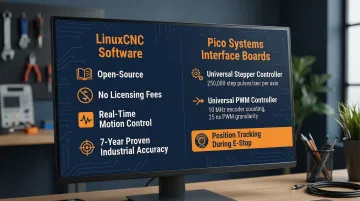
LinuxCNC (formerly EMC2) is a free, open-source CNC control software platform widely used for cost-effective retrofits on mills, lathes, routers, and custom machines. Its real-time motion control requires hardware interfaces to bridge the software with physical servo and stepper drive systems.
Pico Systems (Kirkwood, MO) provides specialized motion control interface boards—including servo amplifier interfaces and encoder feedback modules—that are specifically compatible with LinuxCNC. Their products enable manufacturers and integrators to build high-performance retrofit solutions without proprietary lock-in. A 2024 peer-reviewed study confirmed that a machining center retrofitted with LinuxCNC achieved accuracy and usability comparable to modern CNCs after seven years of industrial operation.
Pico Systems' interface boards handle the performance demands of industrial retrofit builds:
- Universal Stepper Controller: generates smooth step pulses up to 250,000 per second per axis
- Universal PWM Controller: high-speed encoder counting up to 10 MHz per axis with 25 nanosecond PWM granularity
- Both products support position tracking even during emergency stops
| Best For | Industrial automation integrators, CNC machine builders, and manufacturers seeking open-architecture, low-cost retrofit solutions |
|---|---|
| Key Components | LinuxCNC software + Pico Systems servo/stepper interface boards |
| Key Differentiator | Open-source flexibility with no licensing fees; Pico Systems interfaces enable position tracking even during emergency stops |
Centroid CNC Retrofit
Centroid builds retrofit-friendly CNC controls for mills, lathes, routers, and plasma machines. Their systems have earned a following from hobbyists and professional retrofitters alike, largely because of how straightforward the configuration process is.
Centroid's value: a Windows-based, graphical user interface with strong G-code support, onboard conversational programming (Intercon), and a large community of retrofit integrators. Users on forums like Practical Machinist describe it as "by far the easiest and capable conversational control" they have used, making operator training fast and lowering the learning curve for shops transitioning from legacy systems.
| Best For | Small to mid-size shops retrofitting mills, lathes, and routers seeking user-friendly controls |
|---|---|
| Key Differentiator | Conversational programming; strong retrofit integrator network |
| Pricing Tier | Mid-range |
PC Controls Metal Fabrication Retrofit Kits
PC Controls (Arlington, TX) specializes in CNC control retrofits for metal fabrication equipment—specifically press brakes, shears, and single-station punch presses. They offer PC-based control kits (Press Kit, Punch Kit, Shear Kit) that replace outdated proprietary controllers from brands like Hurco, Amada, Cincinnati, and Wysong.
Their differentiator: machine-specific retrofit kits with dedicated software (Bend Wizard, Shear Wizard, Punch Wizard) that provide intuitive operator interfaces, real-time diagnostics, and improved bending/cutting accuracy for metal fabricators. The deep compatibility list covers legacy metal fab equipment from major OEMs.
| Best For | Metal fabricators with aging press brakes, shears, and punch presses from legacy OEM brands |
|---|---|
| Compatible Machines | Hurco, Amada, Cincinnati, LVD, Wysong, Strippit, Accurpress, Pacific |
| Key Differentiator | Machine-specific software wizards; deep compatibility list for legacy metal fab equipment |
Masso G3 CNC Controller
Masso is a standalone CNC controller designed for router, plasma, laser, and milling machine retrofits—no PC required. It runs on its own embedded OS, removing Windows reliability concerns and cutting wiring complexity for in-house retrofit projects.
Masso's retrofit advantage: plug-and-play compatibility with common stepper and servo drivers, a touchscreen interface, built-in tool length measurement support, and a self-contained design that simplifies wiring and setup for in-house retrofit projects. The G3 Touch model features an integrated 15-inch touchscreen interface.
| Best For | Routers, plasma cutters, laser systems, and light milling machine retrofits without a PC |
|---|---|
| Key Differentiator | Standalone embedded controller; no PC dependency; touchscreen interface |
| Pricing Tier | Entry to mid-range |
Fagor Automation CNC Retrofit
Fagor Automation offers open-architecture control systems (8060 series, 8065 series) for lathes, mills, and multi-process machines. The controls support custom macros and open programming environments, making them a practical choice where flexibility and cost control take priority.
Fagor's retrofit appeal: compatibility with standard servo and drive components from multiple vendors, strong European market presence, and a modular hardware architecture that allows partial or full control system upgrades depending on the machine's condition. The 8065 series supports Industry 4.0 features and high-speed machining.
| Best For | Lathes, mills, and multi-process machines where open-architecture flexibility and cost control are priorities |
|---|---|
| Notable Models | Fagor 8060, Fagor 8065 |
| Key Differentiator | Open architecture; multi-vendor drive/servo compatibility |
Haas Next-Gen Control Retrofit (Factory Upgrade)
Haas Automation's Next-Gen Control (NGC) upgrade program allows owners of older Haas CNC machines to upgrade to the latest control platform while retaining the existing mechanical structure. The G-code-based, touchscreen interface is highly familiar to Haas machine operators.
The key differentiator: this is a factory-supported upgrade path, meaning Haas-authorized technicians perform the installation, Haas provides the parts, and the upgraded machine benefits from Haas's global support network—reducing integration risk. Eligibility is generally for mills and lathes manufactured between 1995 and 2015.
| Best For | Existing Haas CNC machine owners looking for a low-risk, factory-supported control upgrade |
|---|---|
| Key Differentiator | Factory-authorized upgrade; familiar G-code interface; global Haas support network |
| Limitation | Only applicable to Haas machines; not a cross-brand retrofit solution |
Heidenhain TNC Retrofit
Heidenhain TNC controllers (TNC 620, TNC 640) are premium retrofit options for precision machining applications. They are widely used in mold-making, medical, aerospace, and die manufacturing where micron-level accuracy and complex surface contouring are required.
Heidenhain's key differentiators: integrated CAD/CAM programming directly at the control, fast block processing (0.5 ms for the TNC 640), and optimization for 5-axis simultaneous machining and High-Speed Cutting (HSC). The TNC 640 features multi-touch screen capability and is the retrofit of choice when precision demands exceed what general-purpose controllers can deliver.
| Best For | High-precision mold, medical, aerospace, and die machining applications requiring sub-micron accuracy |
|---|---|
| Notable Models | TNC 620, TNC 640 |
| Key Differentiator | Fast block processing; integrated CAD/CAM at the control; 5-axis optimization |
Key Components of a Successful CNC Retrofit
A typical CNC retrofit touches four core hardware elements:
- CNC controller and control panel
- Servo drives and amplifiers
- Servo or stepper motors
- I/O systems
Some retrofits replace only the controller. Full retrofits address all electromechanical components.
Motion control interface boards connect the control software to servo and stepper drives. In open-architecture retrofits using platforms like LinuxCNC, these boards directly affect system reliability, encoder feedback accuracy, and emergency stop behavior.
The Pico Systems Gecko Interface, for instance, allows LinuxCNC to function as a DRO (Digital Read Out) during E-stop conditions, keeping the coordinate system intact.
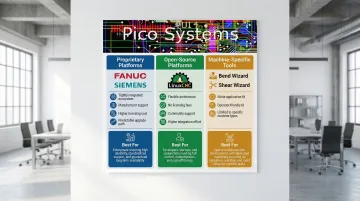
Beyond hardware, software selection shapes the entire operator experience. Proprietary platforms like FANUC and Siemens offer tightly integrated ecosystems; open-source options like LinuxCNC trade that integration for flexibility and lower licensing costs; machine-specific tools like Bend Wizard serve niche applications such as press brakes. Each choice carries different maintenance workloads and long-term upgrade paths, so software should be evaluated in parallel with hardware from the start.
How We Chose These CNC Retrofit Solutions
Each solution on this list was evaluated across six criteria: machine-type coverage, vendor track record, parts availability, integration complexity, total cost of ownership, and real-world adoption across manufacturing sectors. Upfront cost was never the deciding factor — parts obsolescence risk and long-term supportability weighed just as heavily.
Evaluation criteria:
- Controller architecture (open vs. proprietary)
- Supported machine types
- Installation pathway (turnkey vs. self-install)
- Available technical support
- Compatibility with industry communication standards (Ethernet, Profibus, EtherCAT)
- Parts availability timelines
- Vendor longevity and market presence
Conclusion
Choosing the right CNC retrofit solution requires matching the platform's capabilities to the machine type, production environment, and long-term support needs—not the most recognized brand or the lowest-cost option.
Before committing to a platform, evaluate scalability, parts availability timelines, and vendor support depth. The motion control interface layer—servo/stepper interfaces, encoder feedback hardware—is just as critical as the control software itself.
Manufacturers and integrators building custom or open-architecture retrofits can explore Pico Systems' range of LinuxCNC-compatible motion control interfaces at pico-systems.com or contact their team at elson@pico-systems.com.
Frequently Asked Questions
What is a CNC retrofit, and what components are typically replaced?
A CNC retrofit involves replacing the obsolete control system—including the CNC controller, servo drives, motors, and I/O modules—on an existing machine while retaining the mechanical frame and structure. The goal is restoring full production capability at lower cost than a new machine purchase.
How much does a CNC retrofit cost compared to buying a new CNC machine?
Retrofit costs vary widely by machine type and solution scope, but typically run 30-50% less than new machine purchases. A well-executed retrofit can achieve ROI in as little as 6 to 12 months, depending on production volume and efficiency gains.
What is the typical timeline to complete a CNC retrofit?
Timeline depends on retrofit complexity and installation method. Turnkey installations by a provider can take days to a few weeks, while self-install kits may take longer depending on the shop's technical resources. Dynatect Manufacturing returned to production within one week after a full MachMotion turnkey install.
Which CNC retrofit platform is best for older mills and lathes?
The most widely used platforms for mill and lathe retrofits are:
- FANUC — industrial-grade reliability with long-term parts availability
- Centroid — user-friendly with conversational programming support
- LinuxCNC — open-architecture option well-suited for cost-sensitive projects
Can a CNC retrofit improve machine safety and regulatory compliance?
Modern retrofit controllers include integrated safety-rated I/O, fault diagnostics, and emergency stop handling that legacy systems lack. Conduct a professional safety risk assessment per ISO 12100 when upgrading CNC controls to confirm compliance with ISO 11161 and ANSI B11.0.
What is the difference between a controller-only retrofit and a full CNC retrofit?
A controller-only retrofit replaces the CNC control panel and software while keeping existing drives and motors intact—lower cost, shorter downtime. A full retrofit replaces all electromechanical components: servo drives, motors, and I/O systems. The right choice depends on the condition of your existing drive and motor hardware.