Introduction
Aging industrial robotic systems present manufacturers with a costly dilemma: full replacement often requires six-figure capital expenditure, extensive downtime, and complete reprogramming of production workflows. Retrofit motion control offers a practical alternative—upgrading only the electronic control layer while preserving mechanically sound hardware—reducing costs by 30–50% while extending equipment life by 10–15 years.
Retrofit motion control systems swap out the electronics of existing robots and CNC machines—without touching the mechanical structure—by replacing:
- Servo drives and amplifiers
- Motion controllers and encoder interfaces
- Communication boards supporting protocols like EtherCAT and CANopen
This targeted modernization improves servo response and integrates legacy equipment into Industry 4.0 environments.
That demand is reflected in market growth: the motion control market is projected to reach $21.63 billion by 2029 (CAGR 5.5%), driven by retrofitting existing robots and CNC machines rather than replacing them outright. For manufacturers operating mechanically sound but electronically obsolete equipment, retrofit solutions deliver ROI in 6–12 months—compared to 2–4 years for full replacement.
Key Takeaways
- Retrofit motion control systems modernize robot electronics while preserving mechanical hardware, at 30–50% of full replacement cost
- Essential selection criteria: motor/encoder compatibility, software openness (LinuxCNC vs. proprietary), supported protocols such as EtherCAT and CANopen, and axis count capacity
- Specialized manufacturers like Pico Systems and Mesa Electronics offer purpose-built LinuxCNC-compatible interfaces for CNC and small robotic retrofits
- Industrial-scale providers including Yaskawa, Bosch Rexroth, and Mitsubishi Electric deliver complete servo drive and controller upgrade paths with extensive support infrastructure
- Match your choice to hardware compatibility, axis count, and long-term support availability for your specific robot architecture
What Is a Retrofit Motion Control System?
A retrofit motion control system replaces the control electronics—servo drives, motion controllers, encoder interfaces, and communication boards—of an existing robot or CNC machine while retaining its mechanical structure. This preserves the substantial investment in gantries, robot arms, gearboxes, and structural components while modernizing the control layer with up-to-date technology.
That control layer distinction is what separates retrofits from full system builds. New installations cover both mechanical and electronic components—requiring complete integration, workspace reconfiguration, and often facility modifications. Retrofits target only the electronics, cutting deployment time and capital expenditure significantly. For CNC machine builders and integrators working with aging but mechanically sound equipment, this scope difference is the core appeal.
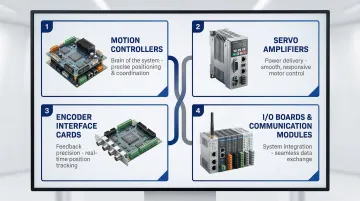
Typical components replaced during retrofits include:
- Motion controllers (replacing proprietary controllers with open-architecture alternatives)
- Servo amplifiers (upgrading to modern digital drives with network connectivity)
- Encoder interface cards (converting legacy feedback signals to current standards)
- I/O boards and communication modules (adding EtherCAT, CANopen, or Ethernet connectivity)
Software compatibility is where many retrofits succeed or stall. Open platforms like LinuxCNC offer flexibility and long-term community support. Proprietary systems can provide tighter hardware integration, but they introduce vendor lock-in that limits future modifications. For shops running custom kinematics or specialized toolpath algorithms, that distinction is often the deciding factor in which control architecture to select.
Top 10 Retrofit Motion Control System Manufacturers for Robotics
The right retrofit manufacturer depends on your axis count, budget, existing hardware, and network requirements. Each entry below identifies specific strengths, hardware compatibility, and the retrofit scenarios where that manufacturer delivers the best fit.
Pico Systems
Pico Systems, based in Kirkwood, Missouri, specializes in motion control interface boards and components designed specifically for industrial automation and CNC retrofit applications. Their product line emphasizes LinuxCNC compatibility and provides critical bridging functionality between legacy hardware and modern servo amplifiers.
Key differentiators for retrofit applications:
- Purpose-built interface boards that bridge legacy hardware to contemporary servo amplifiers
- Position tracking capability during emergency stops—critical for maintaining coordinate systems during safety events
- Direct compatibility with Copley Controls and Gecko drives through dedicated interface modules
- Focused product portfolio specifically targeting CNC and robotic system integrators rather than end-users
The company's encoder converter products (Fanuc, Panasonic, and resolver converters) enable integration of proprietary motor feedback systems with standard control platforms, addressing a common retrofit challenge when mechanically sound motors use incompatible encoder protocols.
| Attribute | Details |
|---|---|
| Key Products | Universal Stepper Controller (USC), Universal PWM Controller (UPC), 4-axis DAC, Encoder Counters, Fanuc/Panasonic/Resolver converters, Gecko Interface, Copley Interface |
| Software Compatibility | LinuxCNC (primary platform); PPMC driver integration for all major products |
| Best Fit For | CNC retrofitters, motion control system developers, industrial automation integrators working with 4-8 axis systems |
Mesa Electronics
Mesa Electronics provides FPGA-based motion control cards widely adopted in LinuxCNC retrofit builds, particularly among DIY CNC builders and small-shop robotic retrofitters. Their reputation stems from highly configurable, low-cost hardware backed by active open-source community support.
Retrofit advantages include:
- FPGA architecture allowing flexible I/O configuration without hardware changes
- Multiple encoder channels and servo/stepper drive connections on single cards
- Strong community documentation and configuration examples for common retrofit scenarios
- Ethernet connectivity (100BaseT) for reliable real-time communication without parallel port dependencies
The 7I96S supports up to 5 axes with step/direction control plus isolated I/O, while the 7I92 serves as a flexible Ethernet I/O platform supporting up to 10 axes (step/dir) or 12 axes (analog servo) when paired with appropriate daughtercards like the 7I76.
| Attribute | Details |
|---|---|
| Key Products | 7I96S (5-axis Ethernet step/dir), 7I92 (Ethernet I/O card), 7I76 (step/dir daughtercard with 48 I/O points) |
| Software Compatibility | LinuxCNC (primary); PathPilot (Tormach derivative) with specific driver versions |
| Best Fit For | DIY retrofitters, small-shop CNC builders, open-source motion control developers, budget-conscious upgrades |
Galil Motion Control
Galil Motion Control, based in California, manufactures standalone and PC-based motion controllers with decades of proven performance in retrofit robotics, semiconductor equipment, and precision automation. Their controllers handle complex kinematics and high axis counts uncommon in entry-level retrofit products.
Technical capabilities for retrofit applications:
- Multi-axis controller range from 1-8 axes (DMC-41x3 series) to 32 axes (DMC-52xx0 series)
- EtherCAT Master capability (DMC-500x0 series) enabling mixed local and remote drive architectures
- High-speed encoder inputs (10 MHz) supporting precise position feedback
- Flexible motor support including servo, stepper, and mixed-motor configurations within single controllers
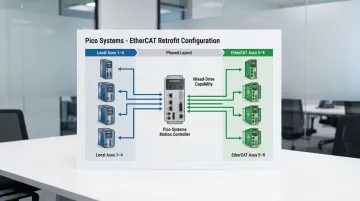
The DMC-500x0 series particularly suits retrofits requiring EtherCAT integration, allowing axes 1-4 to be local or EtherCAT while axes 5-8 operate exclusively via EtherCAT—useful when phasing legacy drives alongside modern networked drives.
| Attribute | Details |
|---|---|
| Key Products | DMC-41x3 (1-8 axis Ethernet/USB), DMC-500x0 (EtherCAT Master, mixed drive support), DMC-52xx0 (up to 32 axes) |
| Communication Interfaces | Ethernet (10/100BaseT), USB, RS-232, EtherCAT (Master on DMC-500x0 series) |
| Best Fit For | Multi-axis robotic retrofits, precision automation, OEM machine builders requiring complex kinematics |
Advanced Motion Controls (AMC)
Advanced Motion Controls manufactures digital servo drives widely deployed in retrofit robotics, medical devices, and industrial automation. Their DigiFlex Performance and networked drive families offer universal feedback support—critical when retrofitting systems with legacy motors using diverse encoder types.
Retrofit-specific features:
- Universal servo motor compatibility through auto-commutation algorithms
- Extensive feedback support including EnDat, Hiperface, BiSS C-Mode, and 1Vp-p Sin/Cos encoders
- Wide voltage/current ranges (18-240 VAC, 10-60A continuous depending on model) accommodating various motor specifications
- Compact form factors (panel, PCB, vehicle mount) fitting constrained retrofit installations
The DPEANIU-C060A400 model supports 200-240 VAC supply with 30A continuous/60A peak current, while the DZMANTU-020B080 handles 18-80 VDC at 10A continuous/20A peak—providing flexibility for different motor power requirements without changing drive families.
| Attribute | Details |
|---|---|
| Key Products | DigiFlex Performance series (DPEANIU, DZMANTU models), networked drives with EtherCAT/CANopen |
| Communication Protocols | EtherCAT, CANopen, POWERLINK, Modbus TCP/RTU |
| Best Fit For | Robotic arm retrofits, high-performance servo upgrades, OEM integrators requiring universal motor compatibility |
Copley Controls
Copley Controls specializes in precision digital servo amplifiers used extensively in robotics, semiconductor, and medical automation retrofit applications. Their Xenus and Accelus drive families provide extensive encoder compatibility and network connectivity suited for demanding retrofit scenarios.
Key retrofit advantages:
- Comprehensive feedback support including SSI, EnDat, BiSS, Panasonic/Sanyo Denki Absolute A, and analog Sin/Cos encoders
- Encoder emulation capabilities (quadrature output from analog Sin/Cos inputs) facilitating legacy controller integration
- EtherCAT and CANopen support enabling modern network architectures
- Precision torque and velocity control algorithms maintaining performance during phased retrofits
The Xenus Plus (XE2) operates on 100-240 VAC with 10A continuous/20A peak per axis, while the Accelnet Panel (ADP) supports 20-180 VDC at up to 6A continuous/18A peak, covering both AC and DC motor retrofit scenarios.
| Attribute | Details |
|---|---|
| Key Products | Xenus series (XE2, XTL - AC powered), Accelnet series (ADP, ACM - DC powered) |
| Communication Protocols | EtherCAT, CANopen; analog and digital command interfaces |
| Best Fit For | High-precision robotic retrofits, semiconductor automation, medical device systems requiring extensive encoder compatibility |
Gecko Drive
Gecko Drive (Geckodrive) provides affordable, reliable stepper and servo motor drives with strong presence in the LinuxCNC user community. Their G-series drives offer practical entry points for retrofit builds on constrained budgets without sacrificing essential protection features.
Retrofit value proposition:
- Low cost-per-axis enabling complete multi-axis retrofits within tight budgets
- Built-in protection features including short-circuit detection, overvoltage protection, and thermal management
- Easy integration with breakout boards and interface cards from Mesa Electronics and Pico Systems
- Officially supported by LinuxCNC with extensive community documentation
The G201X stepper drive ($117) handles 80 VDC at 7A with full-step morphing and mid-band resonance compensation, while the G320X servo drive ($156) supports 18-80 VDC at 20A with internal PID loop—both carrying a reputation for ruggedness in industrial environments.
| Attribute | Details |
|---|---|
| Key Products | G201X/G203V (stepper drives, 7A), G320X (DC brush servo, 20A) |
| Software Compatibility | LinuxCNC (officially supported), Mach3/Mach4 (community verified) |
| Best Fit For | Budget CNC retrofits, hobbyist and small-shop robotic upgrades, stepper-based systems |
Delta Tau / Novanta
Delta Tau, now part of Novanta following acquisition, pioneered multi-axis motion controllers through their PMAC (Programmable Multi-Axis Controller) platform. These controllers have served complex robotic and machine tool retrofit applications for decades, handling advanced kinematics and large axis counts.
Advanced retrofit capabilities:
- Complex kinematic transformations including SCARA robot kinematics and custom coordinate systems
- Large axis counts (up to 32 axes on Turbo PMAC2 Ethernet Ultralite via MACRO ring)
- Real-time interpolation and synchronized motion across multiple coordinated axes
- Power PMAC embedded computer architecture integrating motion control and machine logic
The Power PMAC provides modern embedded computing with built-in motion control, while legacy PMAC2 systems remain widely deployed and supported—a practical consideration for sites already running Delta Tau hardware that need a clear upgrade path without scrapping existing infrastructure.
| Attribute | Details |
|---|---|
| Key Products | Power PMAC (embedded motion computer with SCARA kinematics), PMAC2 (legacy high-performance family, up to 32 axes) |
| Communication Interfaces | EtherCAT, MACRO (fiber optic), Ethernet |
| Best Fit For | Complex multi-axis robot retrofits, machine tool modernization, high-throughput automation requiring advanced kinematics |
Yaskawa Electric
Yaskawa Electric, a global leader in servo drives and motion controllers, offers dedicated retrofit and modernization programs for industrial robots and CNC equipment. Their Sigma series servo drives and established robot controller upgrade paths provide clear migration strategies for aging Yaskawa installations.
Retrofit program advantages:
- Defined upgrade paths for YRC1000 robot controllers with documented software migration procedures
- Sigma-7 servo drives supporting 24-bit absolute encoders for high-precision applications
- Broad encoder compatibility reducing motor replacement requirements during retrofits
- High-speed network support (MECHATROLINK-III, EtherCAT) enabling modern communication architectures
Yaskawa provides PC software tools specifically for selecting and commissioning servo systems, which reduces integration time compared to configuring generic drives from scratch. Regional support infrastructure means on-site technical assistance is available for complex projects rather than relying solely on documentation.
| Attribute | Details |
|---|---|
| Key Products | Sigma-7 servo drives (24-bit encoder support), YRC1000 controller migration paths, MotionWorks IEC platform |
| Communication Protocols | EtherCAT, MECHATROLINK-III, various fieldbus options |
| Best Fit For | Industrial robot modernization, large-scale manufacturing retrofits, servo system upgrades with ongoing vendor support |
Bosch Rexroth
Bosch Rexroth delivers modular, open-architecture motion control platforms suited for both new installations and industrial equipment retrofits. Their ctrlX AUTOMATION and IndraDrive product lines emphasize Industry 4.0 integration and flexible deployment architectures.
Retrofit modernization features:
- Open-architecture ctrlX OS supporting app-based engineering and custom functionality
- Cabinet-free drive options (ctrlX DRIVE) simplifying control cabinet retrofits and reducing wiring complexity
- IIoT integration capabilities allowing data collection from both legacy IndraDrive and new ctrlX systems simultaneously
- EtherCAT, PROFINET, and Sercos support covering diverse existing network architectures
The ability to collect data from legacy IndraDrive systems alongside new ctrlX DRIVE installations enables phased retrofits—modernizing critical axes while maintaining existing drives on less critical functions until the full migration is funded.
| Attribute | Details |
|---|---|
| Key Products | ctrlX DRIVE (compact modular drives with open OS), IndraDrive retrofit series (established drive family) |
| Communication Protocols | EtherCAT (SoE, CoE), PROFINET IO, Sercos |
| Best Fit For | Industrial robot retrofit projects, modular automation upgrades, smart factory integration requiring IIoT connectivity |
Mitsubishi Electric
Mitsubishi Electric offers CNC systems, servo drives, and motion controllers with established retrofit and upgrade pathways for aging robotic and machine tool installations. Their focus on backward compatibility and regional support infrastructure suits large-scale retrofit programs.
Retrofit compatibility features:
- MELSERVO-J5 series with documented migration from J4 series using existing programs
- Backward-compatible wiring options reducing electrical retrofit scope
- Multi-axis synchronous control capabilities (exact synchronization across multiple axes)
- SSCNET III/H fiber optic communication providing high-speed, noise-immune connectivity
Mitsubishi provides a "Transition from MELSERVO-J4 to J5 Handbook" explicitly guiding retrofit implementations—a level of documentation detail most manufacturers leave to the integrator to figure out independently.
| Attribute | Details |
|---|---|
| Key Products | MELSERVO-J5 servo drives (backward-compatible with J4), CNC C80 controller platform |
| Communication Protocols | SSCNET III/H (fiber optic), CC-Link IE TSN, EtherCAT |
| Best Fit For | CNC machine tool retrofits, automotive and electronics manufacturing, large-axis-count upgrades requiring vendor support |
How We Chose the Best Retrofit Motion Control Manufacturers
Selecting retrofit motion control manufacturers requires different evaluation criteria than choosing vendors for new system builds. Common mistakes include prioritizing brand recognition over encoder compatibility, overlooking axis count limitations, or accepting software lock-in that restricts future flexibility. This list reflects research across technical specifications, retrofit-specific documentation, and compatibility with diverse legacy hardware — the criteria below explain exactly what we weighted and why.
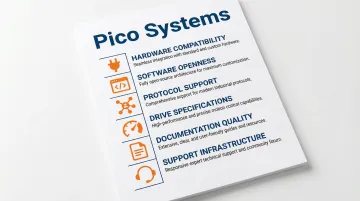
Key evaluation criteria applied:
- Retrofit-specific hardware compatibility — covers motor types (brush, brushless, stepper), encoder interfaces (incremental, absolute, resolver, proprietary), and whether legacy wiring can be accommodated without full rewiring
- Software openness — proprietary platforms vs. open architectures like LinuxCNC; availability of custom kinematics and toolpath modification
- Communication protocol support — EtherCAT, CANopen, analog interfaces, and the ability to bridge legacy protocols still running on older machine hardware
- Drive specifications — voltage/current ranges matching existing motor specifications without requiring motor replacement
- Documentation quality — retrofit guides, migration handbooks, and encoder compatibility matrices that reduce integration guesswork
- Support infrastructure — vendor technical support, community resources, and replacement part availability
The right retrofit partner varies based on project scope. A hobbyist CNC retrofitter prioritizing cost and open-source flexibility has fundamentally different needs than an industrial integrator modernizing a six-axis robot arm. Use these criteria as a filter — a manufacturer that scores well on software openness and community support may score poorly on documented compliance pathways, and that tradeoff matters depending on your application.
Conclusion
The right retrofit motion control manufacturer can reduce upgrade costs by 50-70% and minimize system downtime to days rather than weeks compared to full robot replacement. That outcome depends entirely on whether the chosen system matches your existing mechanical architecture and target performance specifications.
Mismatched encoder interfaces, insufficient drive current ratings, or incompatible communication protocols transform cost-effective retrofits into expensive troubleshooting exercises.
Before committing to any retrofit platform, evaluate:
- Software support timelines — confirm the vendor actively maintains firmware and toolchain updates
- Replacement part availability — verify component sourcing horizons, especially for proprietary hardware
- Fieldbus compatibility — ensure the system integrates cleanly with your broader automation infrastructure
For mission-critical applications, vendor support quality and regional service availability often outweigh initial cost differences, particularly when production downtime costs exceed equipment expenditures.
If those criteria point toward specialized LinuxCNC-compatible hardware, Pico Systems offers dedicated retrofit components — including encoder converters, servo amplifier interfaces, and modular PPMC system boards — designed for engineers and integrators working on servo and stepper-based CNC automation. Browse their product catalog at picosystems.store or reach their technical team at elson@pico-systems.com or +1 314-965-5523.
Frequently Asked Questions
What is a retrofit motion control system for robotics?
A retrofit motion control system replaces the electronic control hardware—servo drives, motion controllers, interface boards, and encoder systems—of an existing robot or CNC machine while retaining its mechanical structure. This approach extends equipment life by 10-15 years at 30-50% the cost of full replacement.
How is a retrofit motion control system different from buying a new system?
New systems include both mechanical and electronic components with complete integration requirements, while retrofits target only the control layer. Retrofits deploy faster (weeks vs. months), cost far less, and deliver ROI in 6-12 months compared to 2-4 years for new installations.
What factors matter most when choosing a retrofit motion control manufacturer?
Prioritize compatibility with existing motors and encoders, software openness (LinuxCNC vs. proprietary platforms), supported communication protocols (EtherCAT, CANopen, analog), drive voltage/current specifications matching your motors, and long-term vendor support including replacement part availability.
Can retrofit motion control systems work with LinuxCNC?
Yes—manufacturers including Pico Systems, Mesa Electronics, and Gecko Drive design hardware specifically for LinuxCNC integration. Its open-source architecture and active community make it a strong choice for retrofits that need flexibility beyond proprietary platforms.
What industries most commonly use retrofit motion control for robotics?
Automotive manufacturing, CNC machining, electronics assembly, and aerospace maintenance lead retrofit adoption. These sectors operate mechanically sound but electronically obsolete robots where retrofitting maintains production throughput while controlling capital costs better than full replacement.
How many axes can a typical retrofit motion control system support?
Entry-level retrofit controllers support 3-6 axes, covering most CNC mills and SCARA robots. High-end platforms like Galil's DMC-52xx0 or Delta Tau's Power PMAC scale to 16-32+ axes for multi-robot workcells and large machine tool retrofits.